Cheri: Teeny tiny terrariums are pretty fascinating places. Those little spaces made with very few items can evoke a whole world by what you see when you look into it.
These little spaces are really quite easy to make and once you have your materials, you can make several at once.
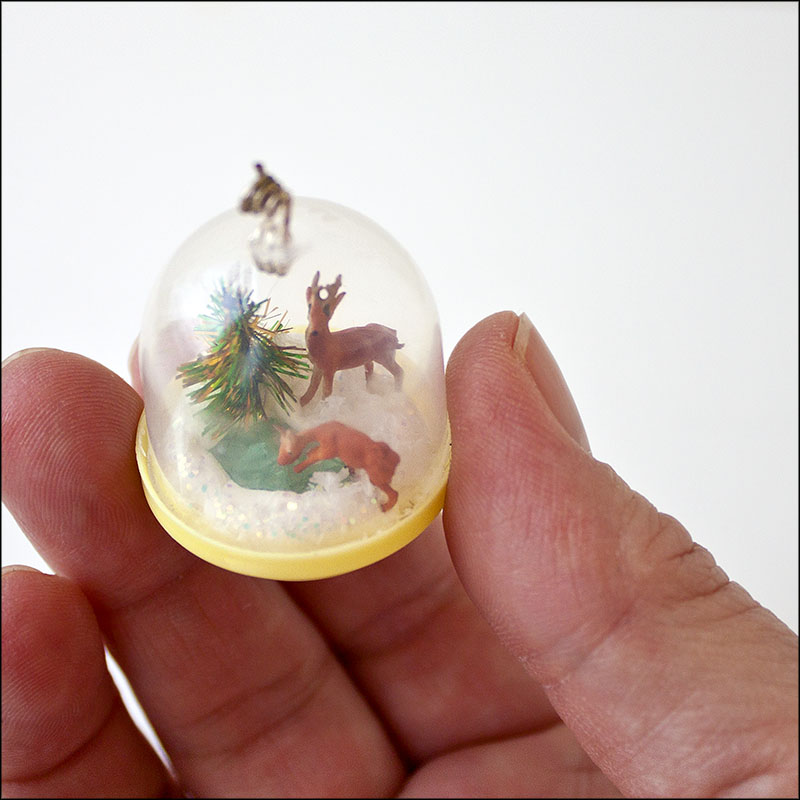
I love to buy things from gumball machines, not only do I like the prizes, but I think I like the containers the prize comes in even more. They certainly lend themselves to this kind of craft.
Gumball vending machine containers
Air dry white clay
Small piece of mirror or tiny glass
Glitter
Small animals
Chenille stems
To start with make a hole in the container. To do this you need to remove the cap and hold the clear dome so you have the convex part toward you. I heated an ice pick to make the hole.
After I had the hole completed, I took a piece of wire and made a loop on one end. I threaded the end of the wire without the loop through the hole and made another loop on the outside of the dome and cut off the wire.
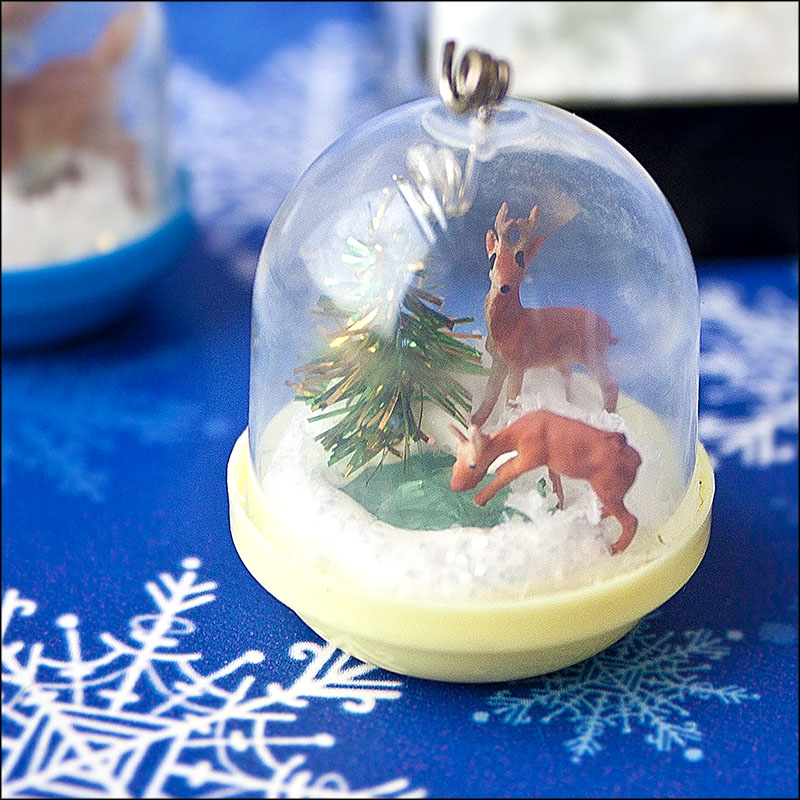
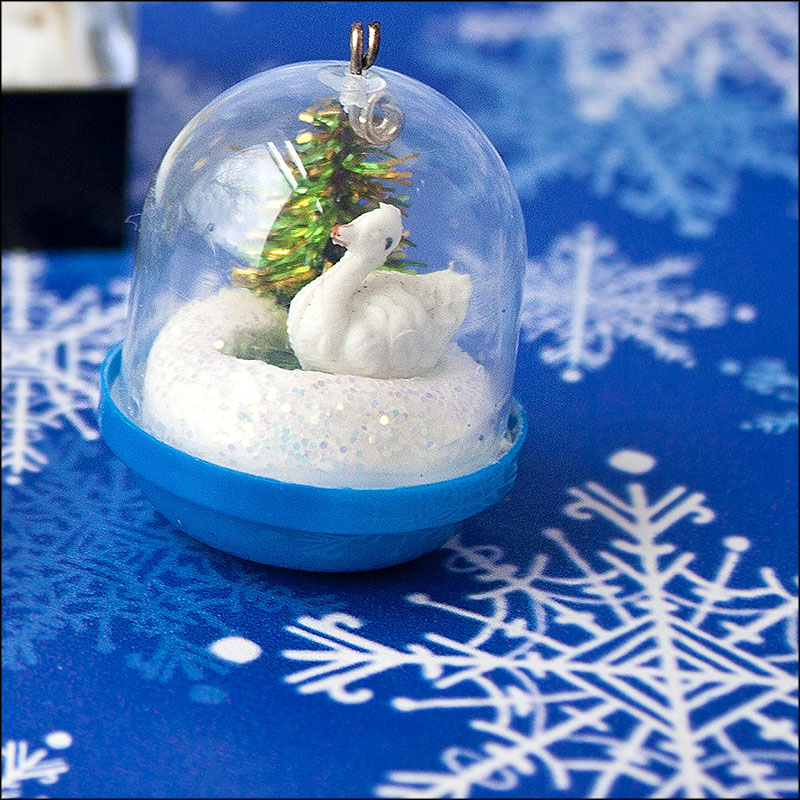
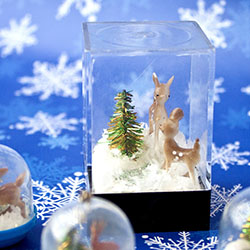
To make the base of the tiny space, I used the cap of the container. I glued a small bit of air dry clay into the base and squished the piece of glass, or mirror in the center. Then I took a piece of chenille (I used tinsel chenille) and cut it very small to look like a tree. I glued this into the clay.
I glued very small animals beside the chenille tree to make it look like a snow scene and let the bottom portion dry overnight. I do this to make sure that there is no shrinkage. After it dries I take a small paintbrush and brush glue over all the surfaces that I want to put snow/glitter on. Shake off the excess and glue the bottom onto the top. This makes it permanent. Make sure you use just plain old glue for this part. I used an epoxy once and melted the face off of a deer (kind of creepy).
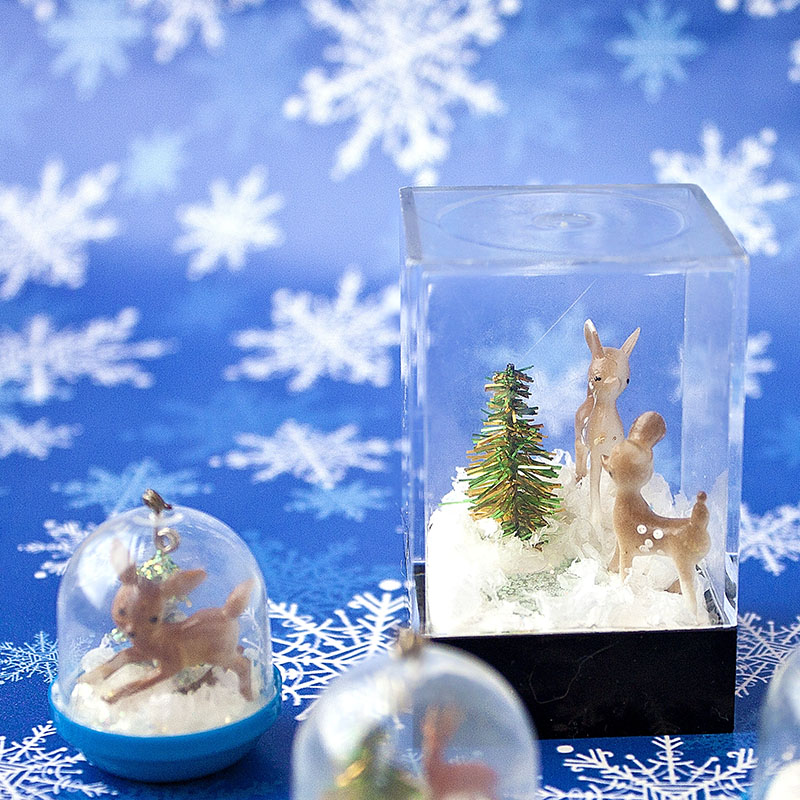
And there you go, all done. The little ones would look great on a small tree and the one that is a little larger I made just to set on my desk. I really enjoy looking into it and feeling the mood of the season any time of year.
HAPPY HOLIDAYS
Two deer at the water's edge.Swan on the lake.Close-up of snow scenes.The gumball containers are teeny tiny places.Teeny tiny places in teeny tiny spaces.
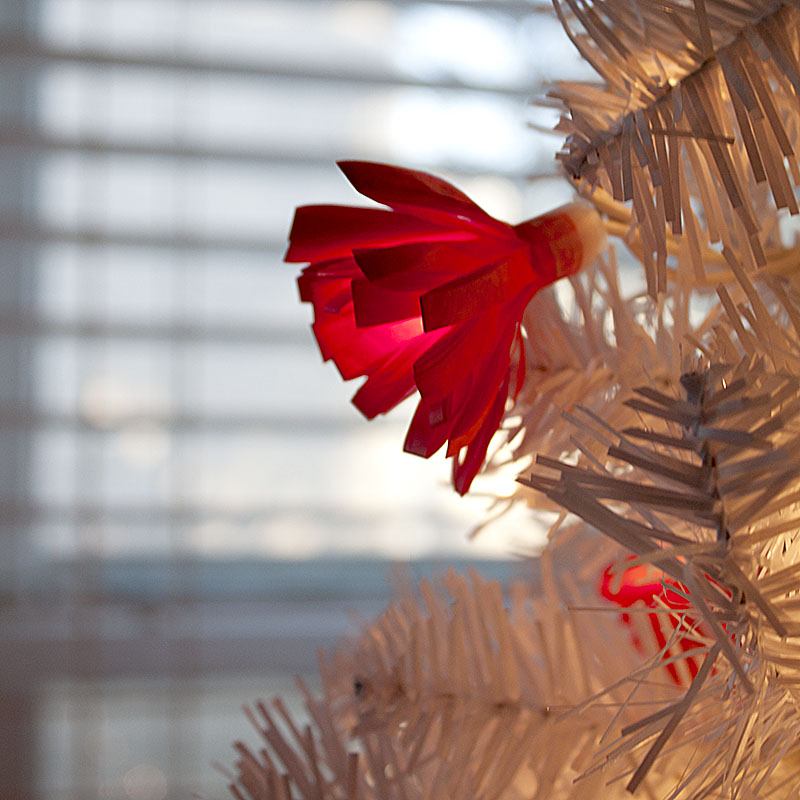
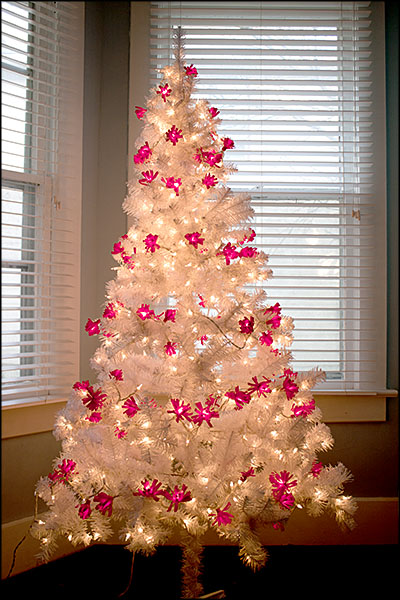
Frilly and festive tissue paper flowers for a Christmas tree garland.My white Christmas tree with its new garlands.
Lynne:Crafty Challenge 5 was a challenge for me. I don’t believe I have made any Christmas ornaments for several years and it was tough to get my mind back into that red and green groove.
I like long garlands and I like them to be lit. Strings of Christmas tree lights seemed to me to be the best way to start, so I bought a strand of 100 clear Christmas tree lights. I needed the light strand to be decorated and the longer I looked at them the more the bulbs looked like the centers of flowers. Why not put a flower around each light bulb? The flower I made for my Do It Best Purse in the hardware store challenge would be the perfect fit to go around the collars of the light bulbs.
I plugged in my strand of lights for two hours to check on how hot they would get. I could still hold them in my hand at the end of the two hours so I used red tissue paper. However, be safe and turn off your tree lights whenever you leave the house.
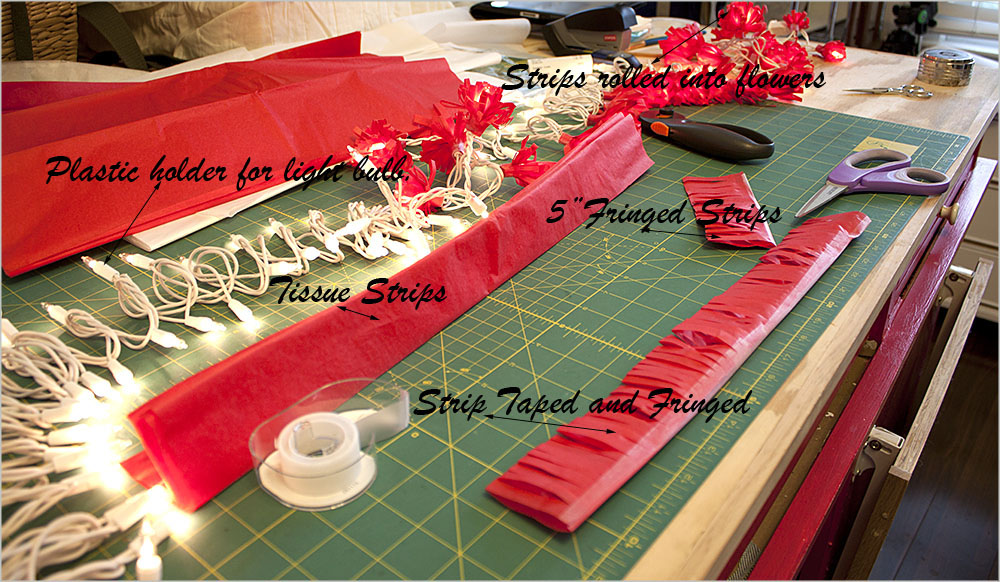
Tissue paper comes folded in its package. When you unfold the paper the creases are good guidelines for cutting the long strips. I cut through all of the layers at the same time, because there was less chance of the sheets slipping while they were still in the original folds. I used a rotary cutter and the resulting strips were about 3″ wide.
Crease from tissue paper being folded for packaging.
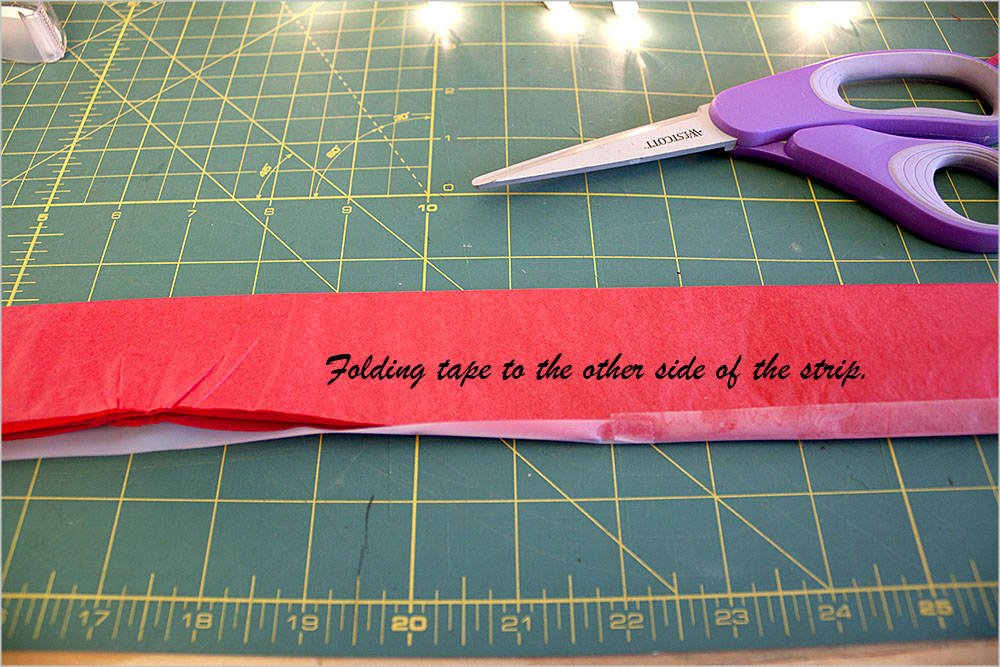
I folded the strip in half and then separated the layers into stacks of two strips each. (The number of layers can vary depending on how thick the paper is and how frilly you want the flowers.) I taped the unfolded edge with scotch tape. I put half the tape on one side then flipped the strip over and folded the tape up onto the other side. Then I used scissors to cut the folded edge of the strip into fringe.
Taping the long strips closed.Taping 2 layers of long strip.I used scissors to fringe the folded edge of the strips.
Once you’ve fringed the length of the strip, cut it into 5″ sections. 5 inches worked best for me but you can make the sections longer if you want fuller flowers. Take each 5″ section and roll it around one of the light bulb plastic holders. The holders are plastic and I found that a dab of hot glue when you first start to roll the flower is strong enough to hold the flower in place. Once you have the flower rolled use a piece of tape to keep it closed. I put a flower on every other light bulb and I was just able to finish the garland in two hours.
I liked the results so much that after the challenge was over I made another garland and bought a white Christmas tree to put them on.
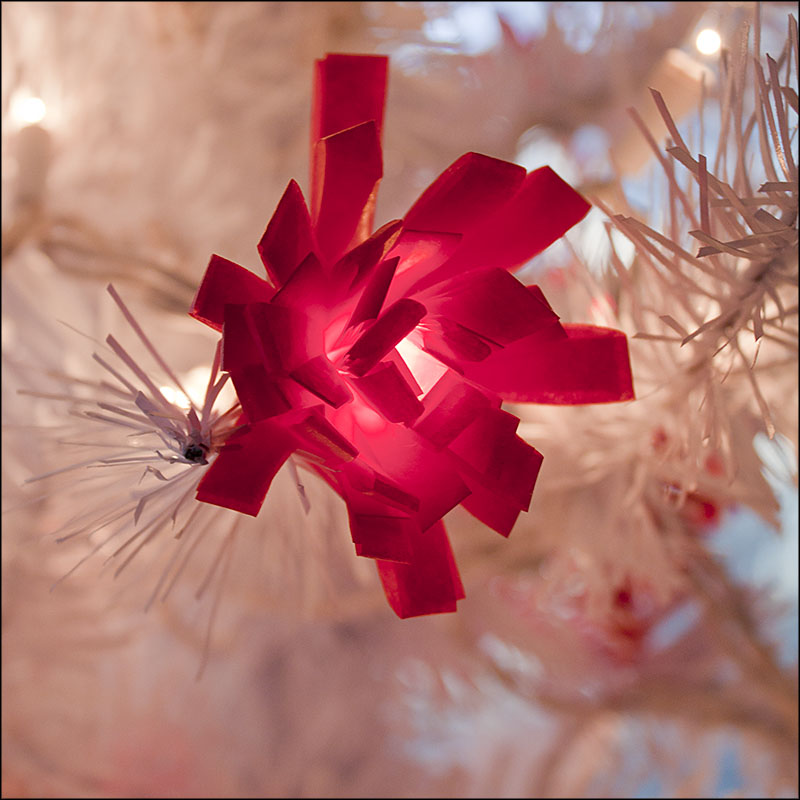
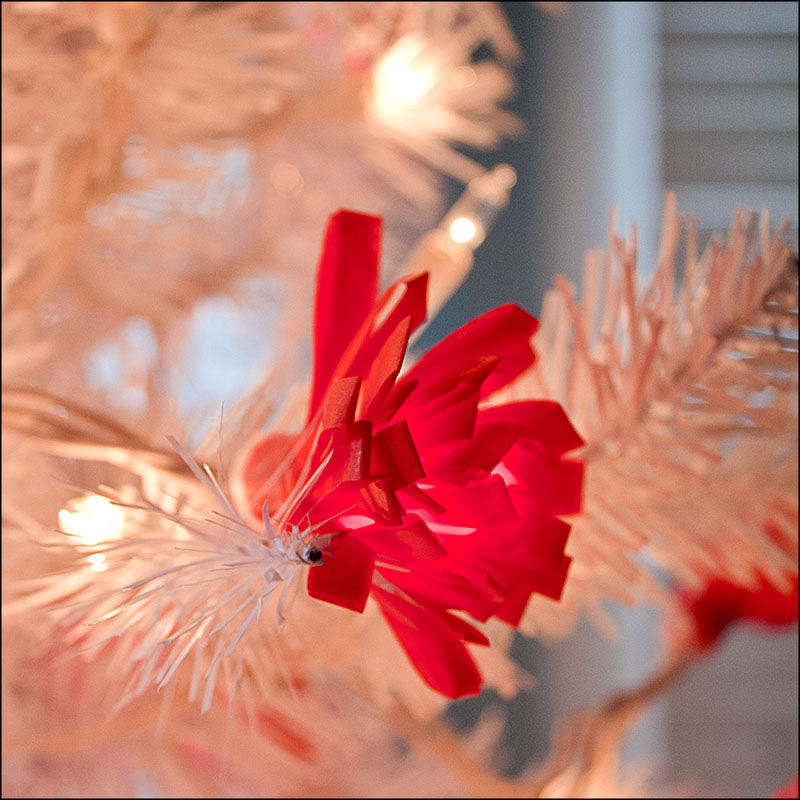
Fold the 5" strip around the holder of the light bulb and tape it closed.Close-up of the flower.Another close-up because they look so pretty and festive.Frilly Flower Garland
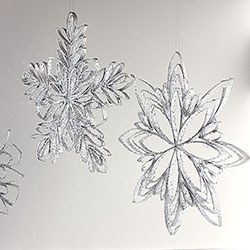
Cheri: This is my second ornament in the Christmas Ornament Countdown. I like to work in paper and when I can use paper that was something else at one time, that makes it doubly good. These ornaments are made from paper and toilet paper rolls. They are really quite easy to make.
All you need to do is take the roll and flatten it. Then take a ruler and measure in ¼ inch increments. After that is done cut them apart with scissors, or if you have a large paper cutter you can use that. You will have several rings of cardboard. I like to start out with a flower pattern and work from there. You can bend the cardboard into any shape that you want and just let your imagination take over.
After I had them glued together, I spray painted them with silver metallic spray paint, then I sprayed adhesive glue and sprinkled them with glitter.
When you are faced with an empty paper roll, you may want to think twice before throwing it out. You never know what you can make out of it.
Simply elegant ornament made form scrapbook paper strips and floral wire.
Cheri:Kristin’s ornament was so awesome that I have to admit I was a tad bit intimidated by this challenge. Actually, this type of challenge really brings out the best in both of us.
My ornament was made with scrapbook paper too.
I cut about 35 strips of paper and pushed a hole in all of them on both ends. I then took some floral wire that I had and made a loop in one end, and fed all the strips onto the wire. I then took the very last strip and threaded it on to the other end of the wire and continued to do this until all of them had been put on.
I fanned them out into a ball, and made a loop in the other end. I really like to use scrapbook paper that has stripes on it because the pattern seems to flow better. So one down 7 more to go.
The ornament hangs vertically with two balls strung together.Christmas Ornament Paper Strip Balls
Cheri: Well, another project come and gone. This one did not freak me out too much. I am always making little projects.
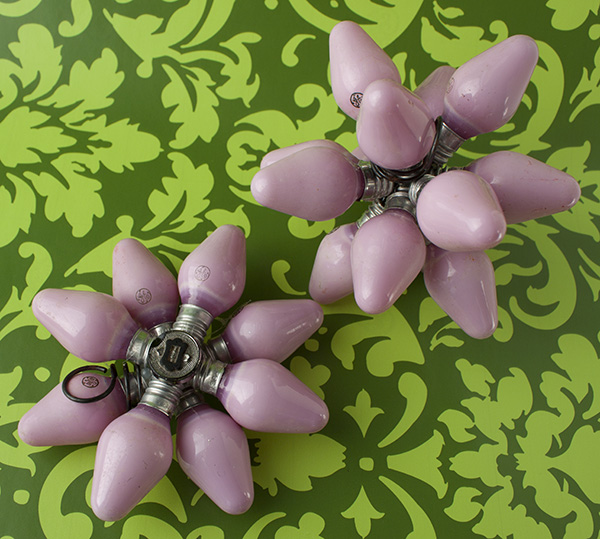
Sometimes I will see an object that I really like because it stirs up memories of being a kid. That is what happened when I bought these Christmas tree light bulbs at a garage sale a few months ago. I was drawn to the color, (pink) and I really liked the vintage feel of them too.
I knew that I would never use bulbs like these on a lighted string (who could trust them), but I still liked the look of them. They were the kind of lights we had on our tree when I was a kid. I don’t even know if these are sold anymore. They do have a tendency to get hot and really the newer, small lights are brighter.
When I saw them for 50 cents, I couldn’t think of anything to do with them at the time so I tucked them away for when an idea came. When this project was discussed, I felt that I could possibly use the light bulbs for something. I was pretty sure what I wanted to do and I was also sure that the idea would work pretty well. All I really needed was hot glue, ( I am the Queen of hot glue).
For the 14 point star ornament, I started out with glue on the metal tips and then I put one light bulb in the center on each side. I tried to do this mathematically but as I am math challenged, I decided to go by sight. It came out pretty well the first time and I knew that I really didn’t want to press my luck so I decided it looked pretty symmetrical.
For the eight point stars, I just glued 4 together and glued 4 more together and attached them. I hot-glued buttons onto them to cover the glue in the center.
I then decided I needed a hanger that was not very noticeable. In the box were 2 bulb clips, so I took one bulb off the star, attached the clip and then glued the bulb back on. This way I can attach a hook to it.
All in all I was quite pleased with the outcome and I think it will look terrific on a tree. The best thing is it was really simple and cheap. I just love it when a plan comes together.
14 point Christmas tree lightbulb star ornament.
The back of the 14 point star ornament with hanger.Four lightbulbs glued together end to end into a four point star and then two of those flat stars glued together to form an eight point star.The back of the eight point star with a close-up of the wire hanger,
Crafty challenge number 3 is no one’s fault but my own. While I was making my hardware-store handbag for the last challenge, I began to think of a challenge that would be mostly confined to materials that were incidental to an item I had bought. Things that you do not buy to use, such as packaging materials, plastic sacks, and styrofoam drinking cups.
There were two materials that had particularly caught my fancy. One was sales slips. Every time I clean my car, I cannot believe how many slips I can accumulate in just a few days. The other was the paper wrappers that hamburgers and breakfast sandwiches come wrapped in. These materials are perfectly suited for their original purpose, but could I think of a secondary recycled purpose?
The sandwich wrappers are plasticized on one side and I thought that perhaps they could be used as an element in a plastic fused-fabric, but the sales slips proved harder to recycle. Sometimes when I don’t have any deposit slips, I’ll grab a sales slip from the floor of the car to write my information on, so I decided that they could be made up into some kind of notepaper.
Since I could only think of notepaper as a use for the sales slips, I knew I would need to make a notebook. I could use other types of wastepaper for additional pages and the various plastic items I had been saving could be used for a plastic fused-fabric cover. One unintentional consequence of this challenge was the ever rising pile of junk on my work table. Just as I found myself putting something in the recycling or the trash, I would think: “wait that may be useful.”
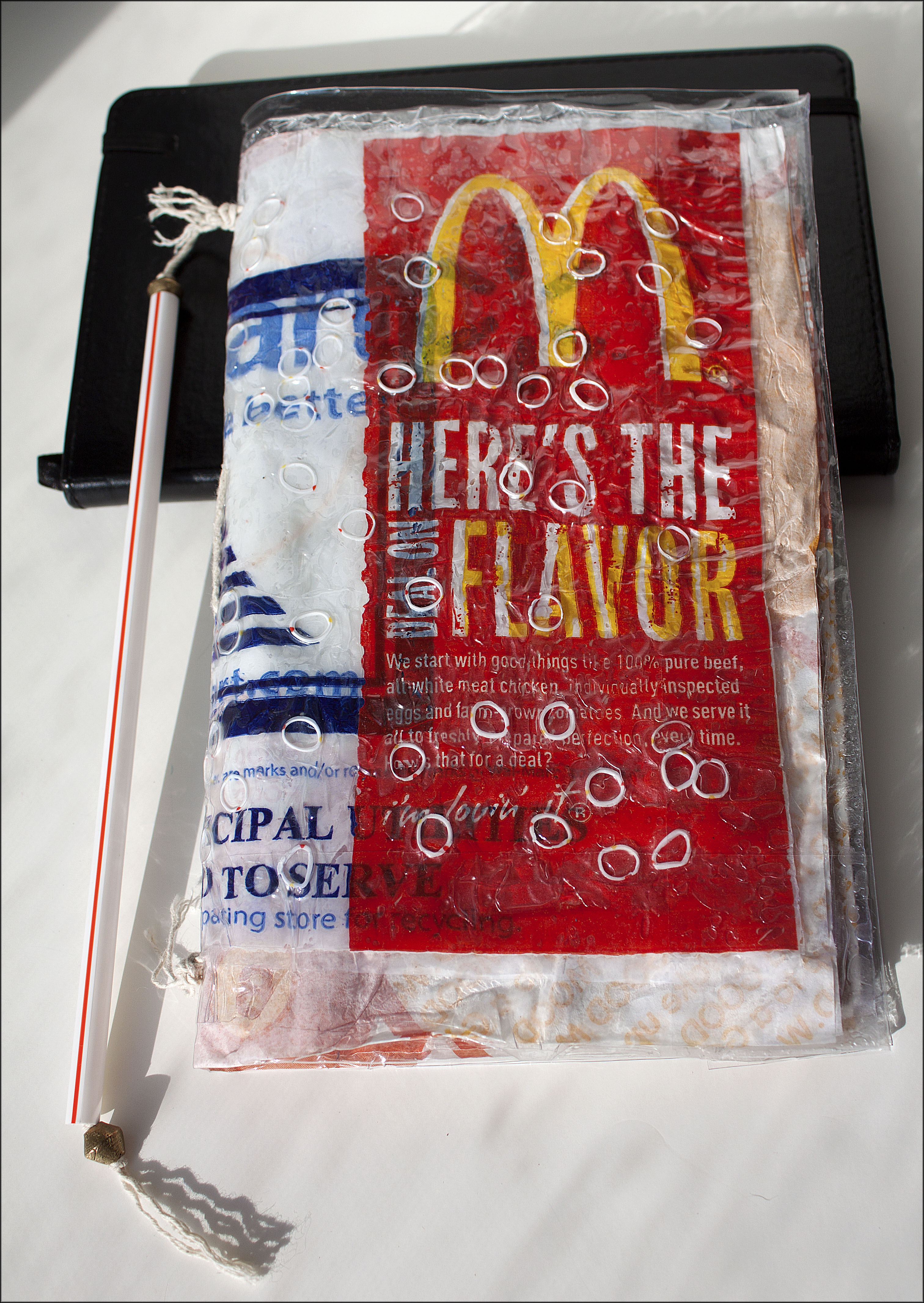
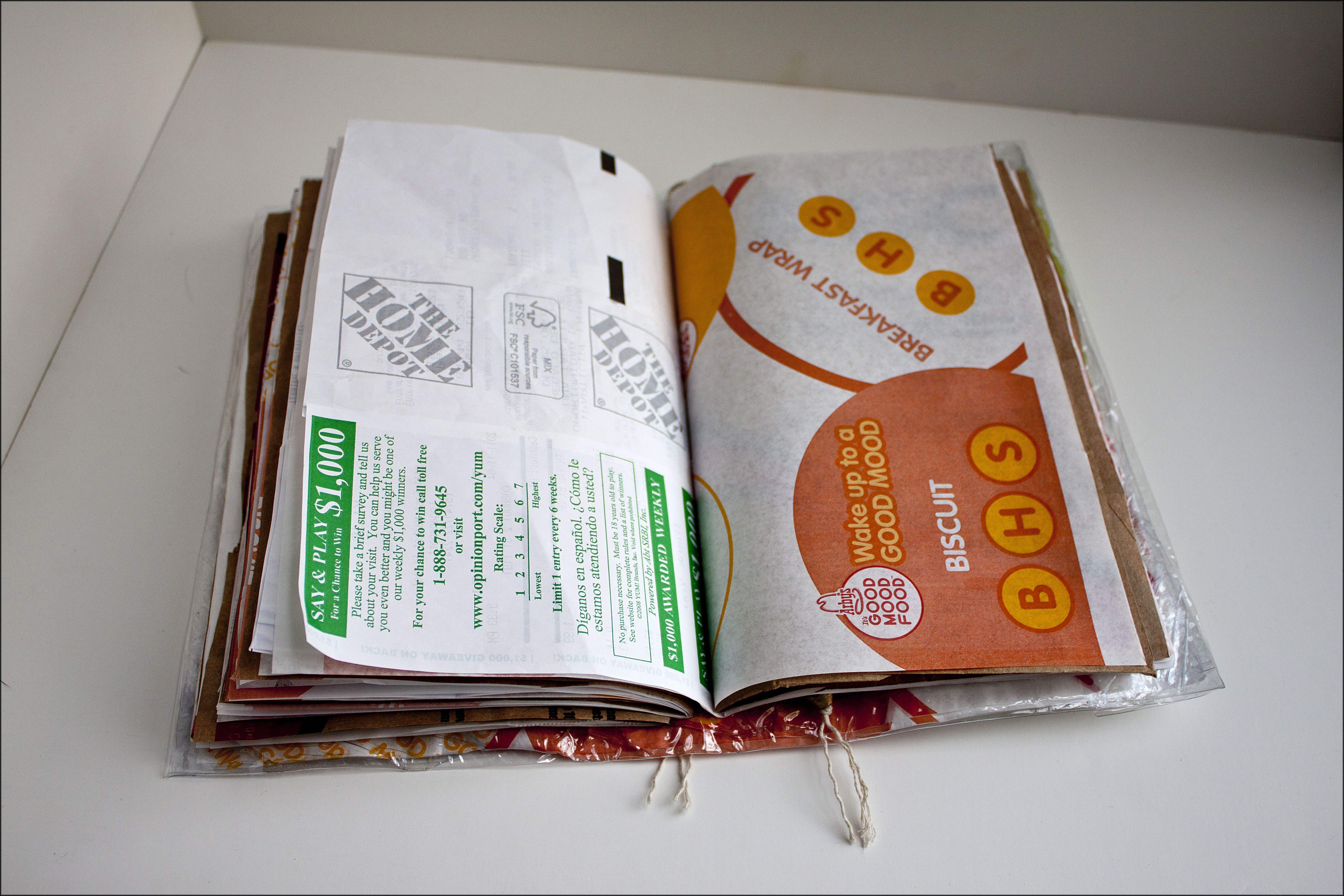
I decided that my “fast food folio” notebook would be composed of three signatures of paper. A signature is a sheet of paper which folds to page size and is then bound with other signatures to form a book. My signatures would be made from sales slips, paper fast food sacks and sandwich wrappers. I glued the sales slips into 8 1/2 inch by 11 inch sheets and cut the paper sacks and sandwich wrappers to the same dimensions. There was just enough material to make eight sheets of 8 1/2 by 11 inch paper per signature. When folded those 8 sheets gave me 16 sheets of 5 1/2 by 8 1/2 inch paper and with three signatures that gave me 48 sheets of paper in a notebook that would be approximately 6 inches by 9 inches with its cover.
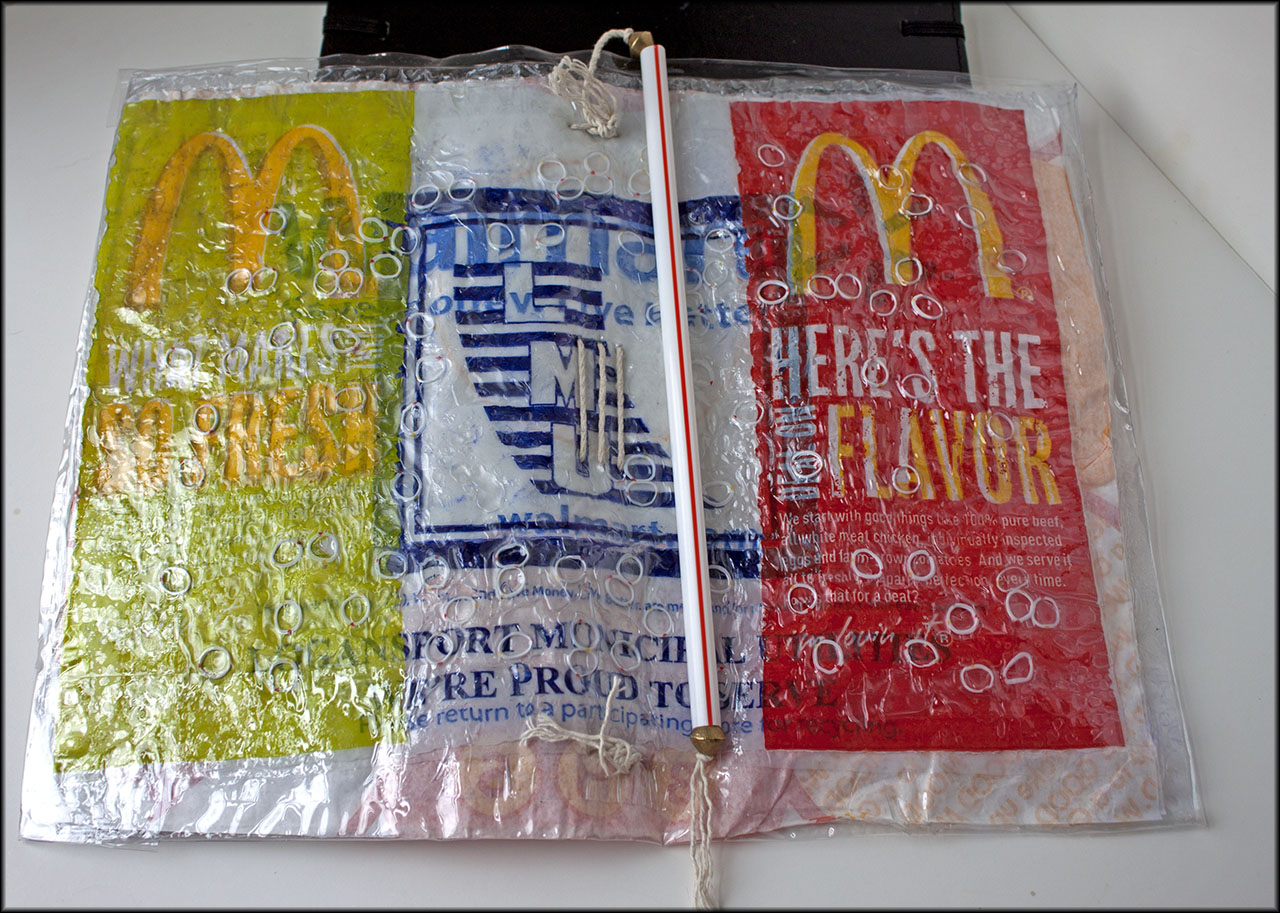
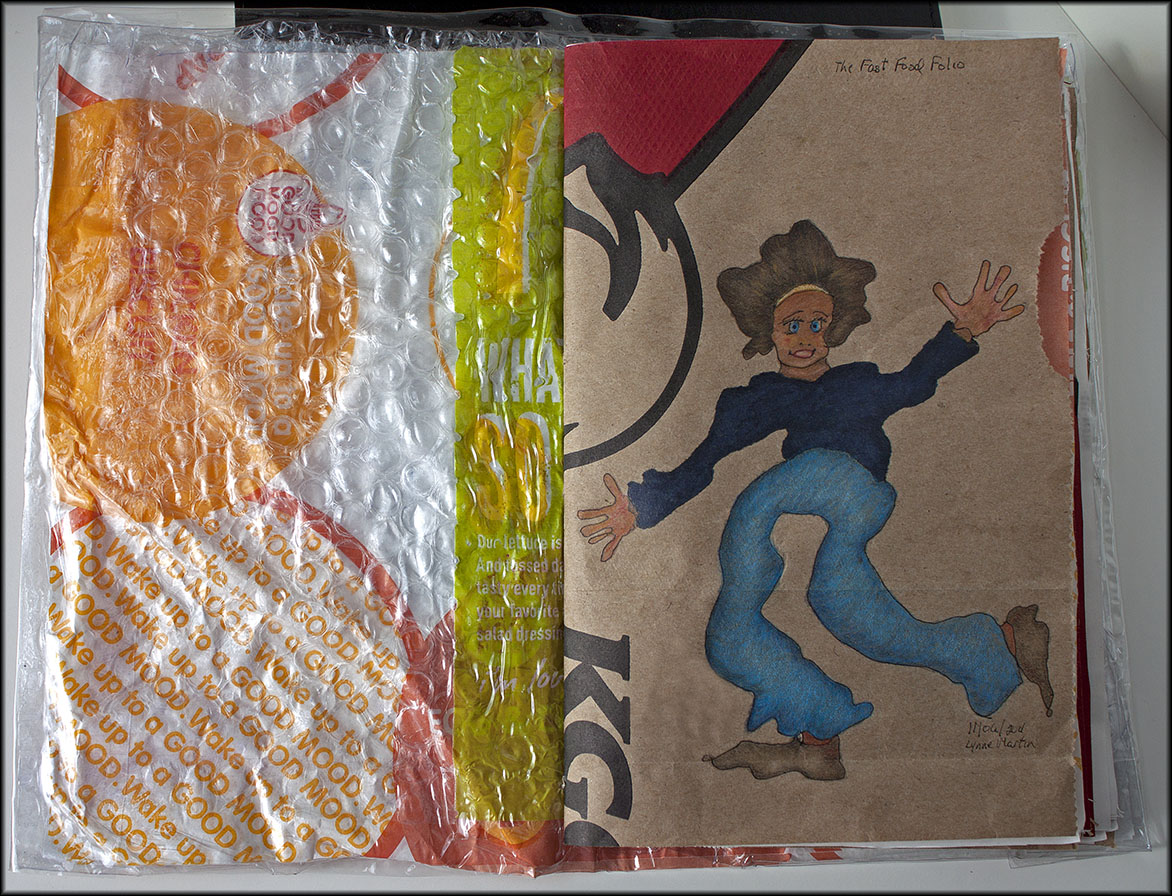
I decided that I would make the cover from layers of plastic bags, bubble wrap and sandwich wrappers. I wanted the bubble wrap to give the cover a honeycomb texture and to make the cover stronger. The plastic bags would provide the graphics and the sandwich wrappers were unique in that only one side is plasticized and I could use them as a protective layer on one side and a fusible layer on the other.
When fusing plastic into fabric some people use wax paper to protect their iron, but I believe that parchment paper is sturdier and less likely to become a part of the fused fabric.This fusing plastic bag tutorial has excellent instructions. The one thing to remember is that when you start mixing different types of plastics, you can have unexpected consequences. Not all plastic materials melt at the same rate and at the same temperature. You have to keep experimenting and have some back-up materials in case a “shrink and shrivel” happens.
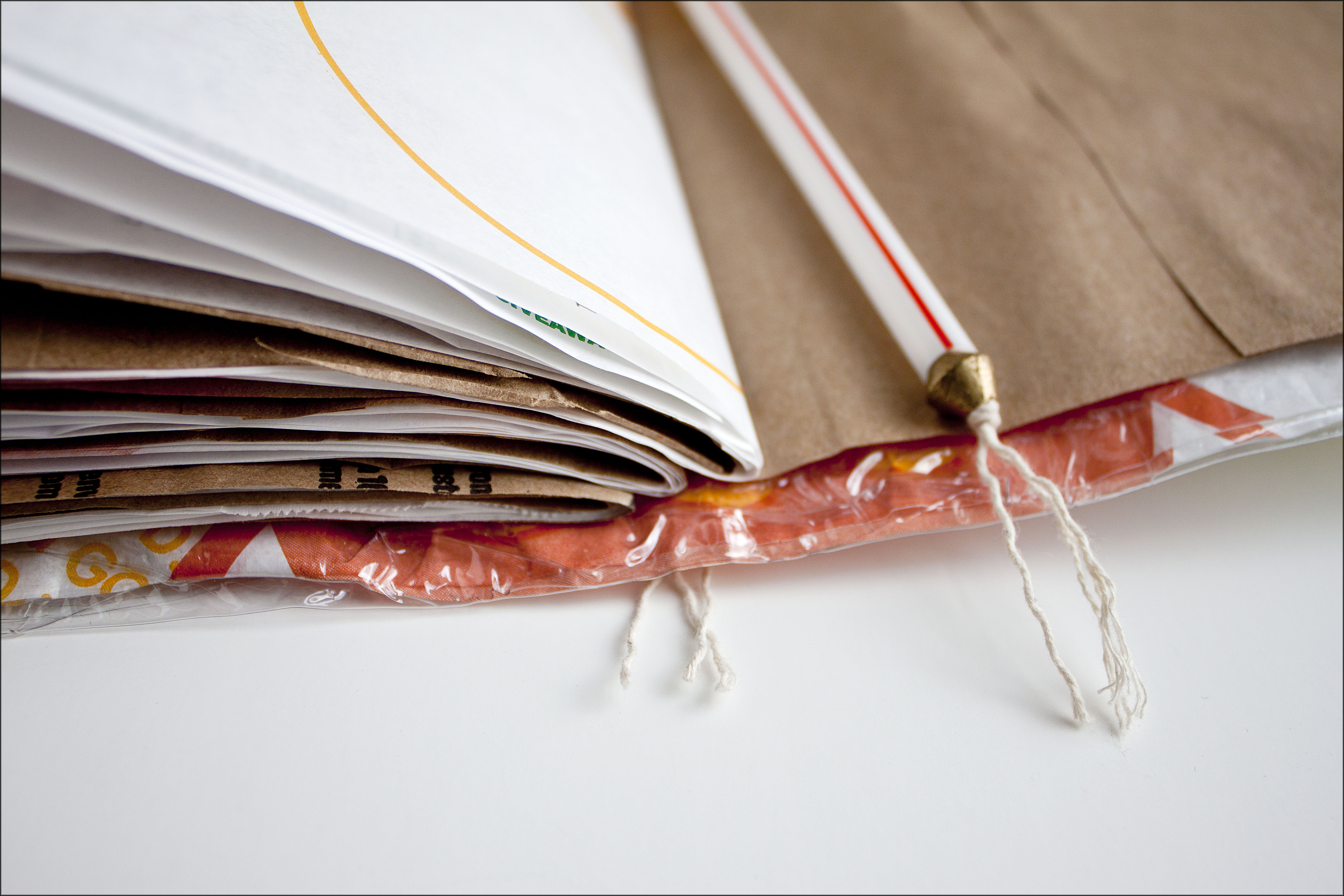
When I had the cover and the signatures made I sewed them together with a large-eyed blunt needle and cotton kitchen twine. I used beeswax on the twine to make it slide easier through the holes in the cover and the signatures. This youtube video ‘simple bookbinding part 1 and its companion video part 2 were the most helpful to me in explaining signatures and how to sew them to a cover.
Most of the time we keep our projects secret from each other but Kristin was in town and I did not wish to spend our time together alone in separate rooms while we worked on our projects. So Kristin saw my project and had some helpful ideas. I wanted to use drinking straws in my project and had experimented with melting them onto a sheet of plastic vinyl. The straws do melt, but not in the way I wanted. Kristin suggested slicing the straw into small circles and then melting them onto the cover. As you can see below, the idea worked extremely well and is quite decorative. She also suggested using a straw as a bookmark. I connected it to the end of the binding twine and used beads as stopper knots. That is the one problem with these challenges. We miss the feedback and suggestions from each other that make our projects just that one step better.
I am surprised by how good the plastic cover feels and by how sturdy it is. I was also very curious how the different types of paper would respond to ink, markers and colored pencil. The brown paper works very well for my squiggles and surprisingly so does the plastic side of the sandwich wrappers. However, the sales slips are treated to accept the ink of their cash registers and are hard on markers, pencils and ink pens. I am thinking of covering them with gesso and if that doesn’t work, a few collage pages will look very good in my notebook.
Our crafty challenges have challenged us in ways that we never anticipated. I have been surprised and amazed at the results. Enough so that we are already working on crafty challenge number 4.
Outside cover and view of hand-sewn binding.Pages made of sales slips and sandwich wrappers.Detail of beads used to cap the drinking straw bookmark.Inside cover and first page with first squiggle on brown paper bag.
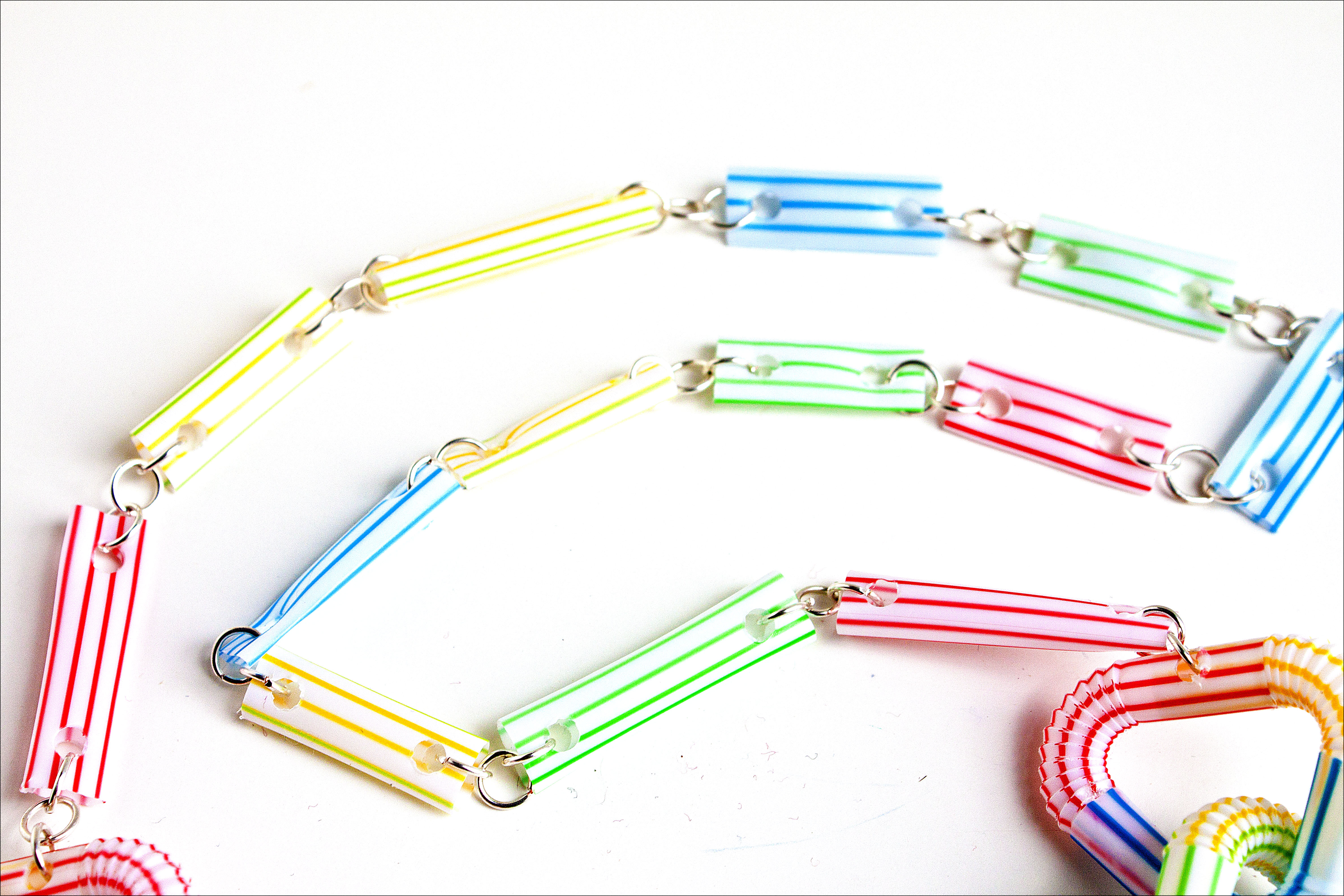
Drinking straw necklace with triangle and chain links.
Cheri: Wow, what a tough challenge number 3 was. I spent a week trying to figure out what I was going to make. I had all kinds of ideas floating around in my head and it really gave me a new perspective on how I looked at items that I was throwing out. With projects like this, I guess the hard part is just picking up something and working with it. It doesn’t always mean that you will like what you are making but each step will give you some insight into your final product.
I decided that I would make my project out of straws. So I grabbed a bunch of straws and started to cut them, bend them and punch holes in them. When I came to the flexible part, which I had discarded, I started to work with the curves. I finally decided that I was going to make them into triangles and I would link one into the other. I fiddled with them until I had the size I wanted and then I glued each one of the ends in to the other end.
I worked with the possibility of making them into a bracelet, which would be awesome, but I really wanted to make a necklace as I had been working with using the leftover portion of the straws as a link in a chain and I liked how it looked.
I love the way the necklace hangs. After I completed it, I started thinking about using straws in different colors or using clear straws. I even worked with a hole punch and put holes in the straws and was able to put other straws through the holes and build structures, like you would with Tinker Toys.
For all my misgivings about this project it ended up being a project with unlimited possibilities, and a go-to whenever I want to make a unique piece of jewelry that is really “out of the box”.
Close up of triangle links.Close up of chain links.
-Lynne: Our hardware challenge sounded straight forward when we first proposed it. The idea of being turned loose in a hardware store seemed more like a dream than a challenge and the $5.00 limit on materials cost did not daunt me at all. We are “make-do” sisters.
Earlier this spring, I found the book “Simply Sublime Bags” by Judi Kahn. In it she shows how to make “no sew” purses using fabric and duct tape. I was so taken by the idea that I made myself a keyhole clutch from a feedsack with matching duct tape. The pattern can be found here online, but the book is well worth getting for all the wonderful ideas.
Beyond being extremely cute and novel, my clutch has been surprisingly durable. I have been wanting a slightly larger purse and this challenge seemed like the perfect time to make another one. After all, duct tape is to a hardware store like water is to a duck. Besides with a project like this, all I would need was the fabric and something to hold the fabric together in its purse shape.
I’m afraid that I became rather testy when I realized that glue, thread, staples, paint, ink and tape would count towards the $5.00 total. I can tell you right now that no hardware store can sell you 50 cents worth of glue. We had to buy what materials we needed in the quantities available and we could not buy a quantity and divide the price by the number we used. I only wanted 4 yards of fishing line, but I would have had to buy 700 yards for $2.99. That was more than half my budget. I needed to rethink how to “sew” the purse together.
I wandered the aisles of all the hardware stores in town. I had knowledgeable, helpful men following me trying to help me find the “right part.” They would always take a step backwards when I told them that not only did I not know the part I needed, I did not know what the part would be for. Hardware by its very nature is made to be used in the manner it was made. Wood screws are for wood and metal screws are for metal and never the twain shall meet. People who work at hardware stores are bewildered and confused by browsers.
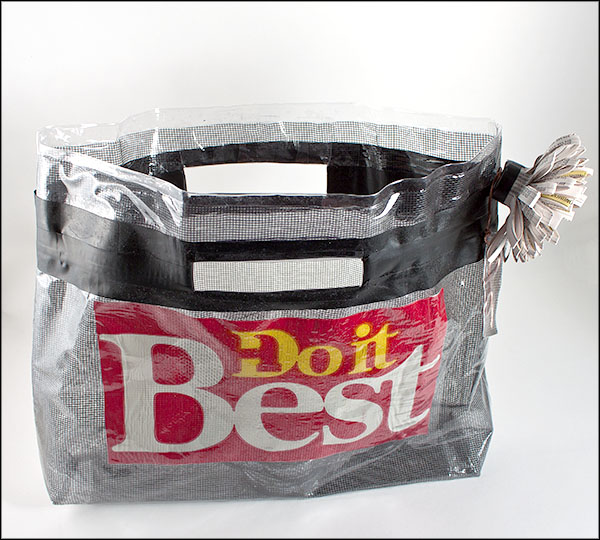
When I saw the fiberglass window screen, I knew I wanted to use it as the fabric for my purse. I could buy one foot of the 36″ wide screen and stay well within my budget. I noticed a roll of clear plastic vinyl next to the screen and remembered that plastic can be fused into a fabric by heating it with an iron. Heat unlike glue and staples would not cost me anything. I could sandwich the screen in between two pieces of the plastic and have both my fabric and my “glue.” I added some electrician’s tape which is cheap because it doesn’t stick to anything, a carriage bolt, a foot of copper wire and a brass hex nut to my list and I was 14 cents under my $5.00 limit.
I found that fusing the “fabric” could be tricky. You have to keep in mind what will melt fastest and that plastic can shrink in odd ways and iron accordingly. The holes in the fiberglass screen allowed the plastic to adhere to itself, but I found that where I needed a strong bond I had to use just the clear plastic. By cutting the screen smaller than the plastic, the seams were only plastic and strong enough to hold all the stuff I put in a purse.
I desperately needed some decoration for my purse and I only had 14 cents left in my budget, but I had become a crafty challenge participant. I gathered up the paper bag I had used for the free popcorn, the plastic bag for my purchases and the free telephone directory at the end of the counter and felt crafty as well as rich in materials.
The electrician’s tape strengthened the open handles and made a nice decorative statement around the top of the purse. I fused the logo from the plastic bag to the front of the purse to add the graphic text and some much-needed color. Once you start fusing it is hard to stop. I fashioned the copper wire into my initial and fused it in a sandwich of clear plastic, fiberglass screen, the label from the paper bag and another layer of plastic for a hang tag.
– Paper flower and hang tag initial.
Hardware is hard and I wanted to soften it with a flower decoration. I had just noticed these paper flowers on craftgawker and I had that free telephone directory. I used a paper punch to put a hole in the edge of the purse and threaded the carriage bolt through it and the center of the folded flower. The hex nut secured the flower to the purse and made a “cuter than a button” flower center.
I may fuse some more plastic around the handles now that the challenge is over and I don’t have to worry about a budget. But I am very happy with the results. I love the idea of making your own fabric and fusing is forgiving. If you make a mistake, keep ironing things on till you like it. That is the way to Do it Best.
-Lynne: Our hardware challenge sounded straight forward when we first proposed it. The idea of being turned loose in a hardware store seemed more like a dream than a challenge and the $5.00 limit on materials cost did not daunt me at all. We are “make-do” sisters.
Earlier this spring, I found the book “Simply Sublime Bags” by Judi Kahn. In it she shows how to make “no sew” purses using fabric and duct tape. I was so taken by the idea that I made myself a keyhole clutch from a feedsack with matching duct tape. The pattern can be found here online, but the book is well worth getting for all the wonderful ideas.
Beyond being extremely cute and novel, my clutch has been surprisingly durable. I have been wanting a slightly larger purse and this challenge seemed like the perfect time to make another one. After all, duct tape is to a hardware store like water is to a duck. Besides with a project like this, all I would need was the fabric and something to hold the fabric together in its purse shape.
I’m afraid that I became rather testy when I realized that glue, thread, staples, paint, ink and tape would count towards the $5.00 total. I can tell you right now that no hardware store can sell you 50 cents worth of glue. We had to buy what materials we needed in the quantities available and we could not buy a quantity and divide the price by the number we used. I only wanted 4 yards of fishing line, but I would have had to buy 700 yards for $2.99. That was more than half my budget. I needed to rethink how to “sew” the purse together.
I wandered the aisles of all the hardware stores in town. I had knowledgeable, helpful men following me trying to help me find the “right part.” They would always take a step backwards when I told them that not only did I not know the part I needed, I did not know what the part would be for. Hardware by its very nature is made to be used in the manner it was made. Wood screws are for wood and metal screws are for metal and never the twain shall meet. People who work at hardware stores are bewildered and confused by browsers.
When I saw the fiberglass window screen, I knew I wanted to use it as the fabric for my purse. I could buy one foot of the 36″ wide screen and stay well within my budget. I noticed a roll of clear plastic vinyl next to the screen and remembered that plastic can be fused into a fabric by heating it with an iron. Heat unlike glue and staples would not cost me anything. I could sandwich the screen in between two pieces of the plastic and have both my fabric and my “glue.” I added some electrician’s tape which is cheap because it doesn’t stick to anything, a carriage bolt, a foot of copper wire and a brass hex nut to my list and I was 14 cents under my $5.00 limit.
I found that fusing the “fabric” could be tricky. You have to keep in mind what will melt fastest and that plastic can shrink in odd ways and iron accordingly. The holes in the fiberglass screen allowed the plastic to adhere to itself, but I found that where I needed a strong bond I had to use just the clear plastic. By cutting the screen smaller than the plastic, the seams were only plastic and strong enough to hold all the stuff I put in a purse.
I desperately needed some decoration for my purse and I only had 14 cents left in my budget, but I had become a crafty challenge participant. I gathered up the paper bag I had used for the free popcorn, the plastic bag for my purchases and the free telephone directory at the end of the counter and felt crafty as well as rich in materials.
The electrician’s tape strengthened the open handles and made a nice decorative statement around the top of the purse. I fused the logo from the plastic bag to the front of the purse to add the graphic text and some much-needed color. Once you start fusing it is hard to stop. I fashioned the copper wire into my initial and fused it in a sandwich of clear plastic, fiberglass screen, the label from the paper bag and another layer of plastic for a hang tag.
– Paper flower and hang tag initial.
Hardware is hard and I wanted to soften it with a flower decoration. I had just noticed these paper flowers on craftgawker and I had that free telephone directory. I used a paper punch to put a hole in the edge of the purse and threaded the carriage bolt through it and the center of the folded flower. The hex nut secured the flower to the purse and made a “cuter than a button” flower center.
I may fuse some more plastic around the handles now that the challenge is over and I don’t have to worry about a budget. But I am very happy with the results. I love the idea of making your own fabric and fusing is forgiving. If you make a mistake, keep ironing things on till you like it. That is the way to Do it Best.
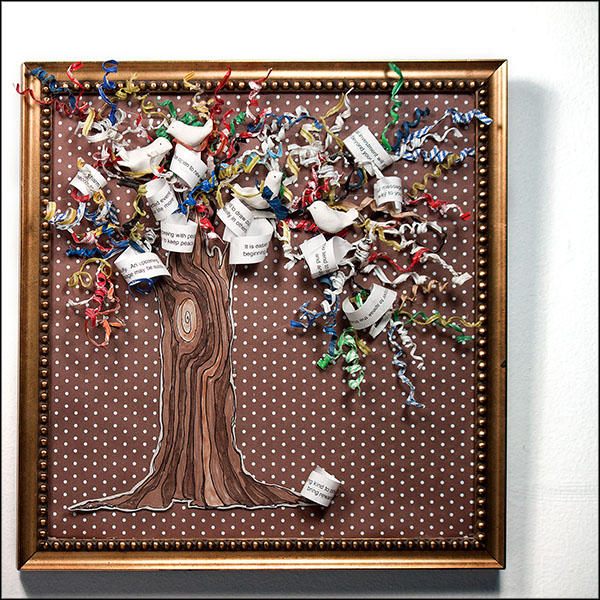
My tree with the fortune cookie leaves and bread twist-tie branches.
Cheri: At garage sales I am usually on the lookout for items that I can use in a collage. I have mentioned before that I like to purchase multiples of small items. My reasoning is; if you have a lot of one item you get the luxury of messing it up and having more to fill in if you really want to try it again. So, I have multiples of various items.
That being said, when you are at a garage sale, do not overlook the free box. This is a great place for multiples. Often, people will collect silly things, like, bread closures, bottle caps, nuts, old nails and the like. I really do not know what makes someone decide to keep these items, but I am always very glad they have.
It was one of those happy instances, when I looked in a free box and there in a bag was about 200 bread wires. They were crinkled up and they looked like a bunch of branches. I had been working on a tree design that I liked and I thought the wires would look great as the branches.
This is how I put together this tree collage. After I placed the branches, I decided the branches needed leaves. I remembered the fortunes that I had been saving from our weekly trips to China Lane (a local Chinese food restaurant). They were perfect for the leaves after I gave them a little curl. The birds were made from Fimo clay and were left over from another project I had been working on. All of the pieces came together and it worked. I really like that when that happens.
Close-up of the Fimo clay birds and Chinese fortunes.















 the crafty sisters