Category Archives: craft

Blue Cube and Pearl Necklace Set

Finishing Projects: Blue Cube and Pearl Necklace and Earring Set

I have so many unfinished projects. I was looking through the pile of them with my mother-in-law last weekend and I couldn’t believe how much material I had there. So much of it needed to be cut up completely. However, some of it just needed to be finished. I pulled a few pieces out and am really making an effort to get them finished and here is the first finished project!

Blue Cube and Pearl Necklace Set

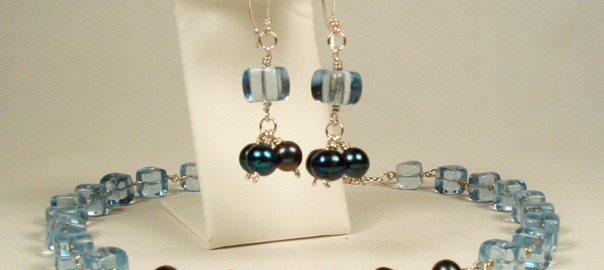
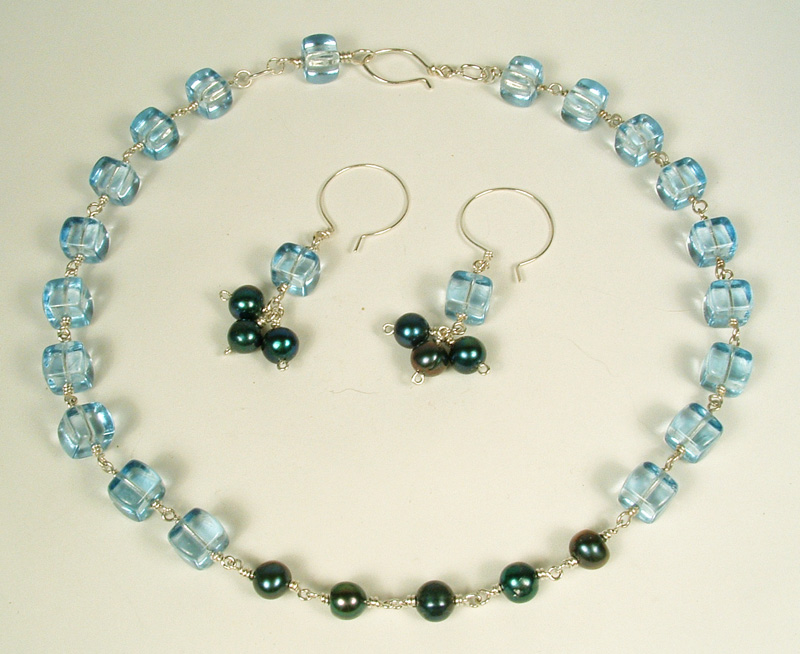
The necklace is made with sterling silver for the wraps and clasp, dark blue/teal pearl beads for the front part of the necklace and clear blue cube beads for the back part of the necklace.

I just loved the clear blue cube beads and knew when I bought them that I wanted to wire wrap them in a strand. I started this necklace about 2 years ago and since then, I add another cube bead every now and then, but I was never quite happy with how simplistic the blue cube beads looked by themselves. I bought the blue/teal pearls last year and looked at them a lot with no real idea what to do with them. I started putting them together and just love how the finished necklace turned out! The contrast of the dark pearl with the light blue cubes just pleases me immensely.

Blue Cube and Pearl Necklace Set

Of course, I had to make earrings to go with the necklace. I like making matching sets of jewelry. I really like the trio of pearls below the cube bead. They swing and bounce quite happily when worn.

Blue Cube and Pearl Necklace Clasp

I also made the clasp. I decided I wanted something with a little more oomph than my standard clasp and made an almond-shaped clasp that had a blue cube bead wrapped in the eye half of the the clasp. I really liked how it turned out and will probably make more clasps like this one in the future.

So, one unfinished project down, an infinite more to go. Mom (Craftysister Lynne) suggested I make a list and cross off my newly finished project, but I said that would just remind me of how many unfinished projects I still have yet to complete.

Blue Cube and Pearl Necklace

Happy crafting,

Kristin

Cootie Insect Collection Specimen Box

Craft Crafty Sisters Cootie framed picture specimen collection
Framed cootie scientific specimen box to hang on your walls.

Cheri:

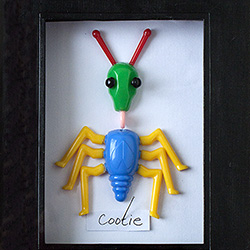
I picked up a box of Cooties last year at a garage sale. I had a plan and it didn’t involve playing the game.Ā I like the look of insect displays, but I don’tĀ  want to have a real insect display. I could have a Cootie display though.

After inspecting the cootie, I felt that I should split the thorax and head. There is a seam that runs along the two pieces and if you carefully insert a flat screwdriver into it, it will pop apart with a little effort. I took the front pieces of the thorax and head and worked with them in the specimen box and chose the placement.

I did have a bit of difficulty when it came time to attach the legs to the thorax, so I decided to hot glue the legs on to the thorax and glued it in place. I then hot glued the head, antenna and the tongue in place. I then cut a scrap of paper and hand wrote ā€œCootieā€ to make it look like it was a real insect specimen and pinned it in place.

This was such a fun project. I think I really like it because it is unexpected yet it is expected.

Insect Collection Craft Handmade DIY
Cootie insect collection.
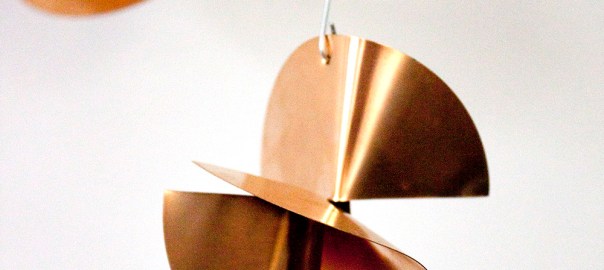
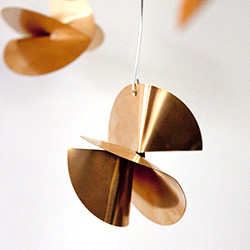
Copper mobile close up

Crafty Challenge 6: Twisted Disk Copper Mobile

Copper mobile close up

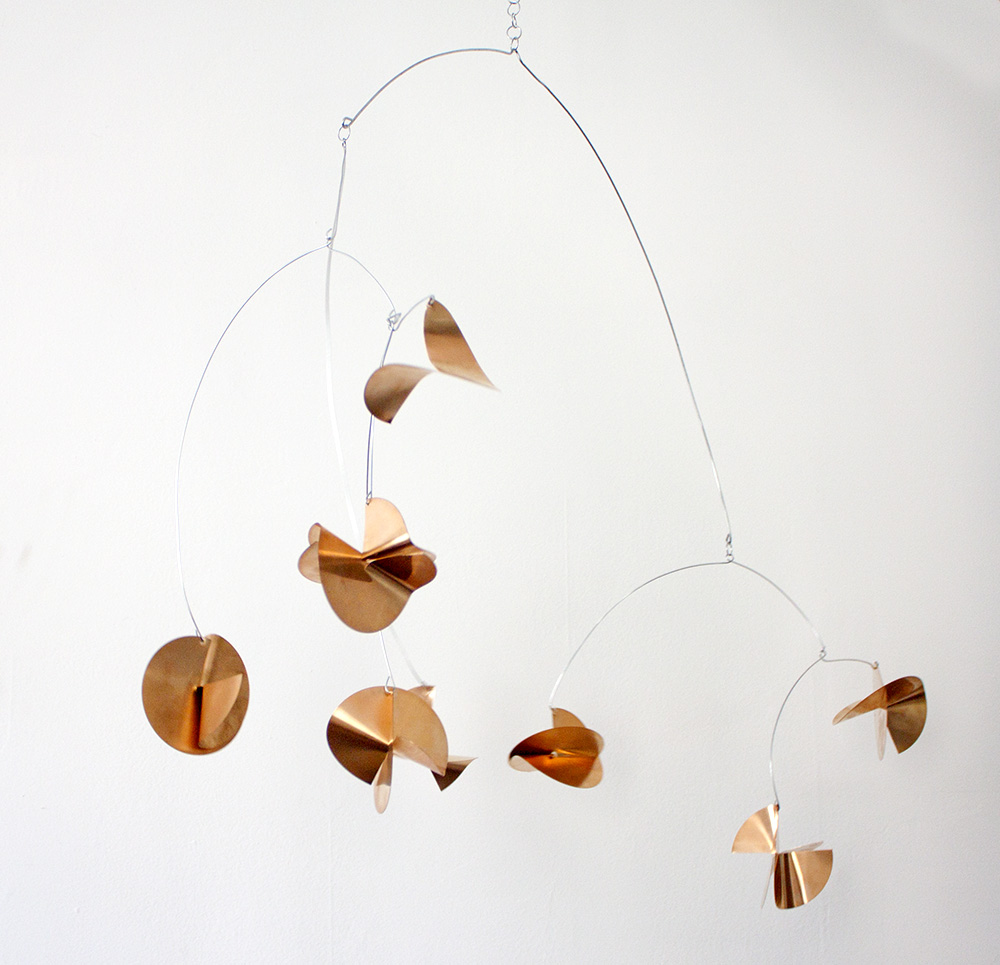
Loryn: This copper challenge was intriguing for me, as the only metalworking I’ve done is twisted wire jewelry. As soon as I saw the copper pieces, I immediately thought of doing a mobile in the style of Alexander Calder.

Full mobile picture

I started out making cut pieces like the leaf-shapes in many of Calder’s mobiles. I had cut about ten, and my hands were starting to hurt, when I had an idea to try making three dimensional shapes out of the disks.

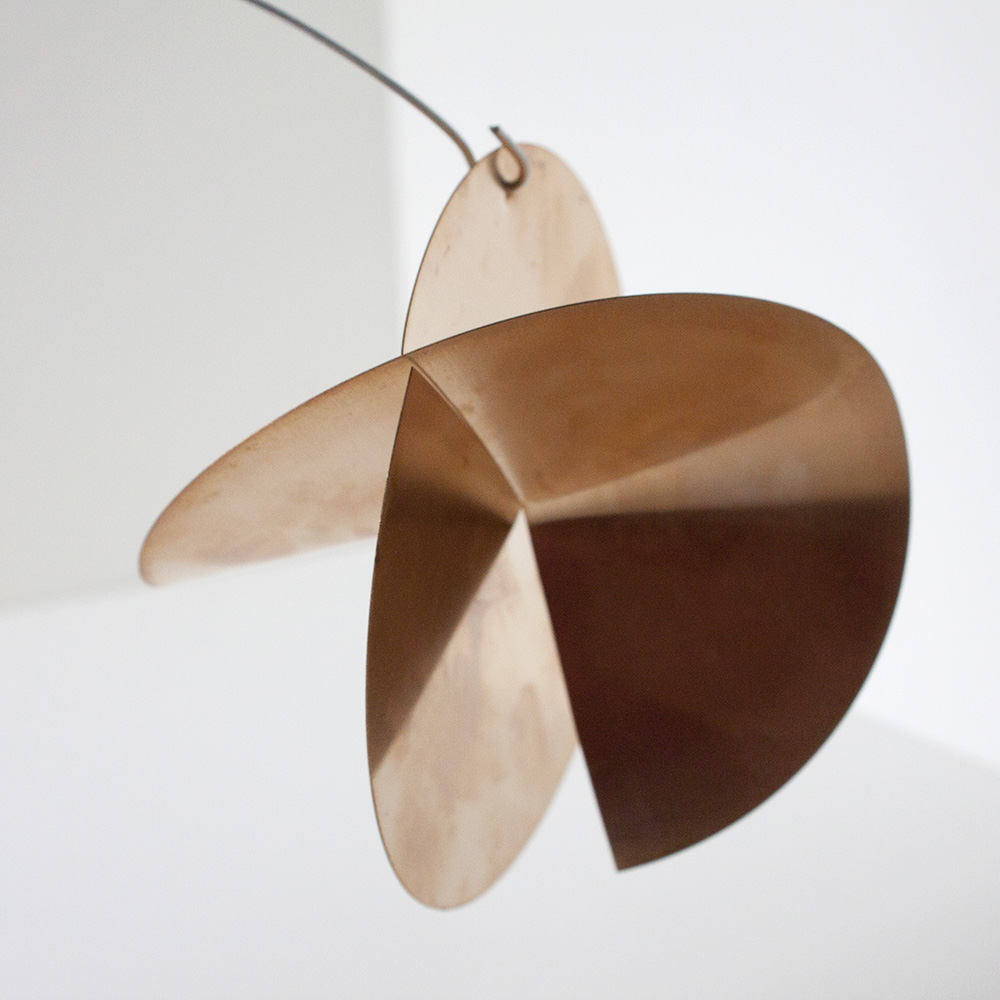
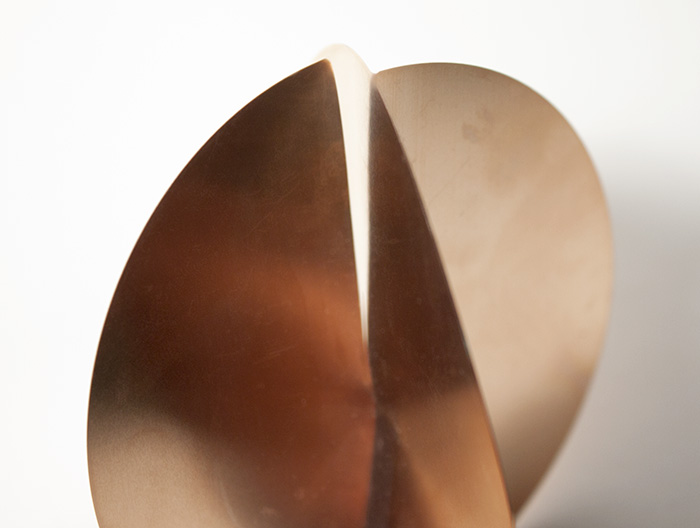
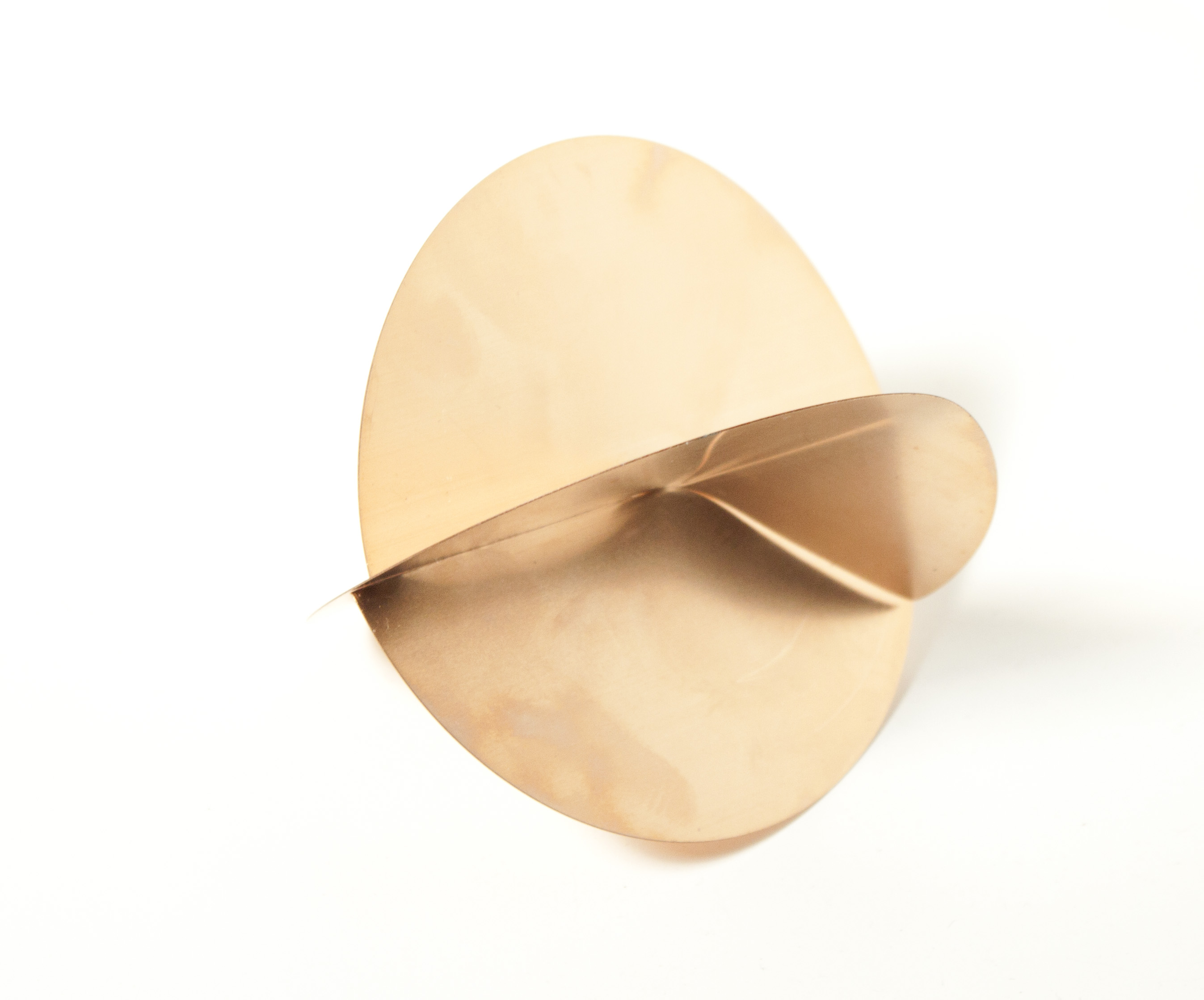
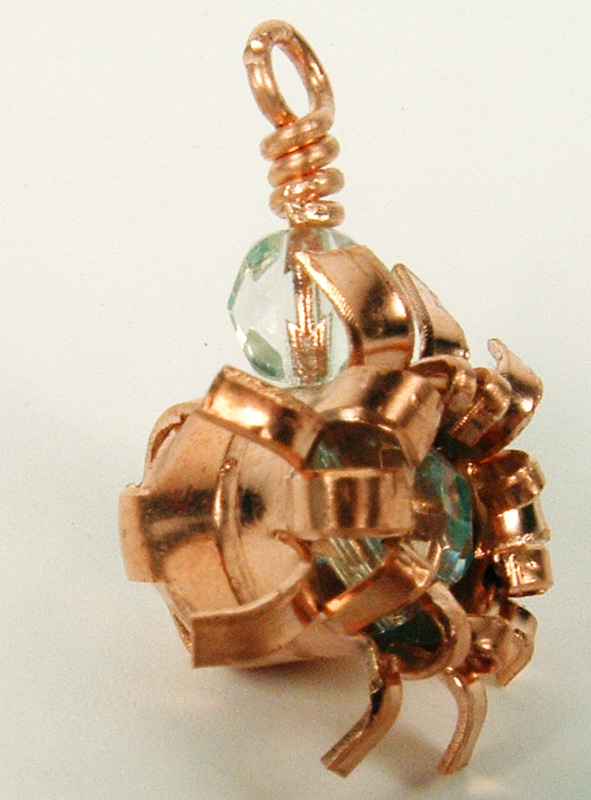
Round copper mobile shape

Each shape is made from two disks cut to fit together.

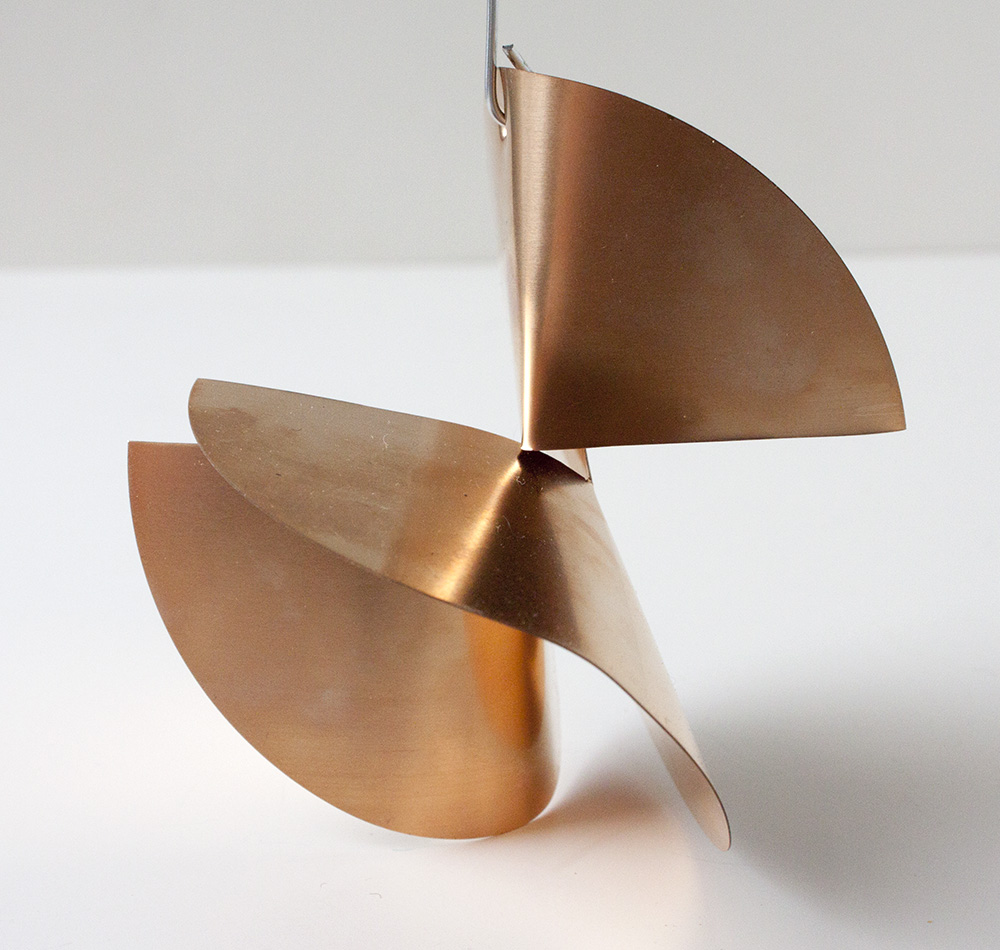
Two simple pieces can make a huge variety of shapes. Read on to see how they are made.

Steps to make the mobile parts:

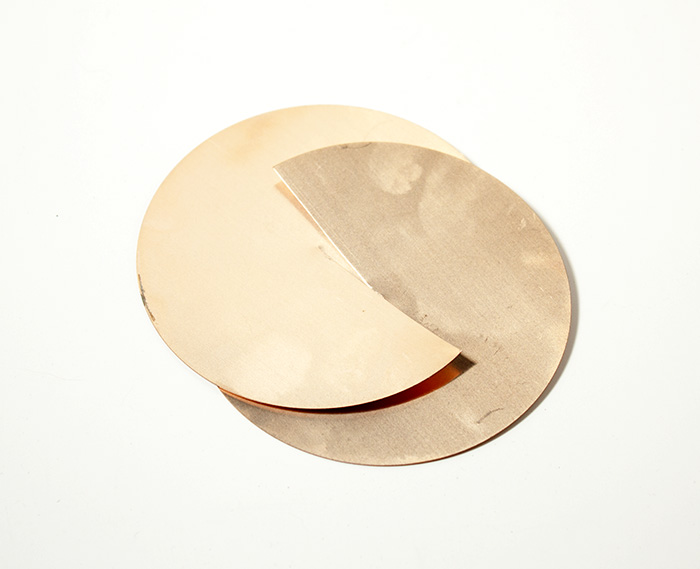
Two disks with first step completed

Make a cut to the center of each disk. Scissors work surprisingly well on this lightweight copper.

Slide the two disks together.

Slide the two disks together on the cuts that you just made. Keep sliding them together until the edges of the circles are even.

Then, start bending the cut pieces into interesting shapes. I started bending the pieces so that the two pieces wouldn’t fall apart. Turning each cut piece in the opposite direction creates a really stable object. This copper (leftover from a manufacturing process 20 years ago) is very hard to bend, so it makes really nice curves. I just kept playing around with different bends on each shape!

To hang each piece, I just used a nail to punch a hole. The mobile wires are made from 18 gauge galvanized wire, with a 12 gauge wire for the upper piece, which holds the most weight. I have a lot of disks left, so I’ll be making lots more of these twisted disk sculptures!

–Loryn

Copper Bracelet Hammered Crafty Sisters

Crafty Challenge 6: Hammered Cuff Bracelet

Copper Bracelet Hammered Crafty Sisters
Hand-hammered cuff bracelet.

Lynne:

I have been accused of shooting down the last few ideas for crafty challenges, so when Loryn came up with the idea of using some scrap copper discs in the garage I couldn’t very well argue. I have had those discs for the last 20 years and had never been able to find a good use for them and now I was backed into using them in a challenge.

I searched the internet and found this video on YouTube. The most exciting thing to me was the minimal need for specialty tools. Of course, when you are not using many tools, skill is always a bigger factor in the finished project. I pulled out a vise, a wrench and a ball peen hammer and set to. I will tell you now that ear plugs are a very good idea.

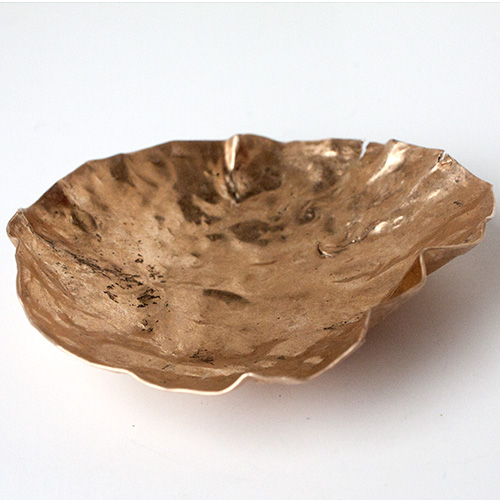
We have another sister who lives out of state and she was here visiting. She had brought some tools and a willingness to hammer out some ideas. Together the two us managed to hammer a small bowl with turned edges. Turning that outer edge under is not so easy but I found that brute strength is not the best idea. A small hammer with a light touch goes a long way as a hard hammer hit will put a tear in the copper.

Copper Craft Challenge Crafty Sisters Hammered
The diameter of our discs was jut 3" so the bowl is very small.
Copper Craft Challenge Crafty Sisters Hammered
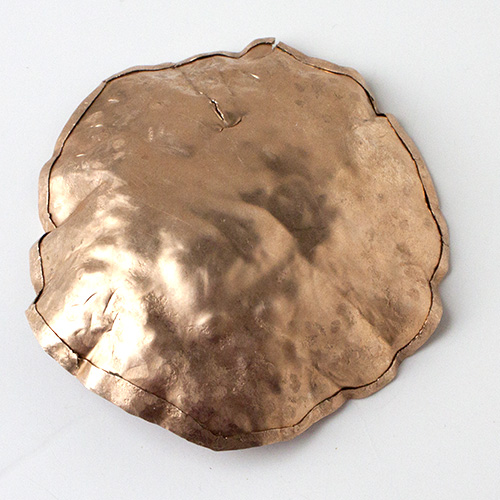
Here is the bowl as seen from the bottom showing the turned edge.

I folded copper, hammered copper, cut copper and cursed copper, but I could not manage to make any progress until last Saturday. I just seemed to make one good hit with the hammer and the copper began to do what I wanted it to do. Failure does lead one to success as long as you keep trying.

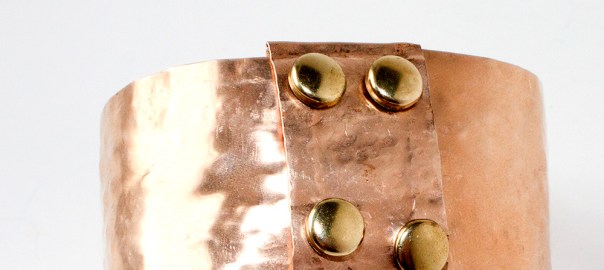
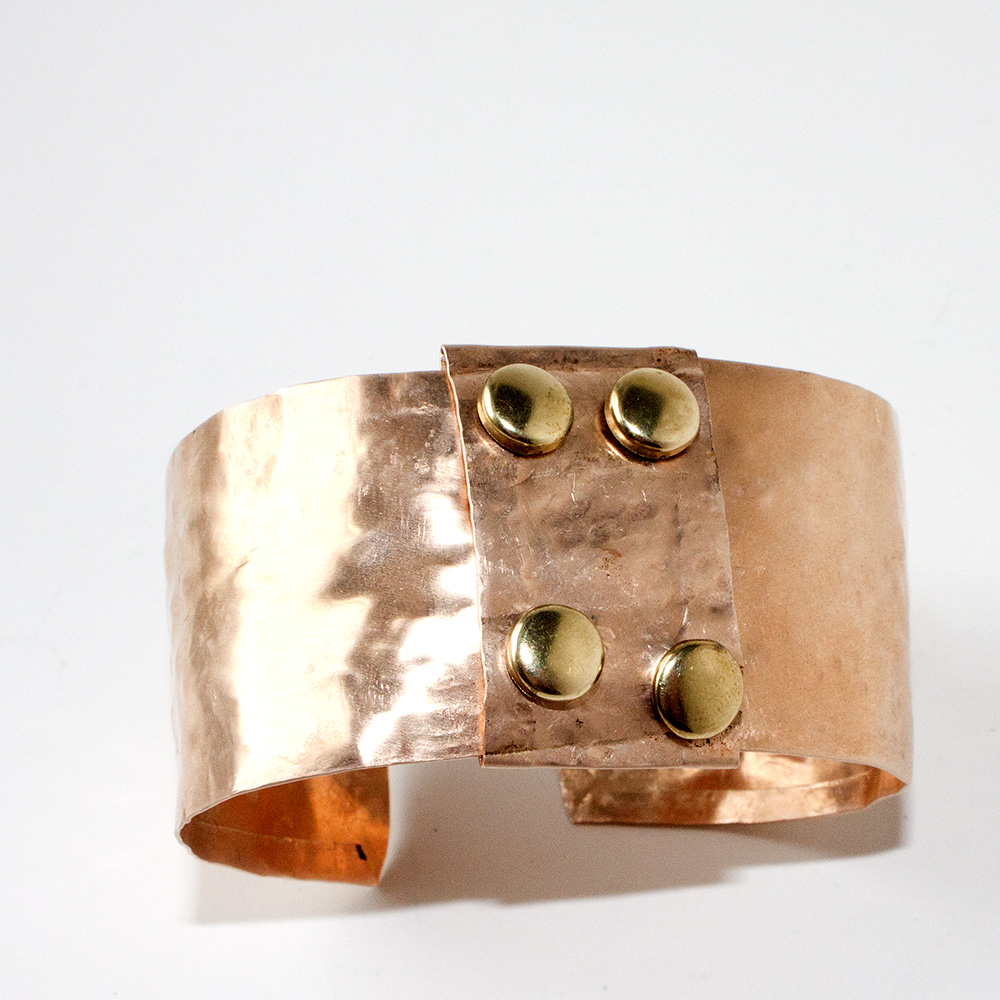
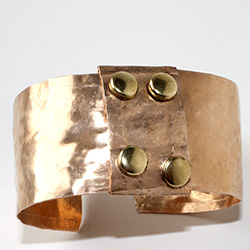
I ended up cutting a rectangle from two copper discs for the two halves of a cuff bracelet. I turned the long edges under and then hammered the finished rectangles into a roughly oval wrist-fitting shape.

One of my failed projects was a ring that was too wide for my finger and I had tossed it into the growing scrap heap. However, when I needed a bridge to hold the two bracelet halves together the too wide ring was perfect. All I had to do was hammer the ring flat, punch holes in it, punch matching holes in the other two pieces and connect them all with paper fasteners (not really sturdy but the deadline was twenty minutes away) and there was my bracelet.

For my first piece of hammered metal work I was extremely happy, and despite all my complaining I have become intrigued with the process and am going to do some more work with copper.
Lynne

Hammered Copper Cuff Bracelet Crafty Sisters
Hammered copper cuff bracelet.
Hammered Copper Pendant Necklace Crafty Sisters

Crafty Challenge 6: Verdigris Copper Pendant and Hammered Chain

Hammered Copper Pendant Necklace Crafty Sisters
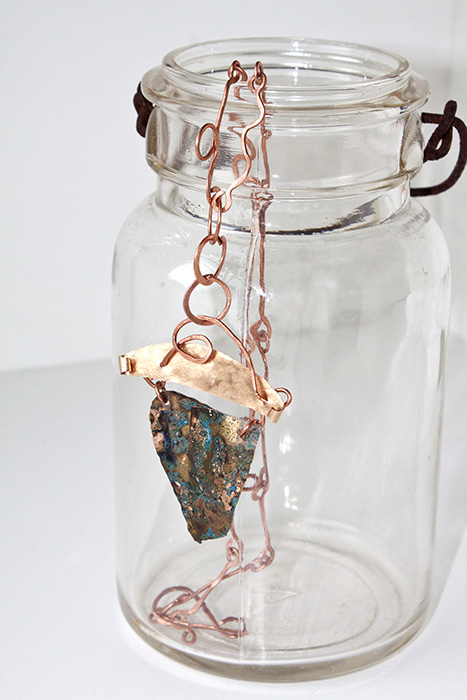
Hammered copper necklace with verdigris patina.
Copper Necklace Pendant Hammered Crafty Sisters
Hammered copper pendant necklace.

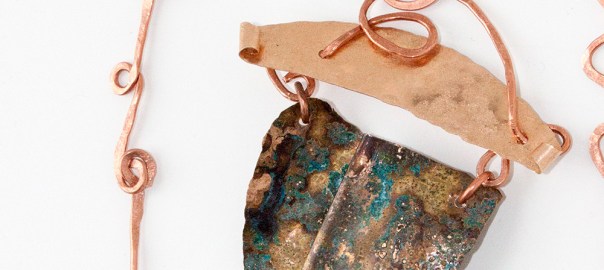
Cheri: It felt so good to get back to a challenge after our winter hiatus. And this challenge couldn’t have been better. I think we were all a little excited and a bit apprehensive when this project was initiated.Ā After playing with the copper for awhile, knew whatever I made, it would most likely be jewelry. This is when I let the metal do the talking. I had a ball peen hammer and a small vice with a flat edge and I went to town banging on some copper. I was pleasantly surprised with how pretty the copper became after being hammered. Metal can lose what small elasticity it has in it after it has been work-hardened so I really wanted to make sure that I did not overdo the hammering or it would become brittle. After I had mastered the shape I wanted, I decided to do some research on adding a patina. I came across an article that said I could add blue to the copper by suspending the piece over a bowl of ammonia in a closed container. This was super easy, just be careful with the odor, it can be a bit overwhelming.Ā  The patina on my piece took about 12 hours to achieve and I think it came out pretty nice.

Copper Rings Hammered Crafty Sisters
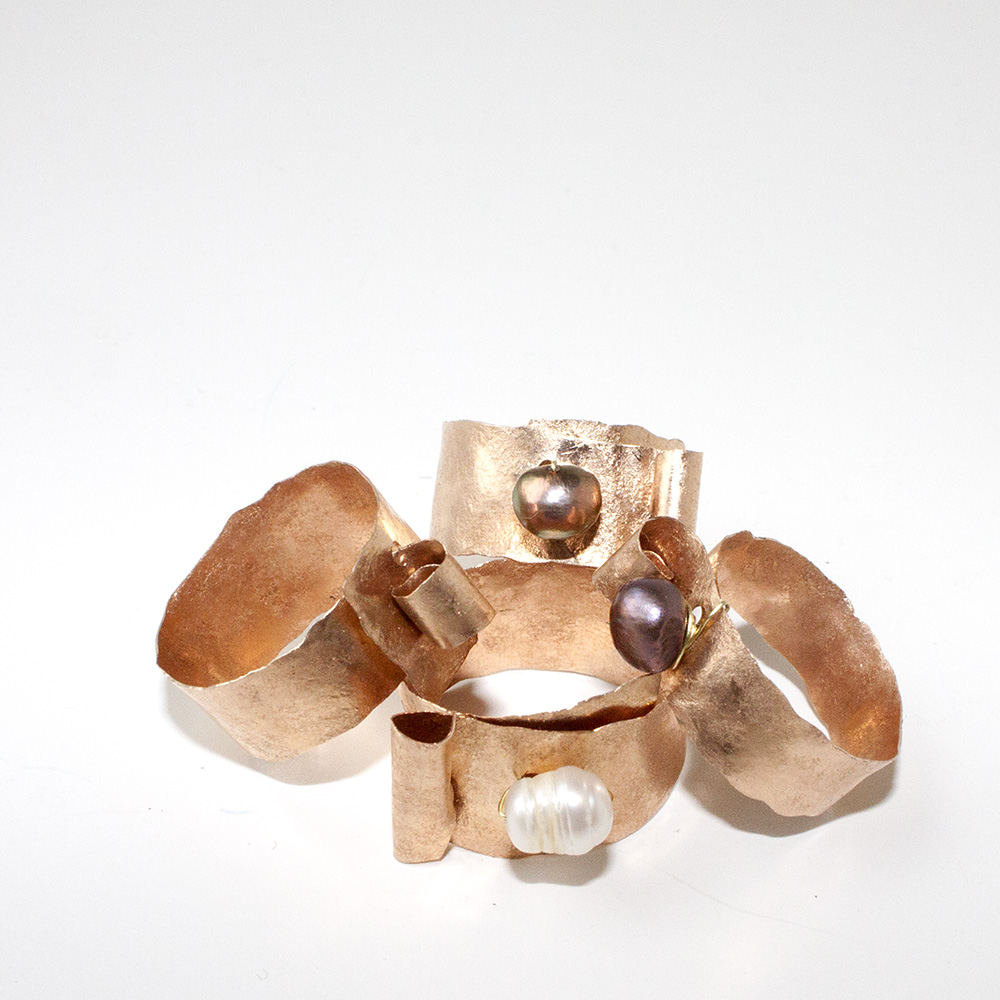
Hammered copper rings with button-hole style closure-clasp.

I punched holes with a hole punch and used copper wire to embellish the pendant and make the chain. I also hammered the copper wire to give it a rustic look. The rings were made by hammering a small strip of copper and then coiling it around a mandrel. I put two holes in the upper end and two holes in the under part. This had a button hole effect when I used a bead to bring the two pieces together and basically tied them with brass wire.

The copper turned out to be an awesome material to work with and I look forward to making many more pieces.

Cheri

Crafty Sisters Hammered Copper Pendant Necklace
Hammered verdigris copper pendant and necklace.
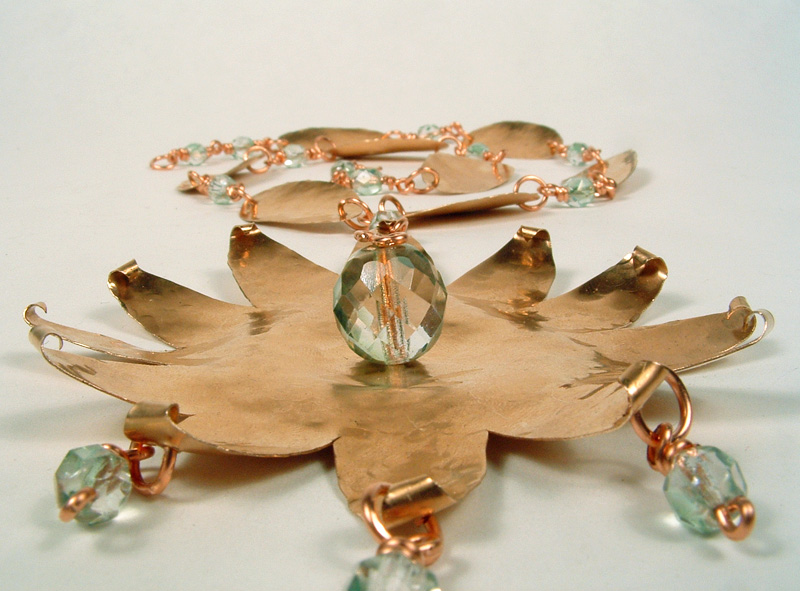
View of copper star-burst necklace from the bottom of the pendant.

Crafty Challenge Six: Copper Star-burst Necklace

View of copper star-burst necklace from the bottom of the pendant.

We are back, baby!

After an additional week due to some time constraints, our Copper Crafty Challenge is complete. We had our final reveal among the Crafty Sisters this afternoon, and boy, we really seem to be at the top of our game for this challenge. I cannot wait for you to see all the projects. We are going to post one project a day, so keep coming back!

I waffled quite a bit on this challenge. I make a lot of jewelry and I wasn’t sure if that was where I wanted to go with this particular project. After a week and a half of indecision, I decided, why mess with a good thing, jewelry it would be.

Copper star-burst pendant and leaf chain.

Using a compass I played Spirograph on a copper disc and cut out the star burst pendant. Amazingly, the copper is thin and soft enough that you can cut the discs with heavy duty scissors. I hammered the star on both sides to give it some depth. I then curled the points of the star (I couldn’t see any other way to really blunt the points. Those suckers were sharp!) to keep from puncturing anyone wearing it or snagging your clothes. I attached the light green crystal bead in the middle with wire and did some wire-wrapped crystals (also light green in color) for the dangles at the bottom of the pendant.

Close-up of the star-burst pendant.

The chain is made up of hammered copper ovals and more wire-wrapped crystals. I did Ā make all the jump rings and the clasp out of wire as well. The wire is standard 18 gauge copper wire from the hardware store.

All the hammering was done on an anvil that my dad made me for Christmas several years ago and with a series of hammers that he made for me 2 years ago. I started all the holes with a punching awl then enlarged then with a Dremel tool and a diamond tipped drill bit. I filled all the edges with a mini file to be sure that you wouldn’t slice yourself open on the sharp edges caused by the scissors.

The star-burst was actually the second pendant I made for this necklace. I wasn’t all that happy with the first one I had made. I showed it around and the other Crafty Sisters and my M-I-L (who joined us from my house this week) thought it was great, which just goes to show how hyper-critical I can be about my own work.

First copper pendant I made.
This pendant is made of a copper plumbing pipe fitting.

Side view of the alternate copper pendant.

I did make a pair of earrings to go along with the necklace (my usual M.O.) and I think they turned out rather well.

Copper leaf earrings.

I really like how the hammered ovals came out looking like leaves. The hammering causes the copper to curl a little and I liked the affect so much that I left it and used the same affect in the star-burst pendant.

Close-up of the hammered copper leaf.

That is my completed project! It was a fairly easy process all in all and one that I found rather fun (until my arm got tired of all the hammering).Ā I cannot wait for the next challenge. In the meantime, I have promised this necklace to my M-I-L and and am going to take the earrings apart to make a matching bracelet instead as she does not have pierced ears. So, back to my craft table to work on some more copper!

Happy Crafting!

Kristin

This post is featured on Todays Creative Blog.

Crafty Challenge Seven: Paper

Our sixth Crafty Challenge has come to a completion and was a rousing success. We will be posting the results one project per day this week. We hope you keep coming back to check them all out!

Crafty Challenge Seven is all about paper. For this project, your main material must be paper. By paper, we mean any paper product (e.g., cardboard, card stock, wrapping paper, tissue paper). This is a challenge to minimize materials, unlike some of our past challenges that were limited by cost or time.

Here are some of the other crafts made out of paper from our crafting history:

Paper flower garland

This is a paper flower garland made by Lynne for Crafty Challenge 5.

Scrapbook Paper Balls

These are Christmas ornaments made by Cheri for our Christmas Ornament Countdown.

Fast Food Folio

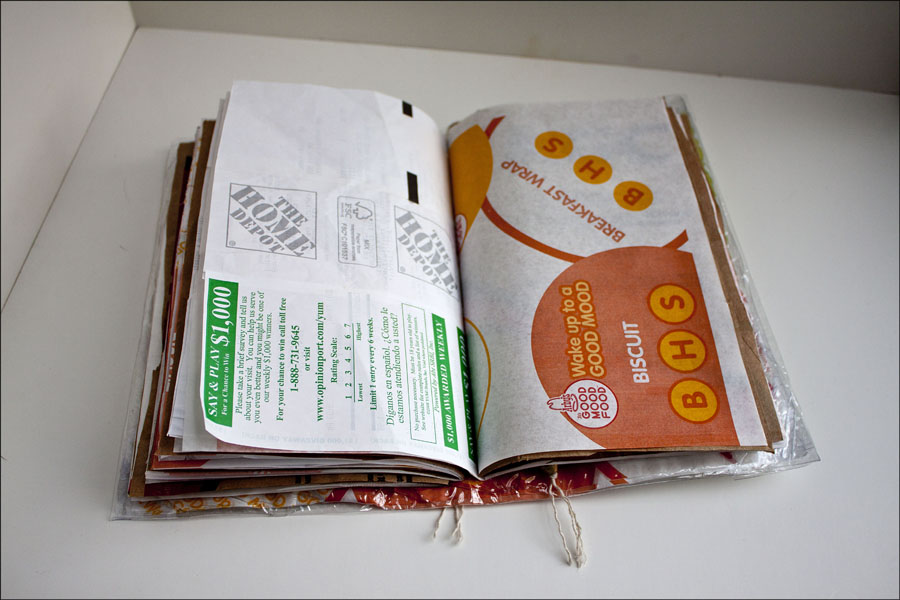
This is a folio made by Lynne for Crafty Challenge 3.

The project can be anything you like and it will be very interesting to see what all the Crafty Sisters come up with! The challenge starts today and we Ā have 2 weeks to complete our project. Our next reveal will be on April 29th (Happy future Birthday to Crafty Sister Cheri’s children, Jacob and Justin who were born on that auspicious day!).

Wish us luck and few paper cuts.

Happy crafting,

Kristin

Crafty Challenge Six: Copper Discs

Spring is here and around Indiana, it is running full steam already. In celebration, we are gearing up for our sixth Crafty Challenge. This round is all about copper.

In another bid to help clean out the garage, Loryn found some really nifty copper discs hiding in a box. (This was how our Wooden Spool Challenge started.) These are cut-outs from sheet metal and their origin is unknown. (Really, where does half the stuff in garages come from? It is like the inverse of the dryer phenomenon.)

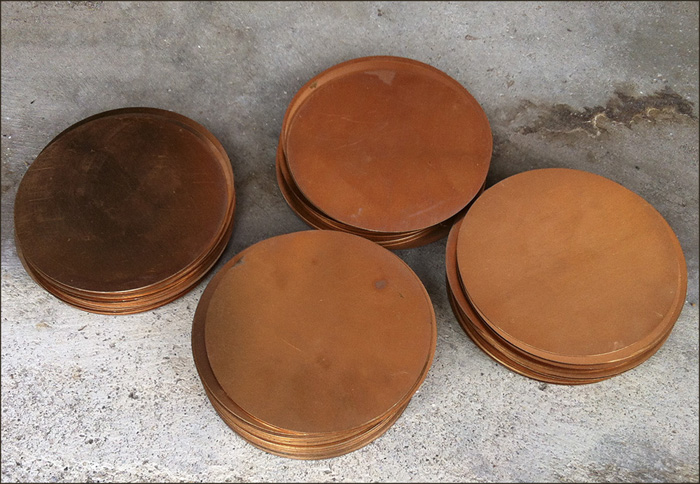
Photo of 4 stacks of copper discs.
Four roughly even stacks for the four Crafty Sisters!

We each got our own stack (we didn’t actually count them out this time, there were too many) and you could just see all our brains buzzing already.

I thought it was really funny after we divided them up, we all took a stack and then remembered that we would need a photo for the blog. We all placed our stack just so and made sure to pick up the same one we set down. We certainly get proprietary over our craft materials don’t we?

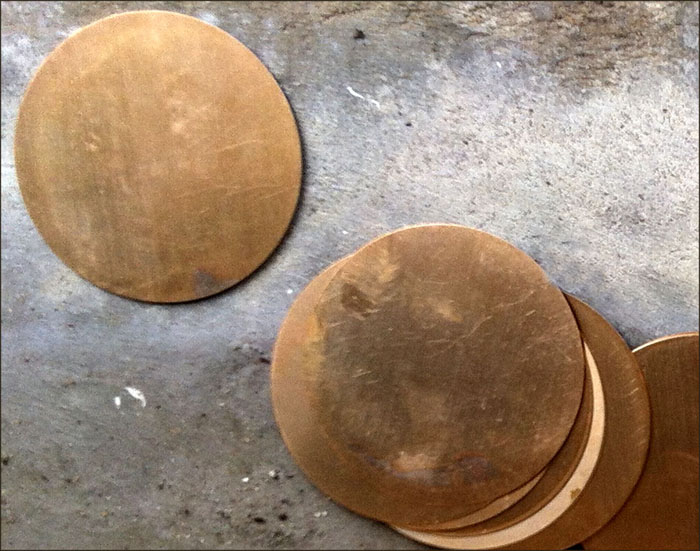
One pile of copper discs fanned out.
This is actually Lynne's pile of copper discs. The rest of us snapped ours up pretty quickly.

So, we now have two weeks (well, at this point 12 days) to come up with a craft that makes use of these bendy little circles.

Stay tuned for the final results on April 8th! I can’t wait to see what we all come up with!

Happy crafting!

Kristin

Almond ear wires with pink conical beads.

Almond Ear Wires and a Pretty Pink Earring/Necklace Set

Almond ear wires with pink conical beads.
I just love this shape of ear wire.

New and interesting shapes for ear wires are very popular lately. My favorites are the almond-shaped ear wires.These have been featured all over the web and television. The first time I really noticed them was on Emily Deschanel in the television series “Bones.” They are elegant and fun and are actually very easy to make.

For demonstration purposes and because it photographs a little easier, I made these ear wires out of heavier 18 gauge sterling silver half-hard wire. I usually use lighter 21 gauge sterling silver half-hard wire, but I wanted something that would be very visible in the photos.

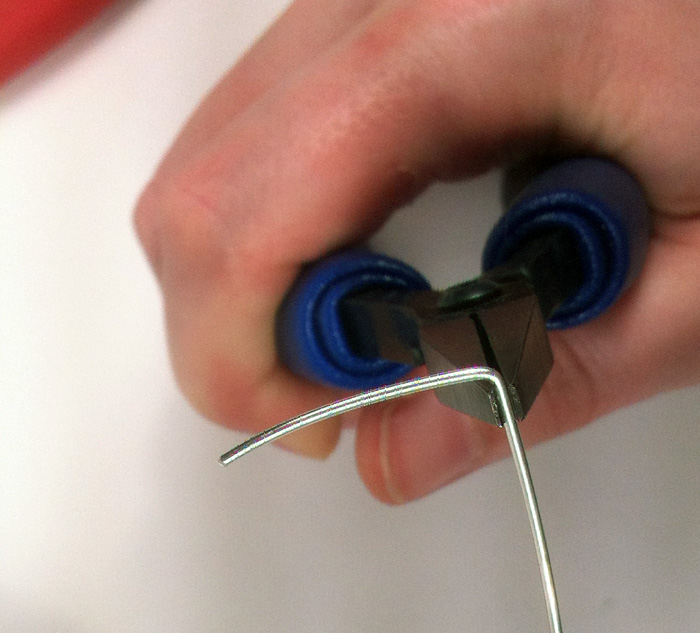
Wire bent at 90 degrees at 3/4".
Bend the wire to 90Āŗ.

Using flat nose pliers (although you can use the rosary pliers for the whole project if you prefer) I bent the wire at 3/4″ to a 90Āŗ angle.

Wire loop made with rosary pliers.
Wrap a loop with the rosary pliers.

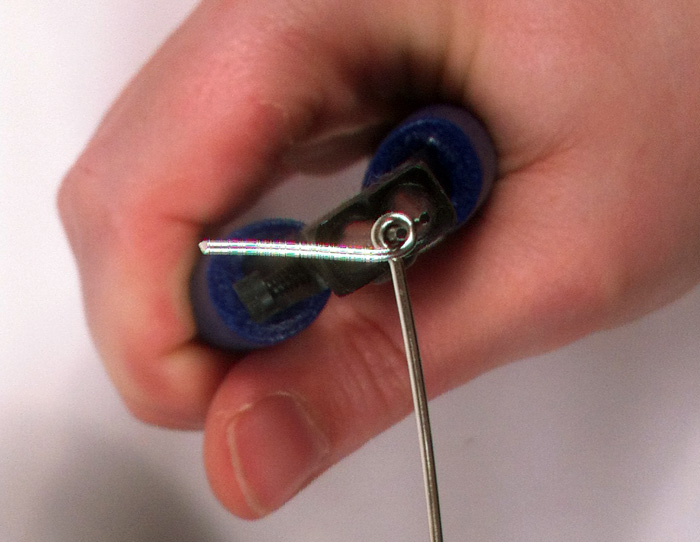
Then I used rosary pliers (also called round-nose pliers) to make a loop by placing the pliers above the bend on the short wire and wrapping it around the nose of the pliers.

Completed wire loop.
Finish wrapping the short end of the wire around the stem.

Holding onto the loop with the rosary pliers, I use the flat nose pliers to twist the short end of the wire around the stem (below the loop). By having only 3/4″ of wire for the loop, there is no wire to trim and you are good to continue on to the next step.

Wire wrapped around the mandrel.
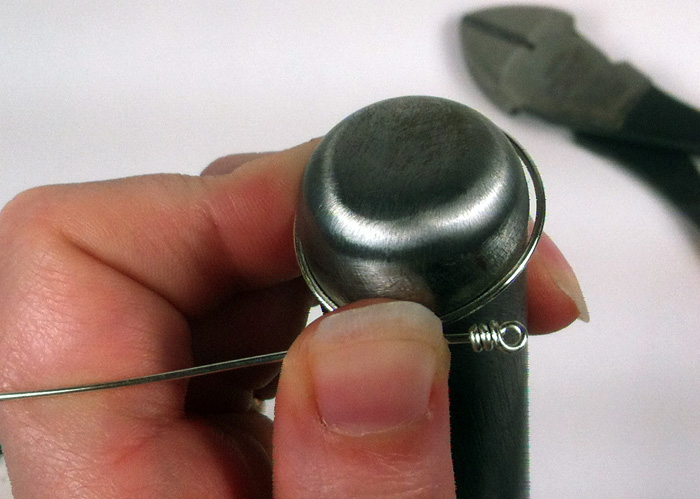
Wrap the wire around a mandrel or other object approximately 1" in diameter.

Here I used a mandrel that my father made me for Christmas a few years ago (Aren’t fathers wonderful?). The widest end of the mandrel is 1″ in diameter and the thinnest end is 1/2″ in diameter. For these ear wires, I wrapped around the widest point of my mandrel at 1″. I just made one wrap around the mandrel and as the wire is half-hard, it stretches back out to an incomplete circle when I let it go as shown in the photo below.

Wire just removed from the mandrel will stretch out to form an incomplete circle.
Completed almond shaped ear wire.
Here is the finished view of the almond ear wire.

Next, I bend the circle at the half-way point to create the top of the almond and lightly stretch out the two halves to create the full almond shape. I also bend the wire-wrapped loop to hang correctly down from the almond. I then use a small file to smooth the cut made by the wire cutters so it won’t catch in your ear when you put it through.

Almond ear wire earrings and matching necklace with pink pendant.

To show the ear wires in action, I made the matching earrings to a necklace I made from pretty pink glass florets, red pearls and crackled white quartz beads. The pendant is a piece of dyed jasper that I wire wrapped to hang it from the necklace.

I hope this helps you to create your own almond ear wires, or inspires you to create your own new shape entirely!

.

Make a Simple Grocery Bag Tote – Part II Assembly

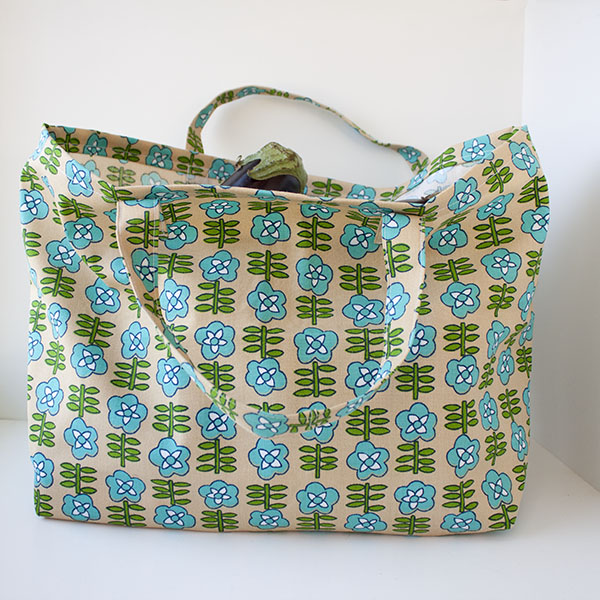
Completed grocery tote bag

My first post, on pattern drafting, showed you how to make a simple tote bag pattern. This post will cover how to assemble it. I’ll also show how to make french seams, which form a quick, easy seam finish that won’t unravel in the wash.

For these bags, I used a vintage 60s polyester canvas. I normally don’t like poly, but it does work well for an item that will get dirty and need to be laundered frequently. Plan on roughly 1/2 a yard per bag, plus extra for handles. For a four bag set like this, plan on 2 1/2 yards.

First, cut out your pattern, keeping it square and on grain. If this is your first time using a new pattern, I recommend finishing one bag completely before cutting out any of the others, so you can fix anything you don’t like. I made my first bag too small and resized the rest. You don’t want to find this out after you have cut up all your fabric!

For this bag, we’ll be using french seams. Here is a quick tutorial:

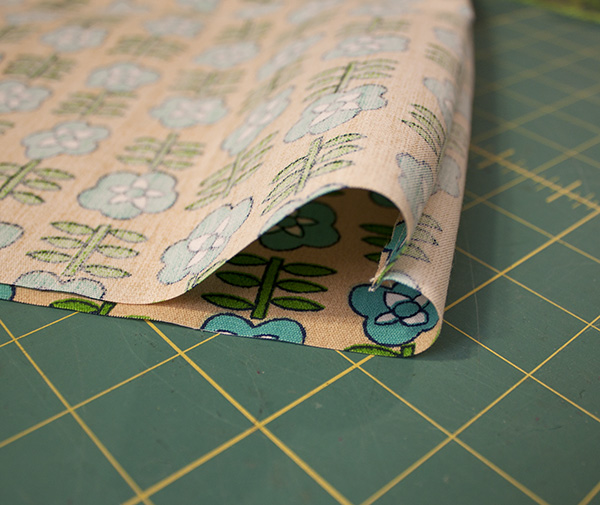
French seams step 1

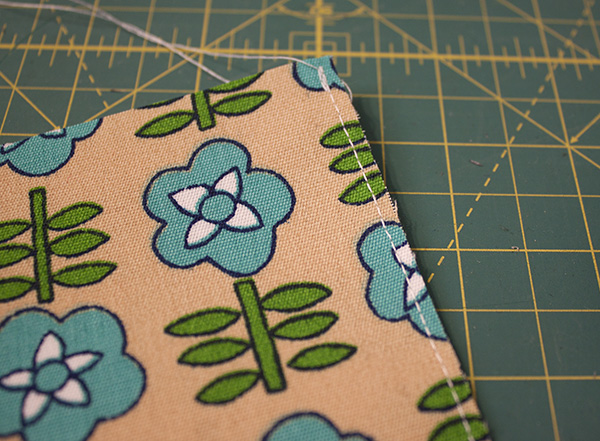
Sew the first seam with the right sides facing OUT. We’ve been so conditioned to always have the right sides facing in that you might have to make a conscious effort to have the right sides facing OUT. Double check before sewing! As you can see in the picture, I’ve sewn a scant 1/8″ seam. If you’re not comfortable with this, cut your seam allowances larger, then sew a 3/8″ or 1/2″ seam and trim it down. In either case, make sure there are no frayed edges that could show through the final seam.

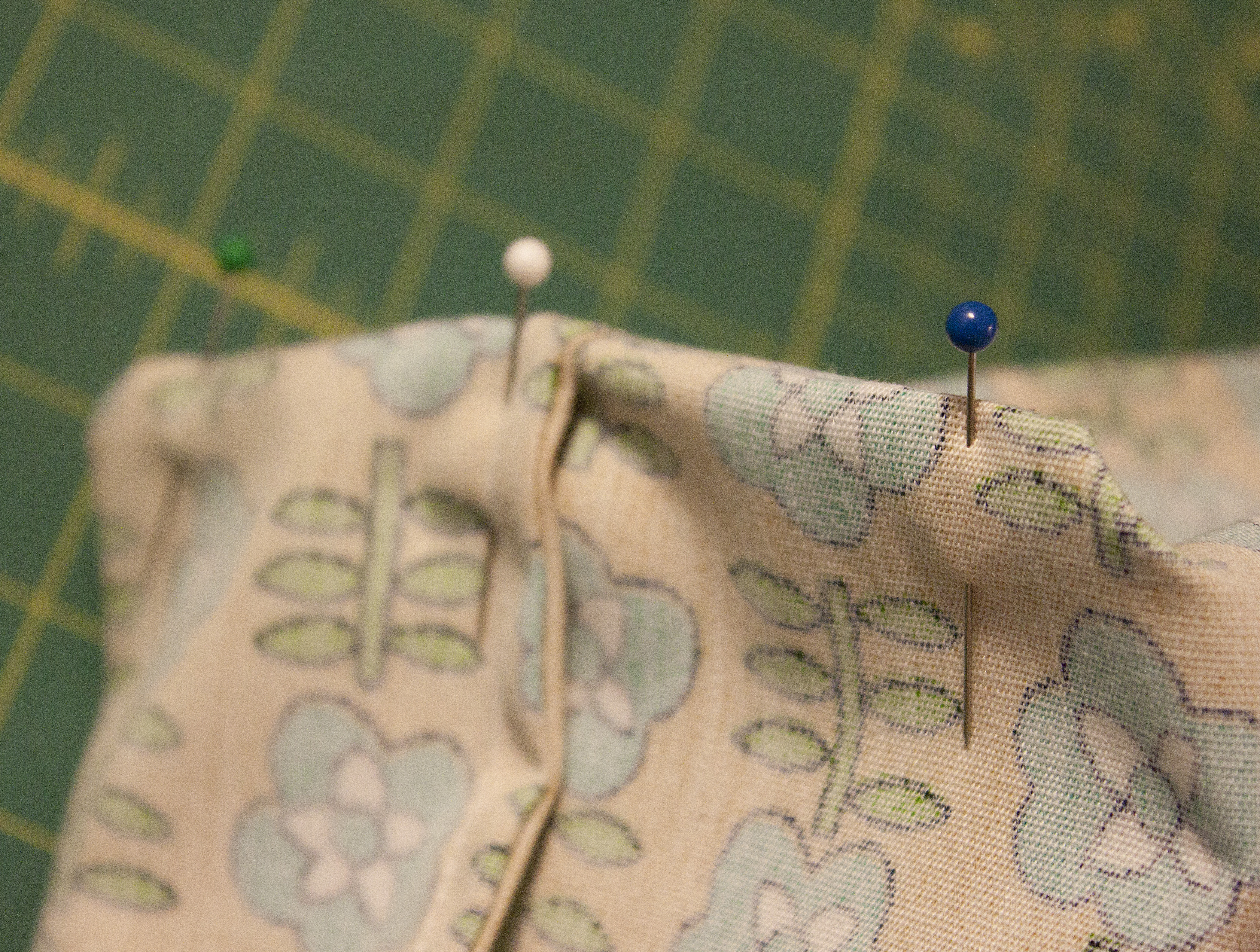
French seam step 2

After you’ve sewn the first seam with right sides facing out, fold the seam so that the right sides are now facing in, as seen above. Your first seam and the raw edges will now be trapped inside a second seam.
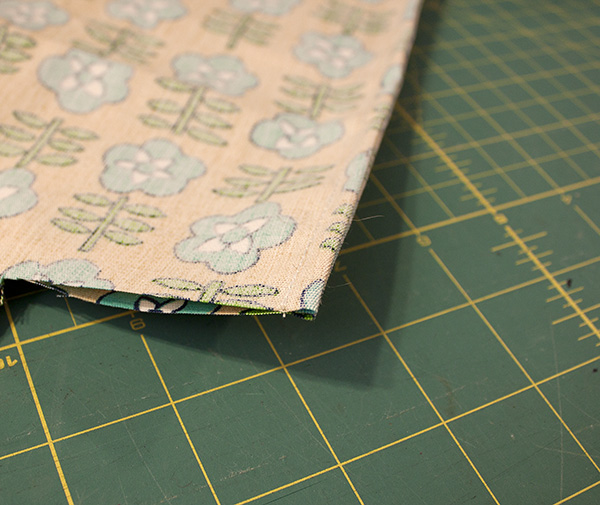
French seams step 3

Sew a second seam with the right sides together. It needs to be large enough to miss the raw edges of the seam inside. As you can see above, it gives a very nice, clean finish!

To sew the bag with french seams, it is fastest to complete step 1, sewing the seam with the right sides facing out, on both sides and the bottom. Turn it wrong side out, and sew the second seam on both the sides and the bottom. When you are finished, it will look like the bag above.
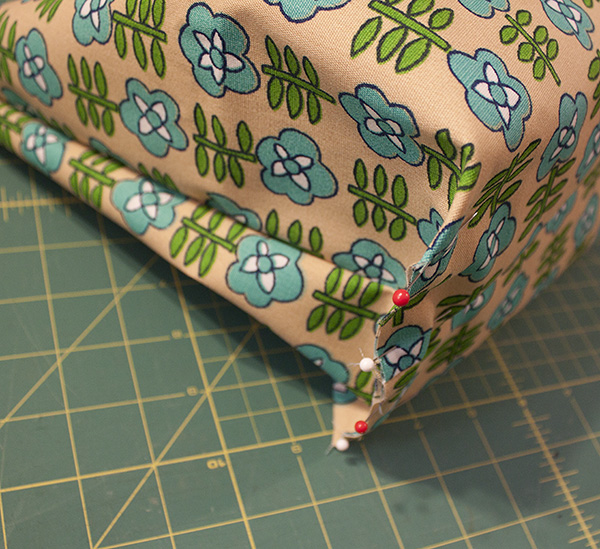
Constructing the corner

Next you’ll make the corners. Turn the bag so that the right sides are out again, and sew step one of the french seam. Make sure that the seam allowance on the bottom is not twisted.
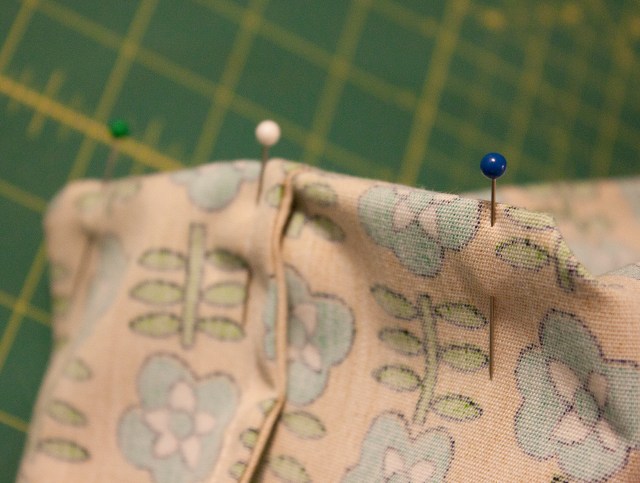
Turn the bag so that the wrong sides are out, and sew the final seam along the bag bottom corners. Now we’re ready to finish the top.
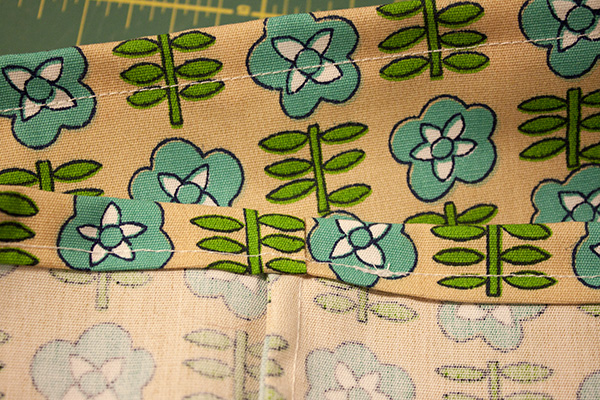
For these grocery bags, just fold over a simple 1/2″ hem, and you’re done with the body!

All that’s left are the handles. I make mine a little differently. I cannot stand to turn tubes. After years of struggling with frayed, ripped out, misshapen messes that were supposed to be an elegantly turned handle, I gave up and developed my own technique. If you are graced with tube-turning ability, then by all means make your handles that way. But if you’re like me, just make them like this. The sewing police aren’t watching!

The first step is to cut two 20″ long by 4″ wide strips for each bag.

Handle construction

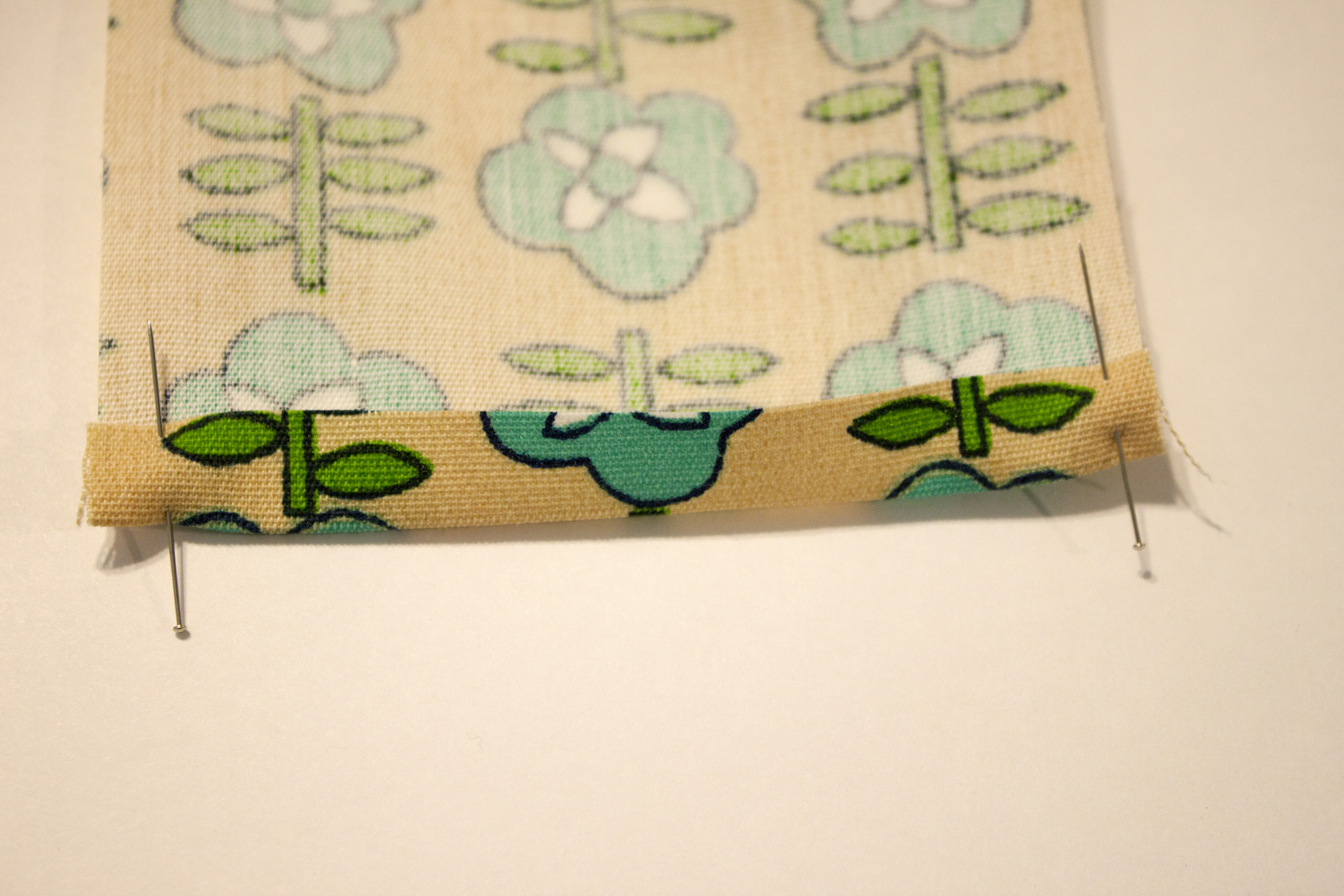
Fold a 1/2″ hem up at each end of the strip.

Then fold the sides in like you would to make a bias strip.

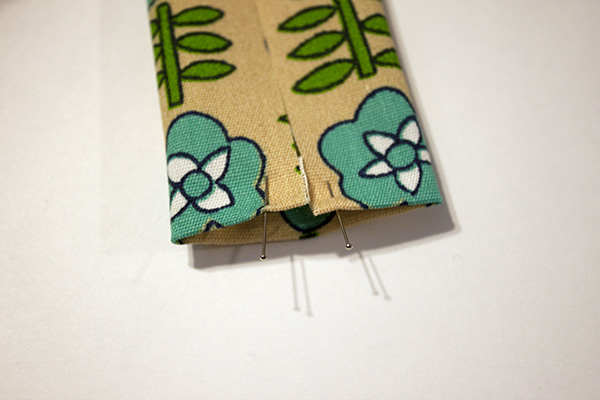
Then fold the strip in so that all raw edges are hidden.

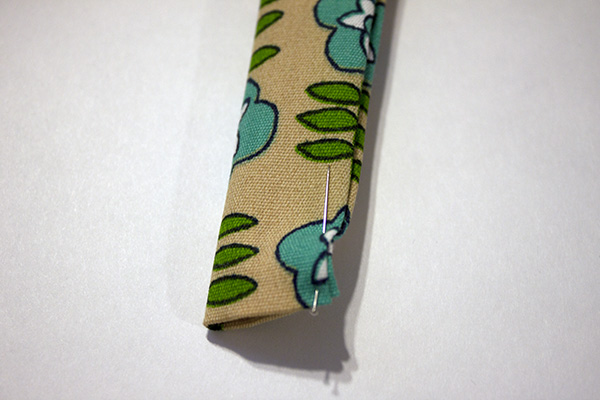
Now pin the handle carefully so that the two edges are aligned, and top stitch all the way around the handle. Not only did you get to avoid turning tubes, but the handle is four thicknesses wide, giving it a nice sturdy feel.
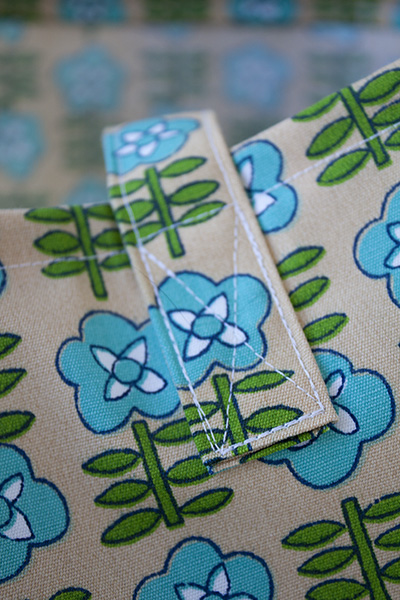
All that’s left is to attach your handles to the bag. For the 18″ wide bag, I placed the handles 5 1/2″ from the outside edge, with 2″ of handle sewn to the bag for strength. Sew an X-shaped design for added reinforcement.

As I mentioned in the pattern drafting post, I made the first bag 14″ wide, which is too small for most groceries. I enlarged the pattern, and made 3 bags that are 18″ wide. It was a serendipitous mistake, because the small bag is perfect for holding the other three bags when not in use, as well as for small shopping trips to get one or two items. These bags are great because you can really stuff them! For my small household, three will accommodate a big shopping trip. For a large family, six would probably work better for you. Happy sewing!

–Loryn