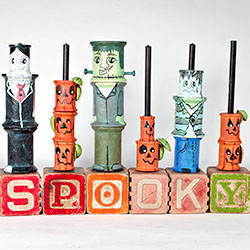
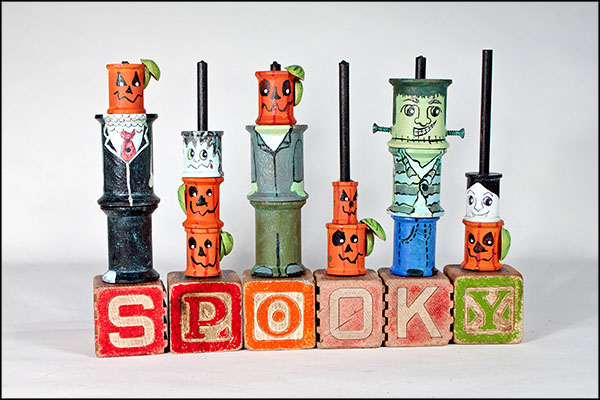
Cheri: This spool challenge was a lot of fun to do. I think all of us had a really good time and our projects were all so different. For my spool project I decided that I wanted to do a Halloween project. That being decided, I realized that I wanted to paint some monsters on the spools and then I thought it would be so cool to be able to change the parts of the monsters around. I spent a few hours painting the spools and then I had to decide what I wanted to display them on. I had picked up some old alphabet blocks maybe a year ago and they just had the right feel to them. I started working with the letters to decide what I wanted to spell and finally felt that “SPOOKY” was a very appropriate word. I drilled a small hole in the top of the blocks and then I cut 5 pieces of dowel. I then hot glued the dowel into the blocks. My son suggested that I paint the dowels black so they didn’t stand out so much, and voila!!! My project was completed. I think we all did an awesome job and I can’t wait to get started on our next project.
Halloween spools.Count Dracula and his pumpkins.Frankenstein with screws in his neck.A zombie for a neighbor.It's even spookier when they exchange body parts.
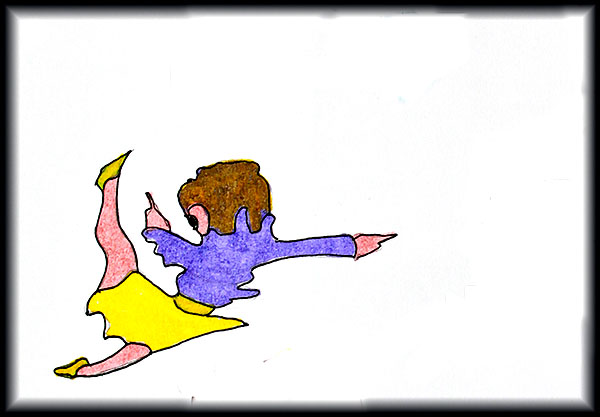
This ballerina is one of my earliest squiggles and is done entirely in marker. I love the freedom of the lines and the movement in the drawing.
-Lynne
Lynne: I was checking the blogs I read and I noticed that Teri Partridge of the Pear Tree Gallery has this wonderful watercolor tutorial up on how to make a greeting card of beautiful bleeding hearts. I’m getting my paints together for a go at it myself.
I used a complementary color scheme of red and green. I used the lighter tones of pink and light green and it makes for a nice contrast. The drawing uses only color pencils, not markers this time.
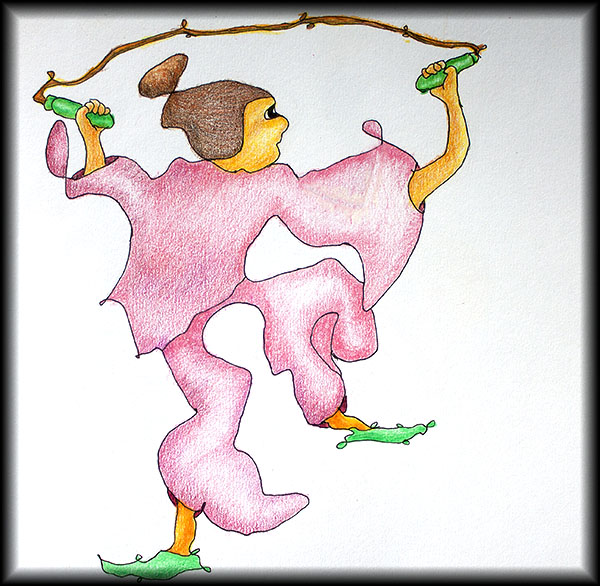
This little girl squiggle has so much energy and her clothes flap in the breeze of her twirling rope.
This elephant is not afraid of mice and loves butterflies.
I did this squiggle of the elephant using only red, blue and yellow color pencils. This was before I used black to bring out some depth and I can see how that would help. I do like the way though that not all of the color is blended. This does add some depth and lots of texture.
The mouse and the butterfly are a combination of marker and pencil. They are there because the elephant was lonely.
This squiggle was an experiment in the use of hot press watercolor paper with markers and color pencils. The paper is so smooth the color pencil works itself into a ball under the point of the pencil until it drops off and leaves a smudge of color. The effect looks interesting, but it is not exactly what I want and I will file the information for use later. In the meantime, I will look at some other paper and save the Arches hot press for watercolor.
I like the position of the boy and the look of motion. He is definitely one of my favorites.
A squiggle that has been built up with markers and then shaded with color pencils.
I have always wanted to be able to draw, but a very early life experience with a football coach posing as an art teacher had me convinced that I was no artist. (In my early years I went to a school that had all the grades together. The rough chastising that must have worked with teenage boys did not have the same effect on a first-grade girl-child.)
In the last several years in an effort to shake the coach’s gloomy prognostications, I have taken drawing lessons. I found the Pear Tree Gallery and Teri Partridge, an artist and teacher, who is bound and determined to make everyone an artist. (Ask anyone who has passed through Columbia Middle School and they will tell you the same. This is not to imply that I am young enough to have had her as a teacher when I was a student there.)
One of her oft repeated lessons (the one on drawing shapes has to be most repeated) is the importance of shading and shadow. What I came to realize after Teri had patiently repeated it over and over was that where I had thought my drawings were simply terrible, in reality they were simply not finished. I came to realize that there is a world of difference between the first set of marks you put on the paper (shapes, always remember) and the last set of marks you put on the paper (shading and shadow.)
Now, after several years, I can say that I am competent with pencil and paper. My black and white drawings look enough like the real thing to make me think some of Teri’s lessons have sunk in. However, I wanted color and unfortunately it did not want anything to do with me. I simply did not know what colors to use. My watercolors did not mix well, I did not like acrylics and oils did not look simple enough..
Finally, after wandering with much self pity among those many did nots, I came across this quote by Johannes Itten, a teacher of the Bauhaus style of art in the 1920’s;
If you unknowing, are able to create masterpieces in color, then unknowledge is your way. But if you are unable to create masterpieces in color out of your unknowledge then you ought to look for knowledge.
With that unsubtle nudge, I decided to seriously look at how color works. Some people know immediately what the primary colors are and their relationship to secondary and tertiary colors, but I have to plod my way through color theory and keep a color wheel beside me. (The Color Chart blog is packed with information about color schemes and theory.)
I was snooping through Cheri’s shelves one day and found a book called Drawing Lab For Mixed Media Artists by Carla Sonheim. There were 52 exercises to make drawing fun, but the one that really caught my eye was scribble drawings. The exercise consisted of making a scribble, just a random mark on the page and then looking at it every which way until something popped out. An arm, a leg or even an eye would peek at me just like the face and vase optical illusion that tricks you into seeing one and then the other. The best thing was that these were the types of doodles I did as a child (frowned upon by a certain football coach) and I had been seeing things in scribbles for years.
What I did not know was that scribble drawings were my eureka moment to color. They only needed a simple color scheme and with the color wheel I could pick the scheme I wanted before I put a marker to paper. As long as I stayed with the predetermined choices, I could play without the fear of a terrible muck up.
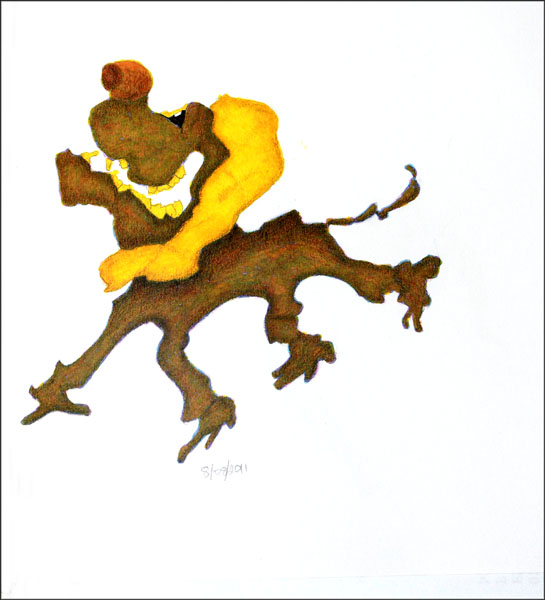
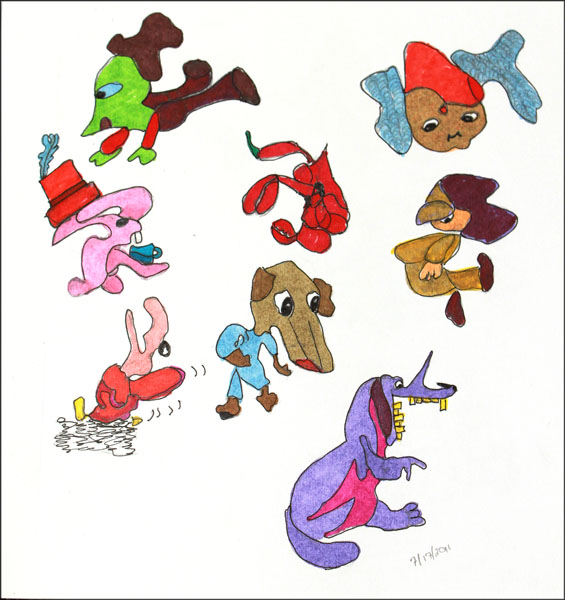
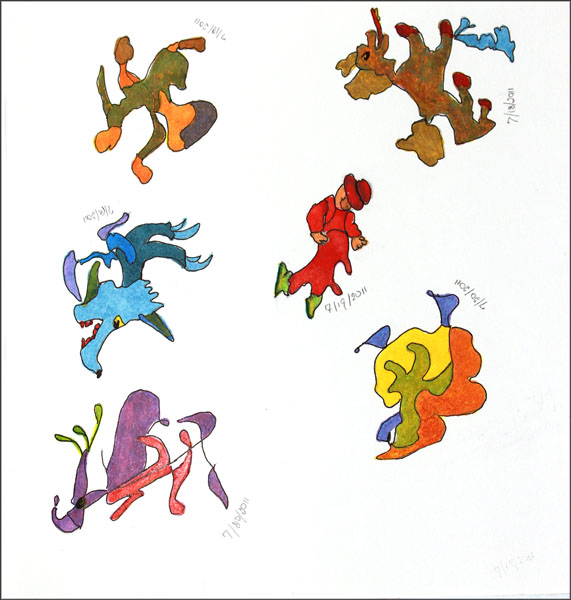
I have named these scribble drawings squiggles because squiggle is an artistic term for the short curves and twists that I end up with when I scribble. The sketchbook pages posted below are the first squiggles I did and I have included three photos of the progression of a scribble to a squiggle. The drawing at the top of the post is what my squiggles are starting to look like now. I add lines and take away lines and use a combination of markers and color pencils to create the shading and shadows. Squiggles are my eccentric way into the world of color and imagination. And who knows? Someday, I may pick up a brush and not muddy the watercolors.
-Lynne
These are all done with markers.Separating one squiggle into two allowed me to think about erasing lines.I have started to turn the sketch book in all different directions.The result of a random scribble.The random scribble turned into a figure.The finished drawing. I used color pencils and marker in a primary blend of red, blue and yellow.
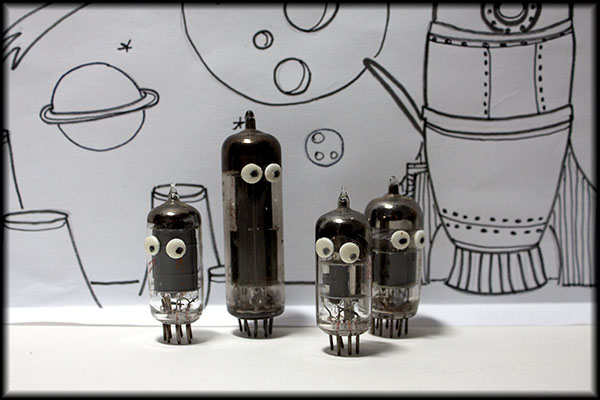
The space invaders ready for a war of the worlds. Or maybe just a close encounter.
Space Invaders
The space invaders ready for a war of the worlds. Or maybe just a close encounter.
I pick up lots of small items at sales, and I have always had a pretty vivid imagination. I like to create creatures out of objects. The TV tubes are the perfect example. At one point you have just TV tubes, (which are really pretty amazing works of art by themselves), but if you put eyes on them, you give them a personality. And if you give the creatures a landscape, you have a whole story. It’s true, one picture is worth a thousand words.
Loryn came to B-ton this weekend to help me get started taking jewelry pictures for my etsy shop. Photography class couldn’t start until I had the tools and environment under control. I had to clean up the are and get the photo table set-up. I have an old drafting table which has become my base, the lights are borrowed from Loryn, the camera is my old Fuji Film 3800 FinePix, and I bought a roll of banner paper from Pygmalion’s, the local art store.
I have hung the brackets and you can see the dowel that will hold the roll of banner paper.
Living in an A-Frame house can cause some difficulties in hanging anything from the walls, so to hang my banner paper which would become my photo backdrop, I purchased two closet rod brackets. I hung these from the walls and put a dowel though the roll of paper. This drapes down to the table and provides a great backdrop that I can replace easily and even write and doodle on with no costly consequences. Just cut and roll out another sheet and you are good to go.
Then came the actual tutorial.
—Kristin
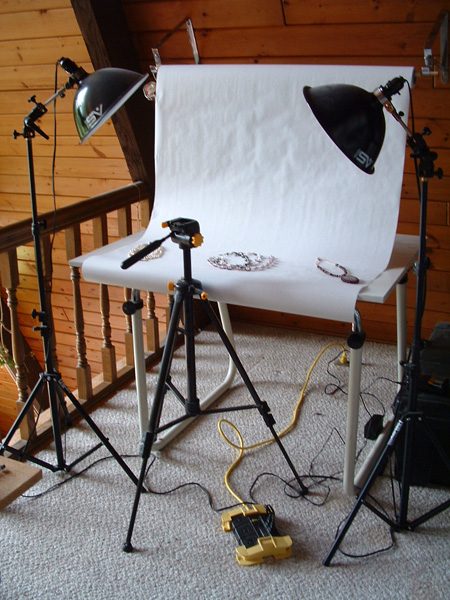
The full photo setup
Loryn here. This is what the full photography set-up looks like. After shooting thousands of objects for sale on eBay, I got the best results by having two lights balanced on each side of the object. The tripod is helpful, but not a necessity with Kristin’s camera, which has good image stabilization.
The power strip has to be close at hand (or foot, really), so we can turn the lights off and on easily. The photo lights are 500 watt daylight bulbs. They are very, very hot, and they have a 5 hour lifespan, so you only want them on while shooting. A truly professional set-up would include lights that are slaved to the camera, so they only come on when you press the shutter release. We’re not there yet, if we will ever be.
Putting the jewelry in place
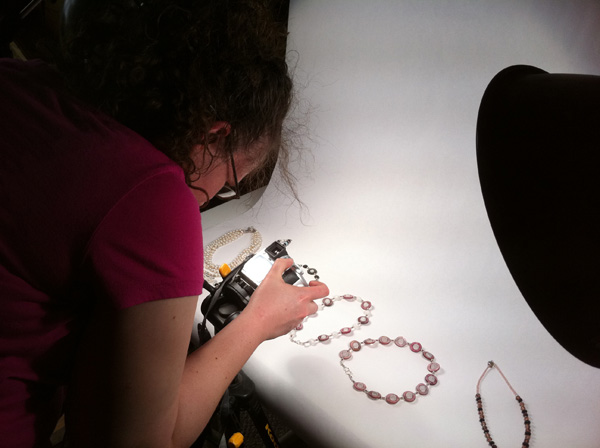
Here I’m trying out different positions for the camera and the jewelry. The camera has a 6X zoom, so it needs to be fairly close to get nice tight macro shots.
Photography in action
I’ve always thought that product photography is similar to taking portraits. Every object has a “face,” even just metaphorically, and a close up of that face is the shot you want for your thumbnails. Here is the “face shot” of Kristin’s pearl necklace:
Close up of Kristin's pearl necklace
Didn’t Kristin do a beautiful job designing this? She let me wear it when I got married, and it looked wonderful with my pink dress.
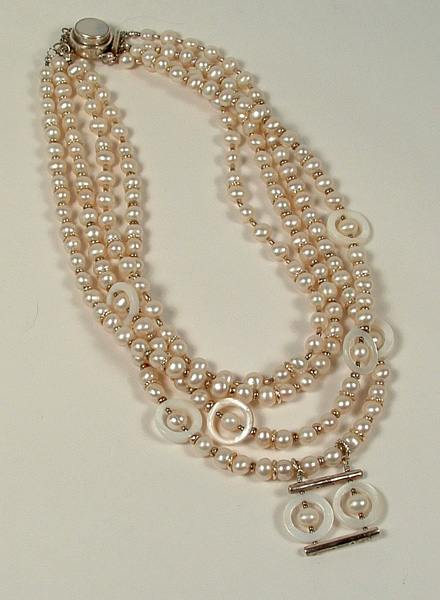
After the face shot, I pull back for the complete object. With necklaces, the challenge is to get the item to fill most of the frame, instead of a mostly white shot. It’s easier with a multi-strand necklace like this.
The full necklace shot
After a few adjustments in Photoshop, the photos are ready to go! Check out the next post for more of Kristin’s jewelry! —Loryn











 the crafty sisters