-Cheri:Craft challenge 2 was a blast. The $5.00 limit adds an interesting twist to the challenge. But I wasn’t too worried about it. Here in Logansport we have a really cool old hardware store. I think they have some of the same merchandise that they had when they opened maybe 60 odd years ago. I spent a good hour pouring over the store, opening drawers and looking in all the little nooks and crannies.
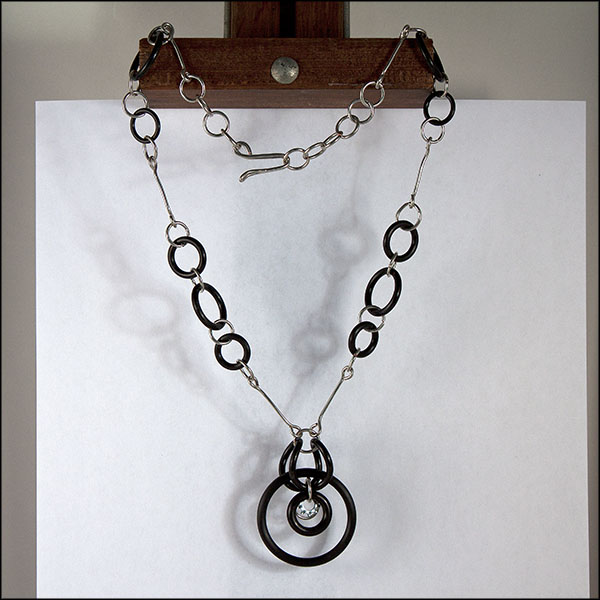
I had so many ideas I knew I was going to have a hard time congealing them into one piece. I have a tendency to overdo things so I decided I was going to get a few items and work with them for a little bit to see what I could come up with. I picked up a variety pack of O rings, a retaining ring, a spring, a small flange washer and wire. I have spent probably the last 20 years making things with wire so I was pretty sure if all else failed, I would be able to make something with the wire.
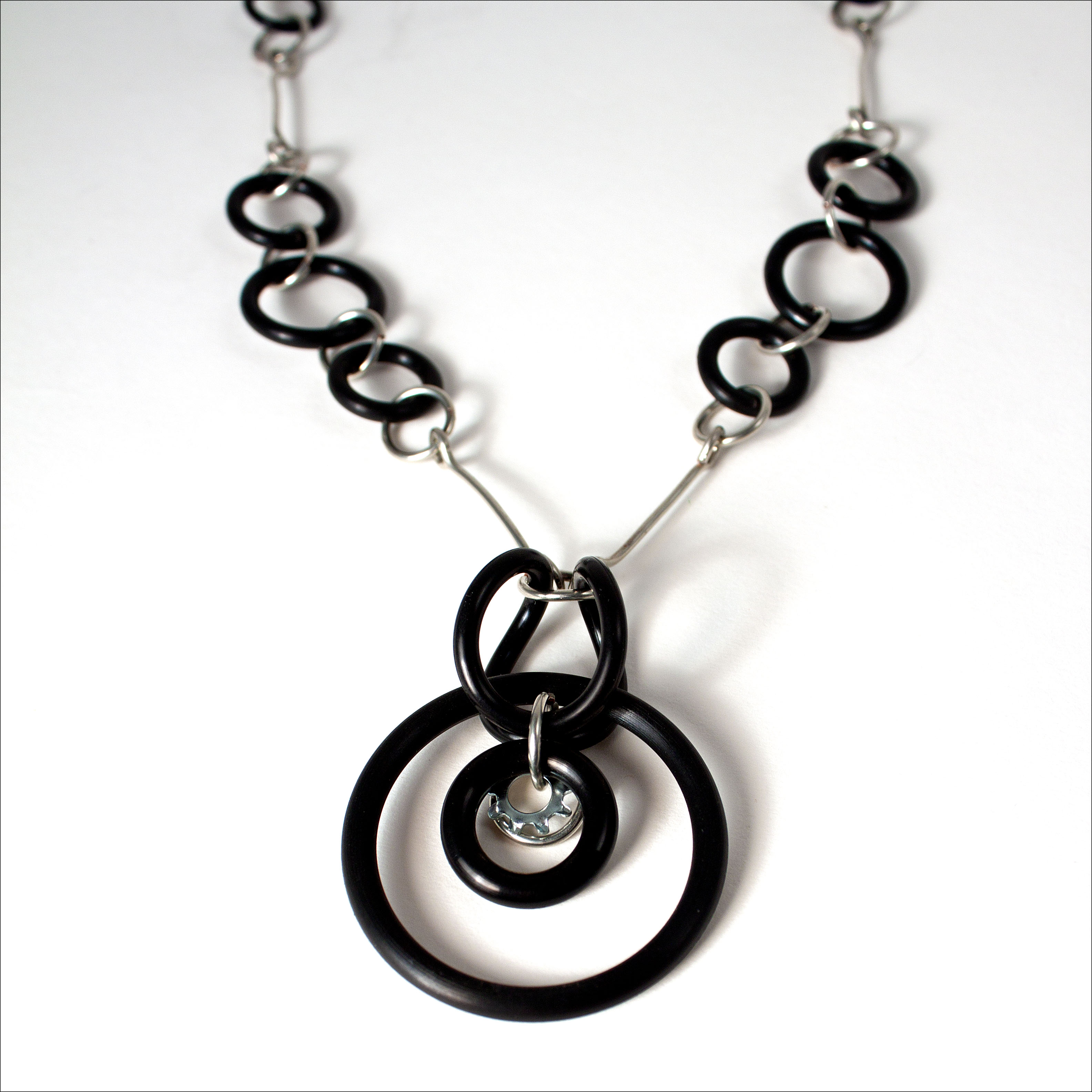
I divided the O rings up into sizes and worked with the large ones to see what I could make. I eventually hit upon the idea of twisting the circles to create a centerpiece for a necklace. I made wire links from wrapping the wire around a pencil and cutting them apart, and formed the longer pieces of wire by making a loop on each end. I was thrilled with the outcome and I think that the hardware store may become one of my favorite places to go for jewelry supplies.
The twisted O ring loop supports the two pendant loops.
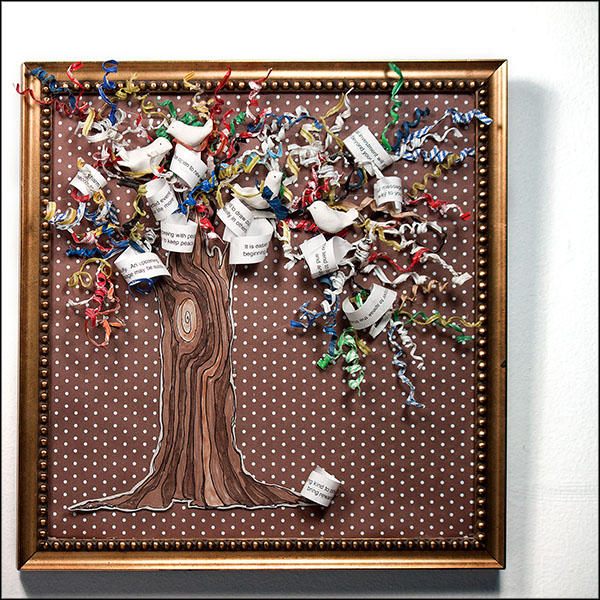
My tree with the fortune cookie leaves and bread twist-tie branches.
Cheri: At garage sales I am usually on the lookout for items that I can use in a collage. I have mentioned before that I like to purchase multiples of small items. My reasoning is; if you have a lot of one item you get the luxury of messing it up and having more to fill in if you really want to try it again. So, I have multiples of various items.
That being said, when you are at a garage sale, do not overlook the free box. This is a great place for multiples. Often, people will collect silly things, like, bread closures, bottle caps, nuts, old nails and the like. I really do not know what makes someone decide to keep these items, but I am always very glad they have.
It was one of those happy instances, when I looked in a free box and there in a bag was about 200 bread wires. They were crinkled up and they looked like a bunch of branches. I had been working on a tree design that I liked and I thought the wires would look great as the branches.
This is how I put together this tree collage. After I placed the branches, I decided the branches needed leaves. I remembered the fortunes that I had been saving from our weekly trips to China Lane (a local Chinese food restaurant). They were perfect for the leaves after I gave them a little curl. The birds were made from Fimo clay and were left over from another project I had been working on. All of the pieces came together and it worked. I really like that when that happens.
Close-up of the Fimo clay birds and Chinese fortunes.
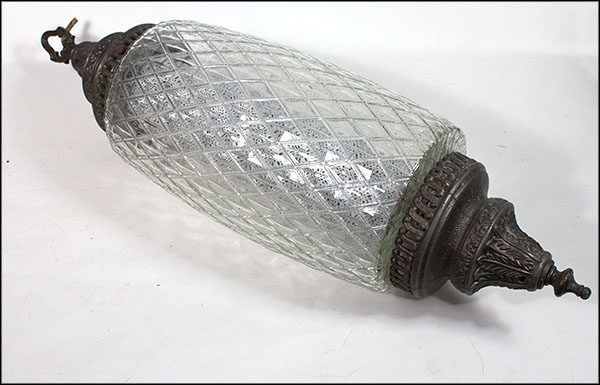
Loryn: These electric hanging lights were everywhere in the 1960s and 70s. I have had this one in storage for a while. I like the look of it, but I hate the 15′ of cord trailing to an outlet that comes with it. It was poised to go to Goodwill until I realized that a battery-operated candle would be perfect for it.
Disassembly
Here I’ve started disassembling the fixture. I cut off the (unplugged!) cord and removed the top metal portion. The bottom metal portion also comes off by twisting off the finial at the bottom. I’ll save the perforated metal diffuser for another project.
The original socket and the replacement stem
I also wanted to remove the socket and replace it with a shorter stem (needed to hold the hanging loop on). I happened to have a shorter piece of lamp pipe to replace it with. You could cut the existing piece off with a hacksaw instead.
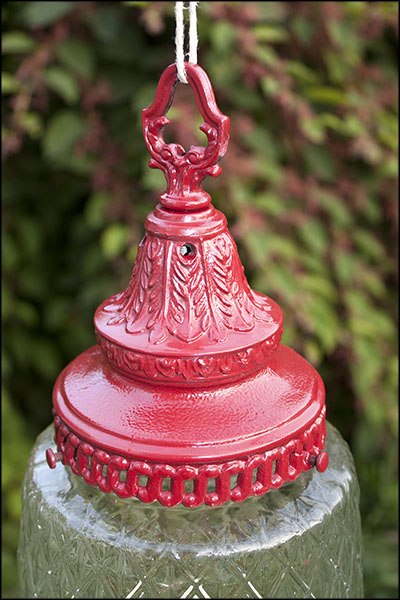
The next step was to thoroughly wash the metal parts so I could spray paint them. I used Krylon’s Colonial Red, which is a gorgeous deep red. Then it was simply a matter of reassembling the lantern.
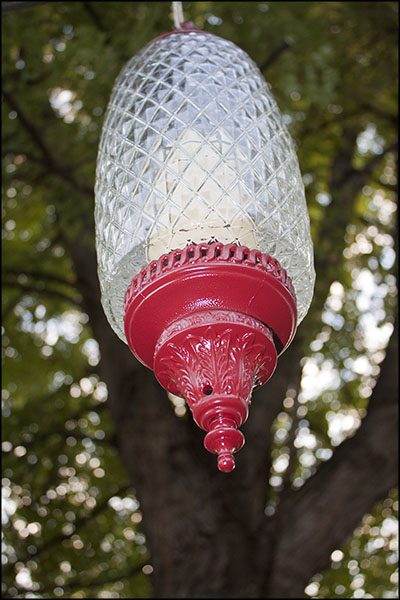
And here is the finished lantern! The battery operated candle is great because you can put it in places that don’t get much air. I thought a remote control for a candle was silly until I came up with this use for it. The lantern will hang close to the ceiling, and the remote makes it really easy to turn on.
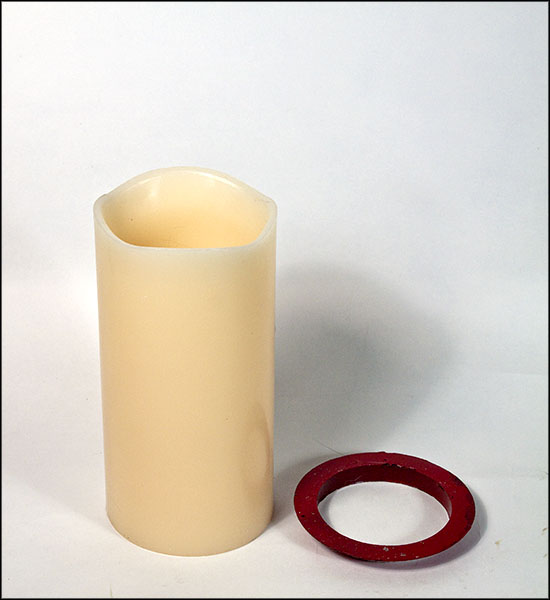
One last thing: The lantern had a washer at the bottom of the glass shade, so the candle couldn’t sit flat. I found a large rubber flange in the plumbing department of my local hardware store and spray painted it to match. Now the candle will sit flat, and it isn’t very noticeable.
Painted flange to sit the candle on.
The finished lantern will go in the hallway outside my guest room, to make a night light for guests. I’ll show it when I get the artwork up in the finished hallway!
Loryn: For the past few weeks, I’ve been working on fixing the plaster in my upstairs hallway. You can see more about the project in my previous post. In the past three years, since I started remodeling my house, I’ve gone from a complete beginner at finishing drywall and skimcoating old plaster walls to being pretty proficient. I’ve been w I made a lot of mistakes, and here are a few to avoid!
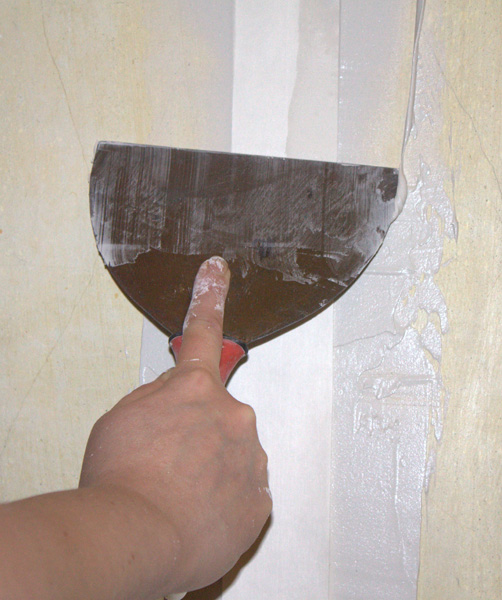
To place paper tape: The trick to applying paper tape without any bubbling is to lay a fairly thick bed of mud under the tape. Then, place the tape and run your knife along it, pressing the tape very firmly into the mud. You’ll remove most of the mud when you do this.
Keep your knife at a very sharp angle most of the time when you’re working.
When putting topcoats on your seams, it’s much better to use too little mud than too much. You can always put more on, but it’s a pain in the neck to sand away too much.
After your first top coat, put on just enough to fill in the dips and voids of the first coat. To get a smooth finish, pull very firmly on the surface, with your knife at the sharp angle.
Don’t keep working and working the mud, you’ll just make it even worse and increase the chance that you’ll get some debris in it. It’s better to fill in on the next coat than to botch a passable coat.
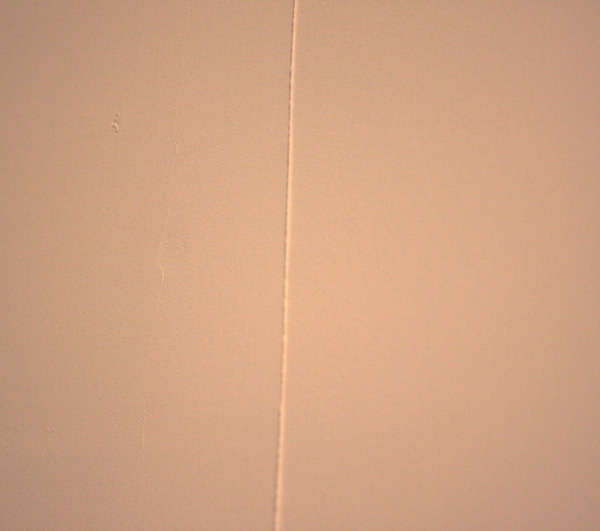
If you have a wide area that you can’t get smooth, leave narrow ridges, like that pictured above, between knife passes. These are really easy to knock down when dry—just run your knife over them.
Expect the process to take more than two topping coats while you’re learning. Continue to fill in small dips until you have the surface fairly flat, and don’t worry about the number of coats you’re putting on. This isn’t the type of job you’ll finish in one day. Instead, work a little bit over several days.
If you have bubbles in your drywall, mixing can help. The best way to do this is to mix it with a half inch drill and a mixing paddle, if you have them handy or can borrow them. This can get messy, so do it somewhere like an old back porch. A pro recommended that I mix a little dish soap in, too. I don’t know if it is the mixing or the soap or both, but I have far fewer bubbles now! And speaking of pros:
If you have any chance to watch pros at work, take it. I learned more from watching a pro for twenty minutes than I did from many hours of website searching. If you know one who will demonstrate technique for you, all the better!
Use specialty cornerbead to help you get good corners. Bead for outside corners is an absolute must for beginners, as it will make your corners look perfect. If you are doing cathedral ceiling, buy special tape for odd angles. I use Strait-Flex tape. It’s pricey, but worth it, as even experienced finishers can have trouble with odd-angled corners. It’s also great for 90 degree inside corners with wide gaps (great if you, like me, are not very good at drywall hanging).
Finally, the very best way for a beginner to get good results is to use flat paint. Really! In old houses, with unsquare corners, rough plasterwork, and layers of wallpaper, flat paint is a necessity. It absorbs light instead of bouncing off every dip and flaw. It is not washable like satin or semi-gloss (though it is more washable than people think), but it more than makes it for that in touch-up-ability. You can touch up small areas of flat paint without leaving any sign of the touch up. Just use a mini roller, and you’re done in no time flat.
Lynne: I was checking the blogs I read and I noticed that Teri Partridge of the Pear Tree Gallery has this wonderful watercolor tutorial up on how to make a greeting card of beautiful bleeding hearts. I’m getting my paints together for a go at it myself.
Loryn: One of the downsides of owning a 100+ year old house is the 100 years of wallpaper layered on every surface. When I first bought the house, I had grand ideas of removing all of it and skimcoating. These delusions ended after it took a few months to strip four rooms—rooms covered in up to fifteen layers of wallpaper, wallpaper that came off inch by frustrating inch. The house has fifteen rooms total, many of them large Victorian rooms with ten foot ceilings, and even my helpful, crafty family just doesn’t have that much enthusiasm!
Since then, I’ve started painting over the already painted wallpaper as a compromise to make the house actually livable. There are a few places, though, where the wallpaper is already peeling and has to come off. The end of my upstairs hallway is one of those places. Above, you can see it in progress. I don’t have a before shot, because I started taking the paper down PB (pre-blog).
There are a lot of methods out there to remove wallpaper, and we’ve tried most of them. The top layer of paper scraped off easily, and I just used hot water on the last layers that didn’t want to come up. Since this is antique paper (not vinyl), the water brings it up pretty easily. (That’s easy on a wallpaper removal scale, which ranges from repetitive annoyance to utter misery).
Here it is, ready to begin patching the plaster. Most of the paper on the right wall was adhered firmly, so I’ll be leveling it out with drywall compound, rather than removing it all. Expediency rules! In this shot, you can see the back stairway, and the doorway to the guest room.
The first thing that I needed to do is to patch a large area where the plaster has pulled away from the lath. I’m planning to use this niche to display artwork, so I need flat, sturdy walls.
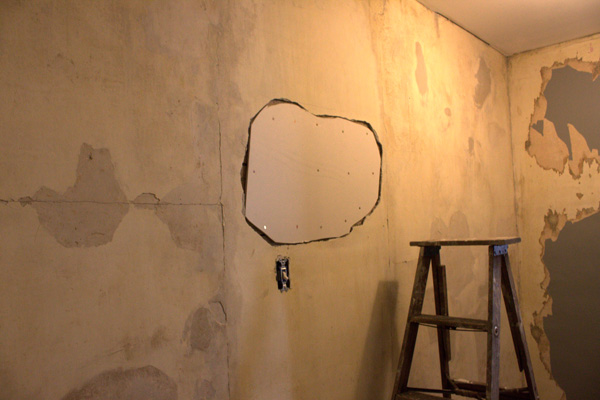
Here is the patch in place. The “proper” way to make this repair would be to cut a square out of the plaster and insert a square patch. I even have a Dremel Multimax that will cut plaster. One small cut in plaster, though, will ruin a $14 blade. Since plaster is hard to cut and drywall is very easy to cut, I’m taking this route! I pulled out the loose plaster with a hammer, and left the lath in place. I made a template by tracing the shape onto brown paper. I used 1/4″ drywall, which matches the plaster pretty well.
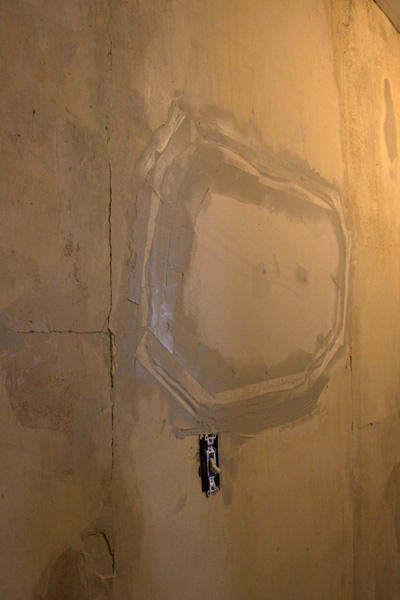
And here is the patch again. To fill in the gaps, I used setting compound or “hot mud.” It’s more like real plaster, in that you mix it yourself, and you have limited time to work with it before it sets. It’s good for filling in large gaps, because it doesn’t shrink like drywall compound. Also, it cures much faster, so you can keep working. I usually use 45 minute compound, but you can also get 20 and 90 minute. I also used paper tape over the seams.
Once that was done, I was ready to start using drywall compound for other cracks and to smooth out some old and uneven plaster repairs. Purists use plaster to repair old plaster, but I’m happy enough with the drywall compound, and it saves many steps. Expediency again!
And here it is with the cracks taped and rough spots leveled. I still need to tape the ceiling seams. A previous owner hung drywall on the ceiling in the not-so-distant past. Unfortunately, their finishing job was pretty bad. They embedded the tape, and never used any topping coats, so the seams look terrible. The tape was also on top of all the layers of wallpaper, so I just pulled it off. I’ll end up redoing all of the seams eventually. Tomorrow, I’ll do that seam and put the first topping coat on!
So, why fix this plaster instead of just demolishing it and putting in drywall? Well, I happen to love old plaster. New drywall just doesn’t compare with the substance of original plaster. This wall was in good shape, with two main vertical cracks. Overall, the amount of finishing I’ll do is not much more than I would if I put in new drywall. Plus, not having to haul all the old plaster out and carry in new drywall is a relief to my back.
I’ll be back tomorrow with an update on this project! If you’re interested in learning more, I used the site www.plaster-wall-ceiling-solutions.com to learn all about repairing plaster. His tutorial was very helpful!
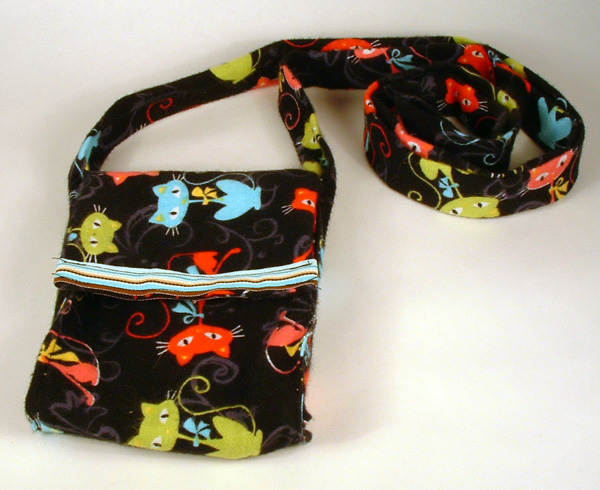
Cheap tricks are great and most of the time, they are things you just don’t think about, you just do them. Today, I did one that I had to think about. I love lounging around my house in comfortable clothes. However, very few of those pajama type bottoms that are the perfect lounging wear actually come with pockets where you can stash your phone, and since I like to listen to audio books and music while working around the house, I definitely need someway to carry my phone around. Hence, I created the Kitty Bag (named after the fabric I used, not the actual application of the bag, although, if the Kitty Bag were big enough, our cat, Jamison, probably wouldn’t mind being carried around in the bag too).
I bought this absolutely adorable, kitty-patterned flannel some time ago. It was just too cute to pass up a few yards and was on sale to boot.
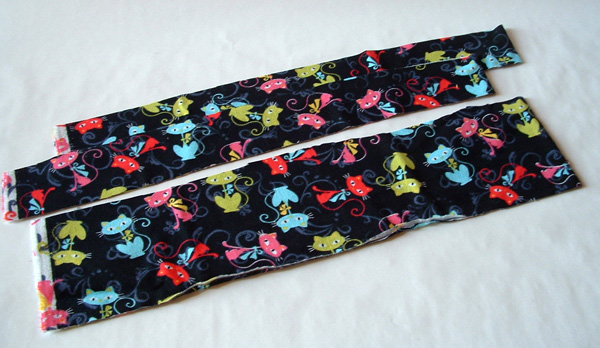
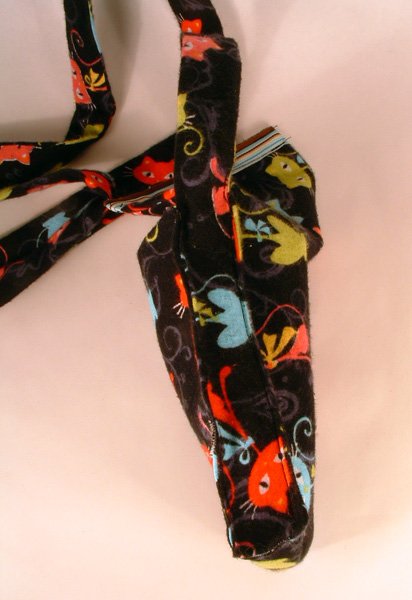
You can see the three pieces I cut out of it today. They are all cut selvage to selvage (45″). I then sewed the long, thin strips at one end, right sides together. Then I sewed this even longer strip into a tube, again right sides together and turned it for the handle. The last piece of fabric (which is about 1″ wider on each side than my iPhone) I also sewed right sides together, leaving the selvage side open to turn the fabric through.
Next I ironed the two pieces (thank you Loryn for stressing ironing projects, it really does help). After determining the length of the handle (the handle is actually sewn all along the sides of the bag, so it needs to be long enough to go from the bottom of the bag over your shoulder and back to the bottom of the other side of the bag) I ended up cutting off about 3 inches on each end. I made the bag to go across my body, not just over my shoulder. Then I sewed the handle in, starting with the front panel of the bag, down and around to the bag with only about a 1/8″ seam. I did the same thing with the other side of the bag. This created a flap of the extra body fabric.
I needed to decide how much of a flap I wanted and I also wanted something to weight it down a little and after digging through my supplies, found a pretty ribbon that looked perfect with my neon kitties. I cut off about three inches from the flap and turned it under and wrapped the ribbon all the way around and sewed two seams, one towards the top edge of the ribbon and one at the bottom. This also has the benefit of closing the opening left from turning the fabric.
All-in-all, this was about 1/4 yard of fabric (if even that much), 6″ of ribbon, black thread and some time, all of which I had on hand today. It was done very quickly (about an hour) and works just perfectly. It is also big enough to hold my ear buds and hangs just at my hip when wrapped across my body. Then flannel lining helps protect my phone from damage or anything else I choose to stuff in it.
Well, time to get some housework done now that I can carry my phone around and bop to the music. Have a wonderful Saturday!
P.S. Sorry about the odd lighting effects, I just got my very own studio lighting and haven’t quite got them where I want them.
Lynne: I was looking at the blogs I have subscribed to and came across this new addition to Teri Partridge’s blog. I like how sure she is about placing the lines of the drawing. I’m still using scribbles to place the first lines. Anyhow, check out her video for Watercolor Whimsey part A. I can’t wait to see the rest.
Loryn: If you’ve been wanting to improve your sewing skills, this article kicks off a series of articles on how to make simple home dec projects really shine. Most home decor projects, like curtains, pillows, and bedskirts, are just simple rectangles, so it’s the details that make them special. These simple curtains look good because of three basics:
Pressing
Lining
Edgestitching
I started sewing when I was about five years old. I made project after project after project, drafting my own patterns and getting wildly creative. The one thing that I didn’t have any patience for was the finishing details. My work was sloppily finished until I saw the projects a friend of mine produced. She wasn’t an experienced sewer, but her simple projects were so beautifully finished that they looked great! It finally sank in that all the creativity in the world didn’t pay off if I didn’t pay attention to the details. If you haven’t been quite happy with the results of your sewing, read on for tips you can apply to any project.
If you only apply one tip to your sewing, it should be pressing. Pressing every seam open may seem like a lot of fuss, but the results are worth it. I set up one end of my work table as an ironing board so I don’t have any excuse to skip it. Because I’m cheap, I just throw a folded towel down and iron on it, as it gives me a lot more surface area than an ironing board.
These curtains are lined, as unlined feedsacks are thin and don’t give a lot of privacy. The lining also helps the curtains keep those nice folds at the top. My favorite source for linings are old sheets. This lining is made from new in package vintage fitted sheets that were too small for thick modern mattresses. If you see at garage sales, be sure to pick them up! Here you can see the difference the lining makes:
To make the lining, I sew the lining and and the main fabric (right sides together) around three sides like a pillowcase. Press the stitched seam, then turn the curtain right side out. Use a pin to get your corners pointy, then press the edges again in preparation for edgestitching.
The edgestitching makes precise edges that look great. I use the 1/8″ mark on my machine’s throat plate to keep the stitching line precise. If your edgestitching is not as straight as you’d like, keep your attention on the 1/8″ mark and keep practicing! Edgestitching around the three seams, and then you’re ready for the hem.
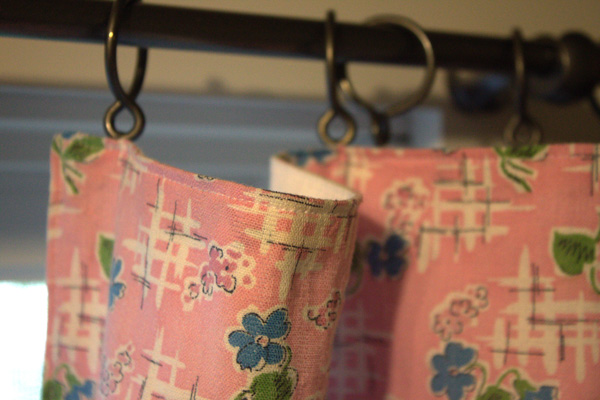
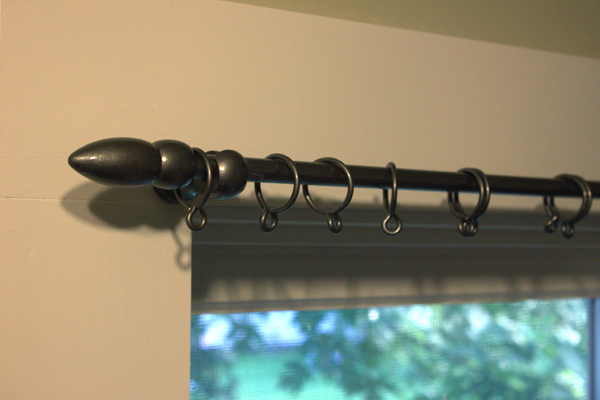
To get the best results, hang your curtains on the rings, and then fold a standard hem. I sewed two lines of stitching. This makes a firm hem that makes a flippy curve along the bottom.
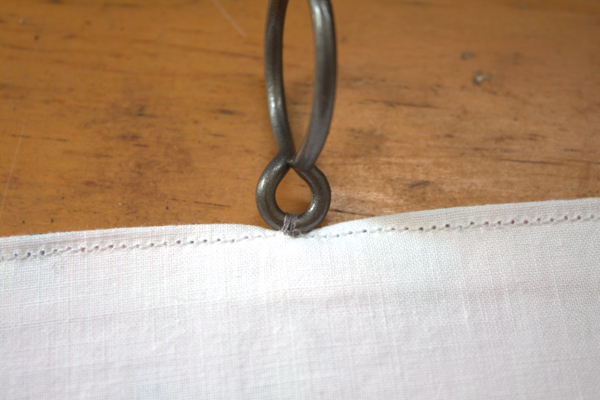
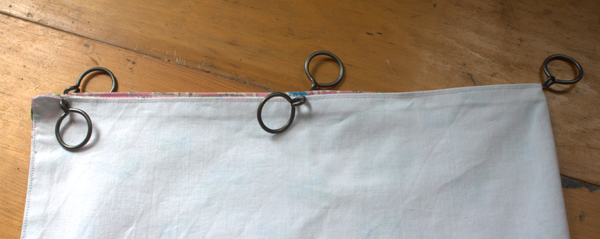
Here you can see how I’ve tacked the rings to the curtain. Clips would also look nice, but I have a large supply of vintage cafe rings.
The rings are brass, which doesn’t go with my kitchen/laundry room, so I spray painted both the rings and the rod:
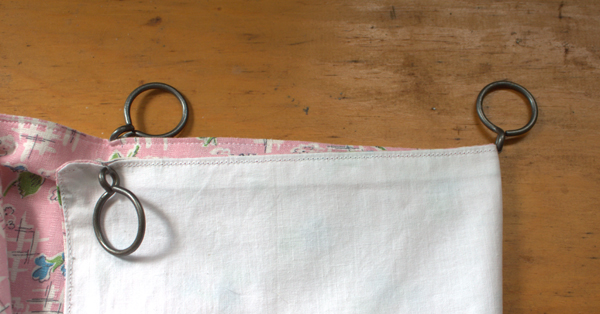
Here’s a simple way to get your rings or clips evenly spaced. First, always use an odd number of rings. Sew or place the rings at the ends, then fold the curtain in half, lining up the rings you just placed. Place the middle ring at the fold mark.
Then quarter the curtain by lining up the end ring with the middle ring. The fold is the spot for your next rings. Do that on each side. For small curtains, I use five rings for each panel.
After one final pressing, the curtains are ready to hang.
I hope you’ve found a few tips that will be helpful. Check back soon for another post on how to upgrade your sewing!
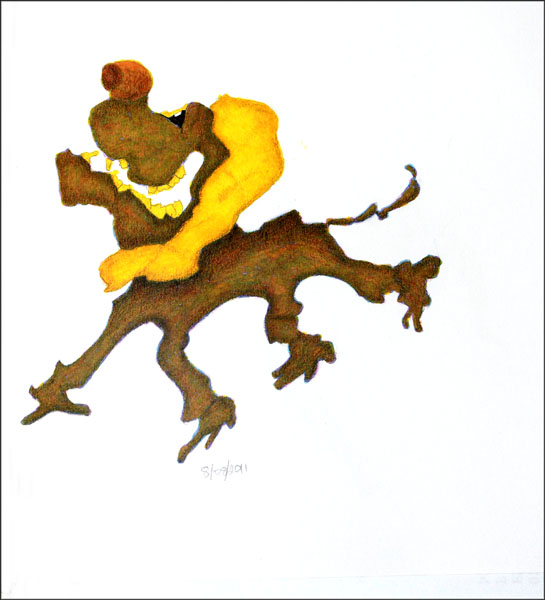
A squiggle that has been built up with markers and then shaded with color pencils.
I have always wanted to be able to draw, but a very early life experience with a football coach posing as an art teacher had me convinced that I was no artist. (In my early years I went to a school that had all the grades together. The rough chastising that must have worked with teenage boys did not have the same effect on a first-grade girl-child.)
In the last several years in an effort to shake the coach’s gloomy prognostications, I have taken drawing lessons. I found the Pear Tree Gallery and Teri Partridge, an artist and teacher, who is bound and determined to make everyone an artist. (Ask anyone who has passed through Columbia Middle School and they will tell you the same. This is not to imply that I am young enough to have had her as a teacher when I was a student there.)
One of her oft repeated lessons (the one on drawing shapes has to be most repeated) is the importance of shading and shadow. What I came to realize after Teri had patiently repeated it over and over was that where I had thought my drawings were simply terrible, in reality they were simply not finished. I came to realize that there is a world of difference between the first set of marks you put on the paper (shapes, always remember) and the last set of marks you put on the paper (shading and shadow.)
Now, after several years, I can say that I am competent with pencil and paper. My black and white drawings look enough like the real thing to make me think some of Teri’s lessons have sunk in. However, I wanted color and unfortunately it did not want anything to do with me. I simply did not know what colors to use. My watercolors did not mix well, I did not like acrylics and oils did not look simple enough..
Finally, after wandering with much self pity among those many did nots, I came across this quote by Johannes Itten, a teacher of the Bauhaus style of art in the 1920’s;
If you unknowing, are able to create masterpieces in color, then unknowledge is your way. But if you are unable to create masterpieces in color out of your unknowledge then you ought to look for knowledge.
With that unsubtle nudge, I decided to seriously look at how color works. Some people know immediately what the primary colors are and their relationship to secondary and tertiary colors, but I have to plod my way through color theory and keep a color wheel beside me. (The Color Chart blog is packed with information about color schemes and theory.)
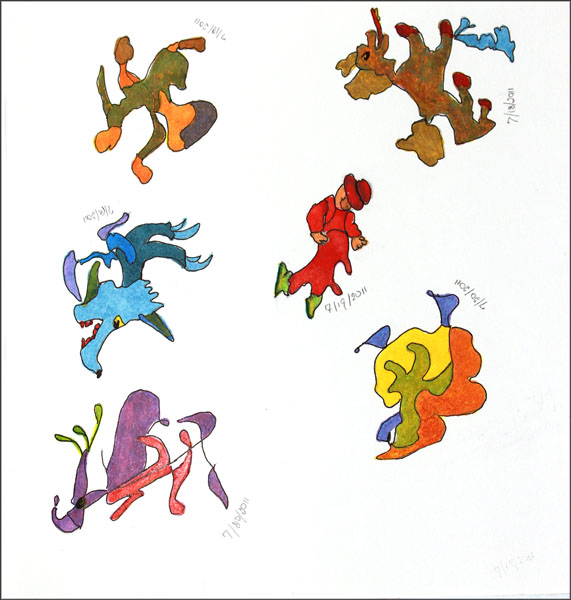
I was snooping through Cheri’s shelves one day and found a book called Drawing Lab For Mixed Media Artists by Carla Sonheim. There were 52 exercises to make drawing fun, but the one that really caught my eye was scribble drawings. The exercise consisted of making a scribble, just a random mark on the page and then looking at it every which way until something popped out. An arm, a leg or even an eye would peek at me just like the face and vase optical illusion that tricks you into seeing one and then the other. The best thing was that these were the types of doodles I did as a child (frowned upon by a certain football coach) and I had been seeing things in scribbles for years.
What I did not know was that scribble drawings were my eureka moment to color. They only needed a simple color scheme and with the color wheel I could pick the scheme I wanted before I put a marker to paper. As long as I stayed with the predetermined choices, I could play without the fear of a terrible muck up.
I have named these scribble drawings squiggles because squiggle is an artistic term for the short curves and twists that I end up with when I scribble. The sketchbook pages posted below are the first squiggles I did and I have included three photos of the progression of a scribble to a squiggle. The drawing at the top of the post is what my squiggles are starting to look like now. I add lines and take away lines and use a combination of markers and color pencils to create the shading and shadows. Squiggles are my eccentric way into the world of color and imagination. And who knows? Someday, I may pick up a brush and not muddy the watercolors.
-Lynne
These are all done with markers.Separating one squiggle into two allowed me to think about erasing lines.I have started to turn the sketch book in all different directions.The result of a random scribble.The random scribble turned into a figure.The finished drawing. I used color pencils and marker in a primary blend of red, blue and yellow.















 the crafty sisters
