Category Archives: DIY

Learn to Draft a Simple Bag with this Pattern Tutorial

Simple grocery bag pattern

Loryn:  If you’d like to be able to create a simple bag or purse pattern in any size you want, this tutorial is for you. I created the pattern to make a set of grocery bags, but you can make them any size you want! The grocery bags are a nice place to get started, though, because they are unlined, with a simple handle, and even if they’re not perfect, they’ll still eliminate the need for a plastic bag! I’ll go over bag assembly in a second post, and I’ll show a gallery of design changes you can make in a third post.

To get started, you’ll need:

  • Paper large enough to draft the pattern. I like the weight of cardstock, so I just taped four pieces together.
  • A pencil
  • A ruler (a 6″ quilting ruler is handy).

Step one to draft your bag pattern

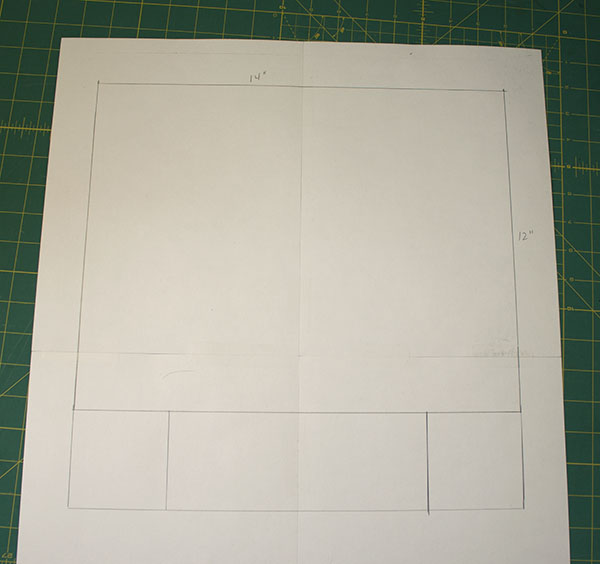
The first step is to determine how wide you want your bag to be across the top (this shape is narrower at the bottom). I decided on 14″ for my grocery bag. Then, determine how tall you want it to be. This bag will be 12″.

Once you’ve decided on the size, draw a rectangle the width and height of your bag. Mine above is 14″ by 12″. Leave room on all four sides for seam allowances and hems, which we’ll add later.

Step two to draft a simple bag pattern

The next step is to determine the depth (width across) of your bag. Add a second rectangle that is half the size of your desired depth. I want my bag to be 6″ deep, so I added a 3″ rectangle onto the bottom of the first rectangle. If you want a 4″ bag, add 2″, etc.
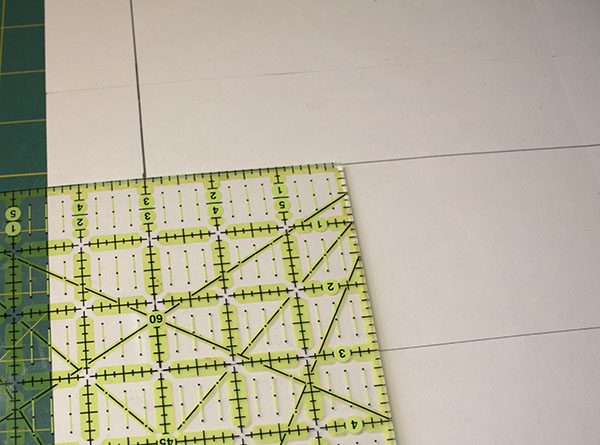
Next, you’ll mark out the corners that will be cut off. The size of the corner is a square, the same size as half the depth of your bag. Since I added a 3″ rectangle, I’ll mark out a 3″ square on each side.
The two outside corners will be cut off. You can achieve a similar result by making a bag the size of the total rectangle, and then sewing across each corner. I prefer this method because it is much more precise and it makes it easier to make your corners exactly the same size.
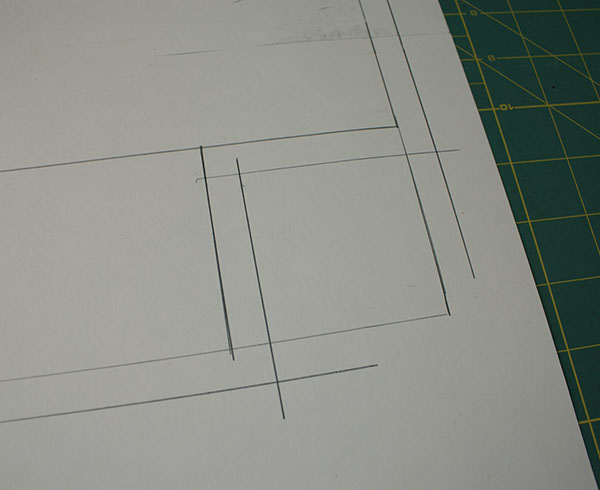
Next, you’ll add seam allowances. The translucent quilting ruler makes this easier. I added 1/2″ seam allowances, and the size will depend on your seam finish. In part 2 of this series, I’ll use french seams to assemble the bag. You might want to add 3/4″ seam allowances if you plan to use this finish. I also added only 1/2″ to the top of the bag. I recommend adding more for a hem allowance, at least 1″.
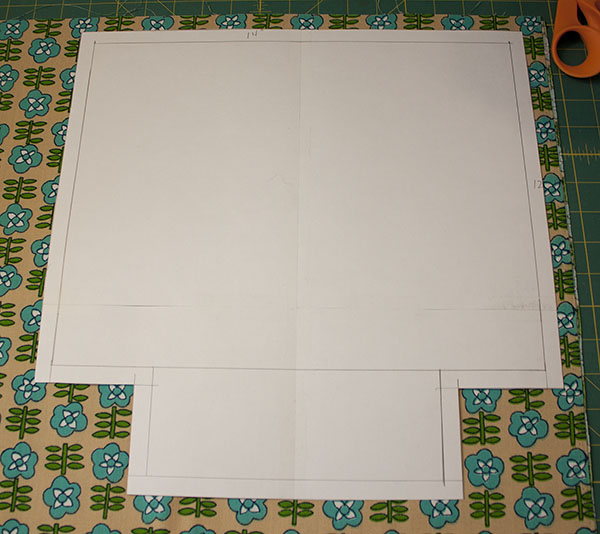
Now you’re ready to cut your pattern out and prepare to cut your fabric! I’ll go through bag assembly in part 2 later this week.

After I assembled my first bag, I discovered that 14″ really is not wide enough for a grocery bag. I measured one of my plastic ones and discovered that they are more like 18″ wide. Luckily, there is a simple way to add width to the pattern without starting from scratch. Just cut it in half like this:
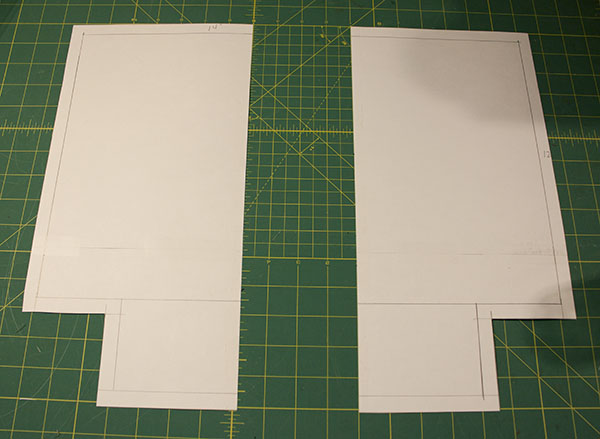
Then add more paper in between to get the size that you want.
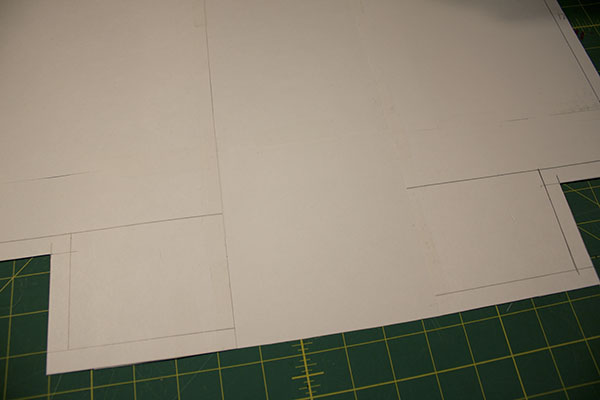
Now you’re ready to cut out the larger pattern.

For the grocery bags, I made a simple handle from a 20″ by 4″ wide strip, two for each bag. I made one 14″ bag, and three 18″ bags. The smaller bag is perfect for holding the other three when they’re not in use, and it’s also nice for trips when I only pick up one or two things.

I’ll be doing a second post on how to assemble the bags and a third post on all the different designs you can make from one pattern. Check back early next week for more!

–Loryn
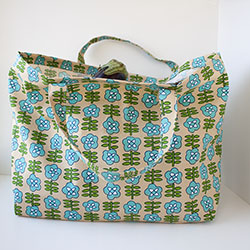
Draft a simple grocery bag pattern

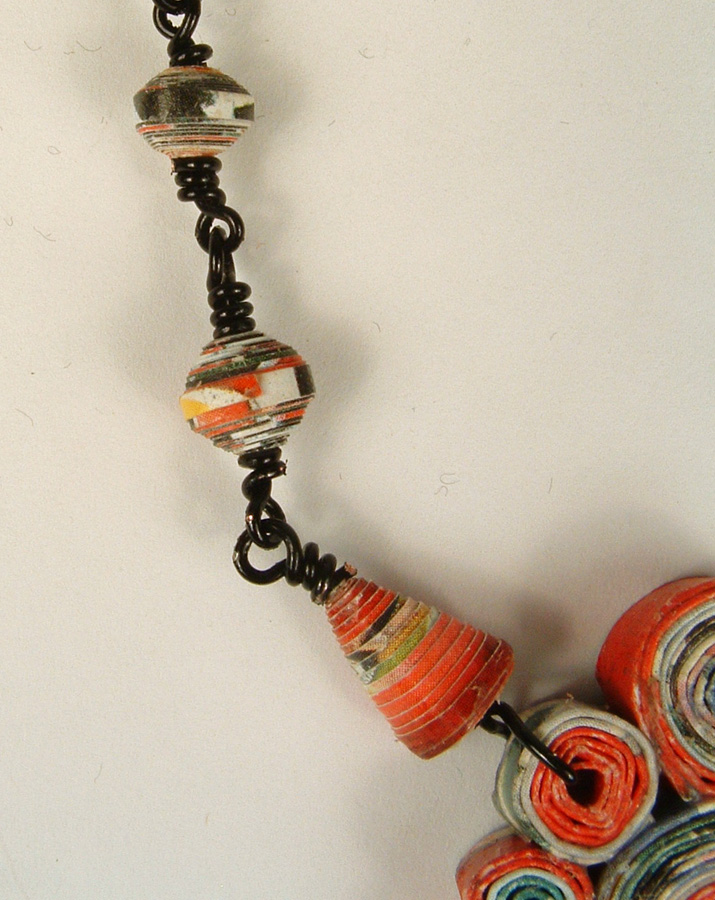
Rolled paper pendant made from Matisse paper.

Matisse Paper Bead Necklace

Rolled paper pendant made from Matisse paper.
I am so happy with how the pendant turned out.

Over the holidays, I visited Half Price Books with a specific project in mind. I wanted to make rolled paper beads. To do this, I needed a coffee table art book. (Yes, I, the bibliophile, was planning to desecrate a book.) My favorite artists are Picasso, Modigliani and Matisse and I was able to find a lovely Matisse art book. Flipping through it, I was able to find a couple of images that I liked. I ended up choosing Plum Blossoms, Green Background, 1948. It is a lovely painting and has these reds and greens that would show up really well in my beads.

Rolled paper beads wire wrapped to form a necklace chain.

I did manage to cut out the page that I had decided to use (it hurt only for a minute). I cut the strips and flags that I wanted and started rolling around a yarn needle and pin. I used Aleene’s Tacky Glue (that wonderful, all-purpose craft glue) to glue the ends of the strips down.

Rolled paper pendant.

For the pendant, I folded the 1/2″ strips in half so that the color could be seen from the front. I also covered the back of it with Tacky Glue to give it better stability.

Rolled paper beads wire wrapped to form a necklace chain.
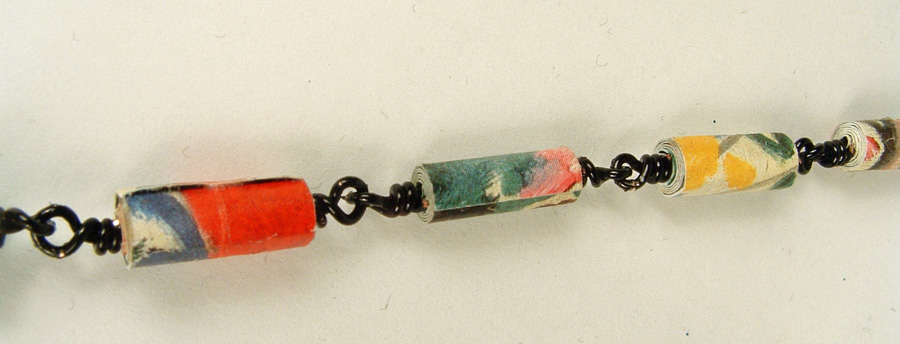
These are 1/2″ strips of paper rolled straight.

I really liked the rondelles, but did not want them to go all the way around the necklace, so I made straight cylinders to finish out the necklace. I wire-wrapped all the beads, made a clasp and I was good to go. For the wire, I used copper coated black wire.

Rolled paper bead necklace.

This is just a study and is not meant to be worn regularly. I do like the pendant so much that I will probably make another one and coat it to make it more durable to regular wear. This process is so much like quilling, that I could probably use some of those techiques to improve my beads if I continue making them.

This is a huge step from the rolled paper beads we used to make as kids. You know the ones.

Rolled paper pendant.

Happy crafting from Kristin!

Upcycled Cashmere Sweater Scarves

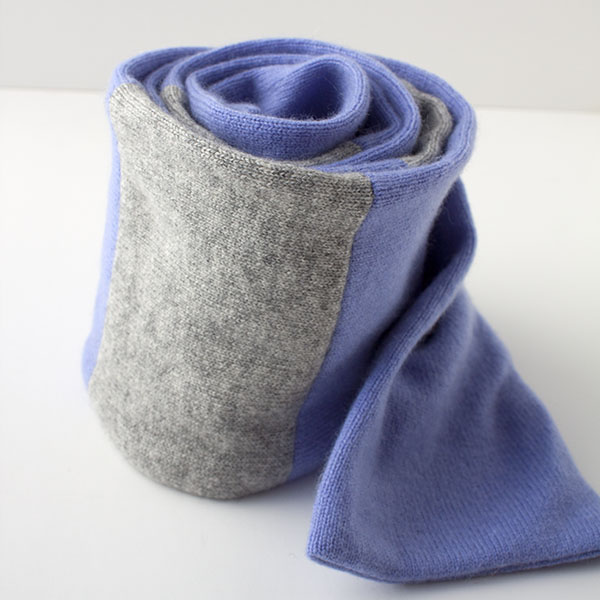
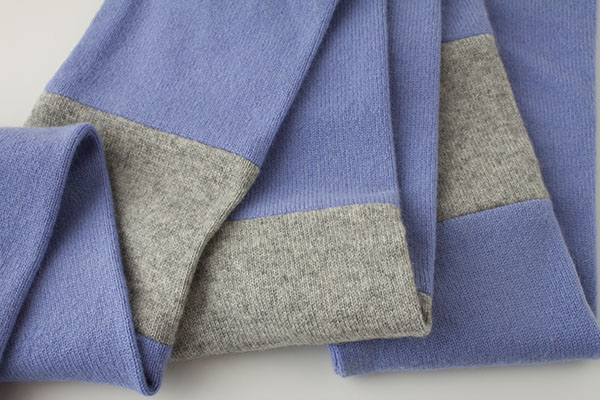
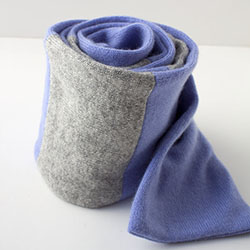
Cashmere scarf made from upcycled sweaters

Loryn: We Crafty Sisters bounce a lot of ideas off of each other, and this cashmere scarf design was the result of a great collaboration. My stepdad (Lynne’s husband) asked for a cashmere scarf for Christmas. Lynne found one for $55 on Amazon, but she was sure there was a thriftier, crafty way to make one.

She and I started brainstorming. I did have a stockpile of thrifted cashmere sweaters to take apart for yarn (see my yarn post here), but she didn’t want to knit a scarf. What about sewing a scarf from the sweaters? The sweaters aren’t big enough to make a complete scarf without seams, making stripes ideal. A tube design hides all the seams and makes a double thickness that feels wonderful. Lynne took several sweaters to experiment with, and came back with this:

Gray cashmere scarf made from an upcycled sweater

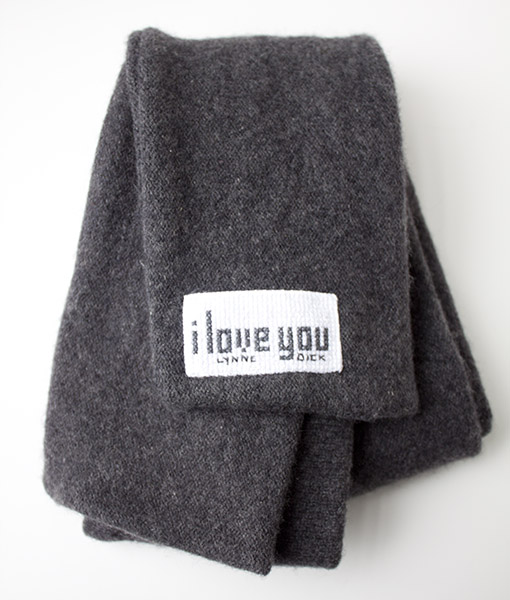
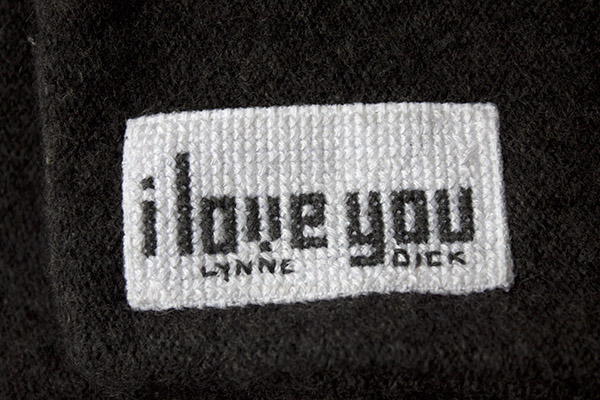
She made it in one solid color for an understated look. The fabric came from a vintage Scottish cashmere vest, so it is the most unbelievably soft scarf you’ve ever felt. She also made the fantastic cross-stitch label:

Cross stitch label for scarf

I loved the scarf so much that I immediately began planning to make a few of my own. Here are the steps:

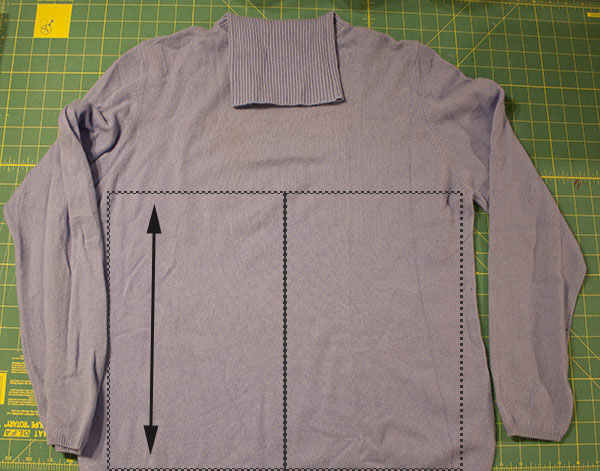
Lay out your sweater so you can plan your scarf. I used four rectangles from each sweater, two from the front and two from the back. The width will depend on the size of your sweater. For this Medium size, I made each rectangle 9 1/2″ wide and 13″ long (up to the armscye).

The scarf will be less likely to stretch out of shape if you keep the rectangles aligned with the vertical length of the sweater (the direction of the arrow). If you cut the rectangles in the other direction, they will stretch more. This rule can be broken like any other, though, so experiment away!

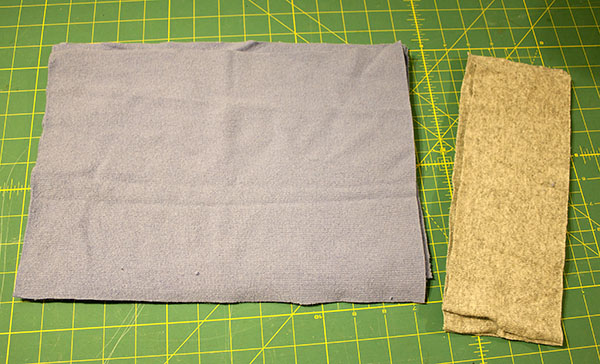
In addition to the four rectangles from the blue sweater, I also cut three 9 1/2″ by 4″ rectangles from a gray cashmere sweater. Again, keep the stretch of the knit crossways to your pieces.

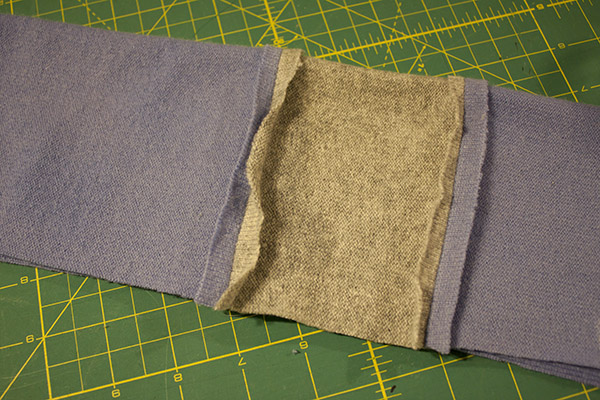
In this step, I’ve sewn the stripes together on the 9 1/2″ edge, alternating colors. Press the seams open when you’re done. Then, fold it in half and sew across one short end, down the long side, and turn the corner of the other end, leaving a small opening to turn the scarf. Turn it, and slip stitch the opening shut (see a slip stitch tutorial here). I gave it another pressing, and it’s done!

These scarves are very quick and easy, and we’ll be whipping up a lot of them for gifts and for ourselves!!

–Loryn

Roman Shades: What to Do When Things Go Wrong

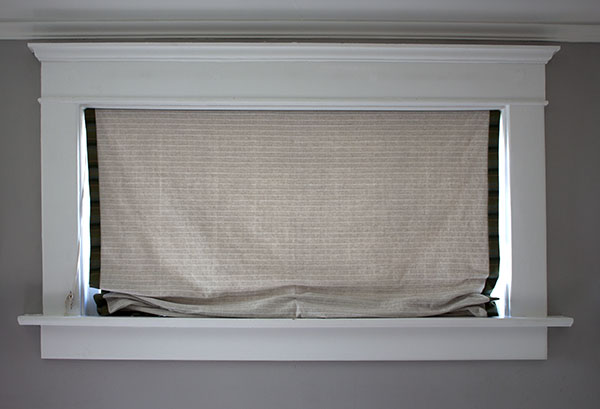
Roman shade

Loryn: No matter how much crafting experience you have, things often go wrong when you’re designing a custom project. The trick is not to get discouraged, and use your creativity to come up with a solution!

Roman shade

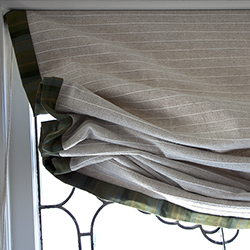
I’ve been wanting roman shades for my living room, and I thought I would get started on this window because it is the smallest of the three (it’s a Victorian house, so the window panes on the downstairs windows are over 6′ tall on most of the windows). I just needed one piece of fabric that was 55″ wide by about 40″ long. What could be easier than that? Famous last words!

Linen cotton fabric

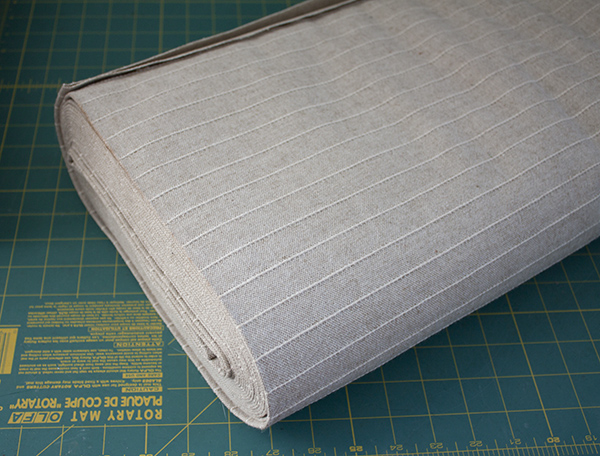
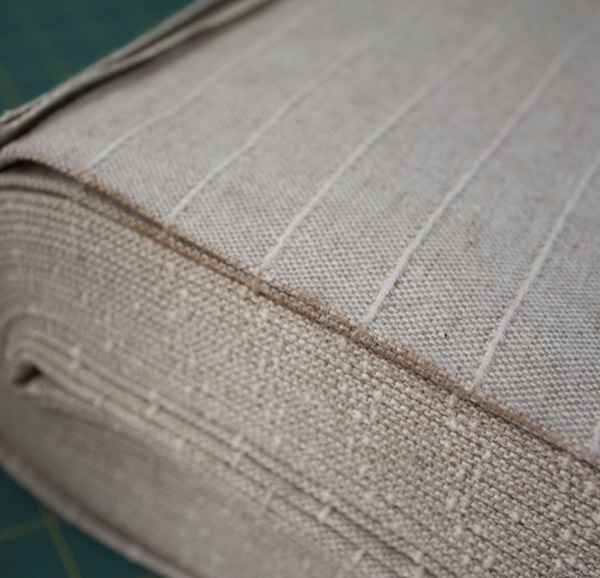
For my fabric, I have a bolt of upholstery-weight linen cotton fabric that I picked up at a garage sale for $10. I bought it specifically for these shades. I love the horizontal woven stripe. The fabric is 56″ wide, so I had one inch to spare for a hem.

First check. After I cut the length I needed, I discovered this stain along the folded edge of the bolt. I need every bit of this fabric for my three windows, so going down to the unstained part of the bolt was not an option. No problem, I’m used to getting stains out of vintage fabrics. I soaked the fabric in Biz (which is what I had on hand) for several hours. Biz is great at getting out greasy stains, but it didn’t have any effect on this stain.

I went out and picked up some oxygen detergent, and used the boiling method to clean it a second time. Stain didn’t budge.

I tried the oxy method again, and this time I boiled the fabric for nearly an hour. Stain didn’t budge.

The oxy method removes just about every stain but rust, so maybe that’s a rust stain. I soaked the fabric in Yellow Out for several hours, which was a pain because it gives off a lot of fumes. Stain still didn’t budge.

By this time, I was ready to admit defeat and start looking for other options to hide the stain.

Roman shade ribbon decoration

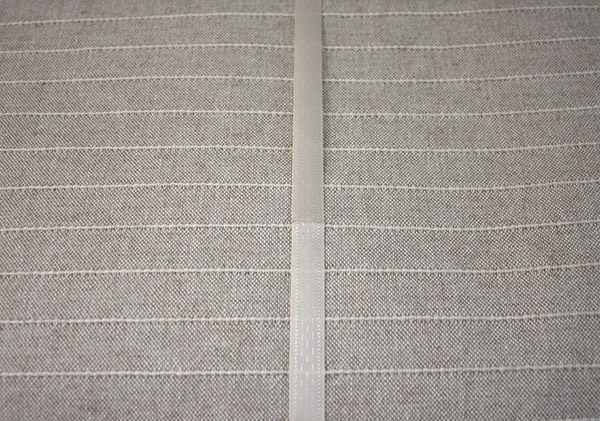
One option would be to cut out the stain and put vertical seams in the shade. I didn’t want to do that in this case because I wanted to emphasize the horizontal lines of the fabric. Roman shades often use ribbons on the front of the shade where the tapes are, so I bought some bias tape that could cover the stain. One piece would go down the middle (over the stain), and two pieces would go at each edge.

Before I could iron the tape on, I needed to run the fabric through a regular laundry cycle to get all the Yellow Out rinsed out. When I pulled the fabric out of the washer, the stain was gone.

What??

Don’t ask me why regular laundry detergent worked where all my other cleaners didn’t. Who knows.

Roman shade binding

I scrapped the bias tape idea, and went back to my original plan. It should be smooth sailing from here, right? Those of you who’ve worked with linen or cotton fabric can probably guess what went wrong next. I dried and ironed the fabric, and then decided to double-check my measurements so I could hem the sides. Only to find that the heat from boiling had shrunk my fabric by 2″. It was now only 54″ wide, and the window is 55″ wide.

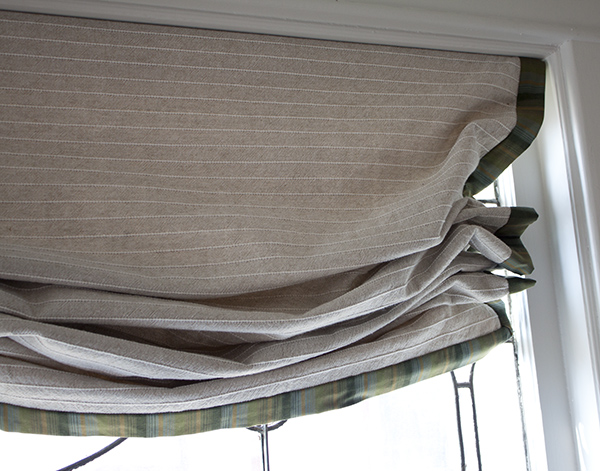
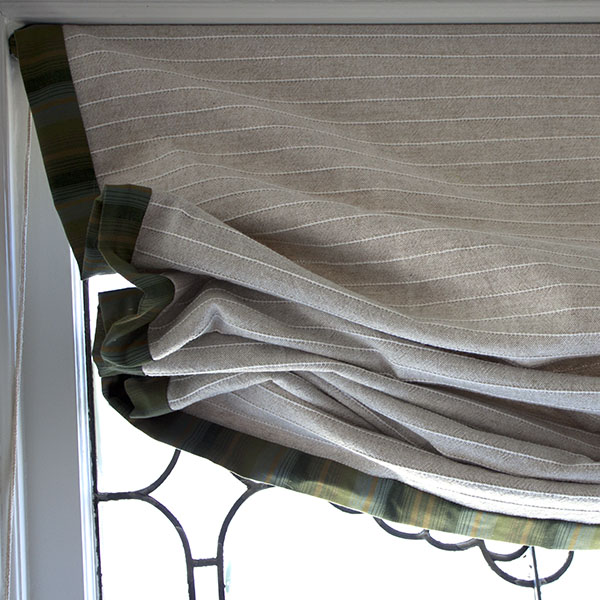
Sigh. I guess it needed a decorative binding anyway, didn’t it? It adds a nice accent color, and nobody has to know it’s covering up a mistake. I cut a 4″ strip of fabric to add a 1 1/2″ finished binding that extends past the edge of the main body and adds the width I need. I cut the binding horizontally across the fabric rather than on the bias so that I could have horizontal stripes along the sides to match the horizontal stripe in the main fabric.

I had a great tutorial to show you on how to make perfect mitered corners for binding. Unfortunately, I learned that my method does not work when the binding extends past the edge. Instead of nice, flat, square corners, the binding pulls, giving my shade convex corners.

This time I admitted defeat. The convex corners are staying! They’re just as hard to see in person as they are in the photos. I’ll show you how to apply binding on another project!

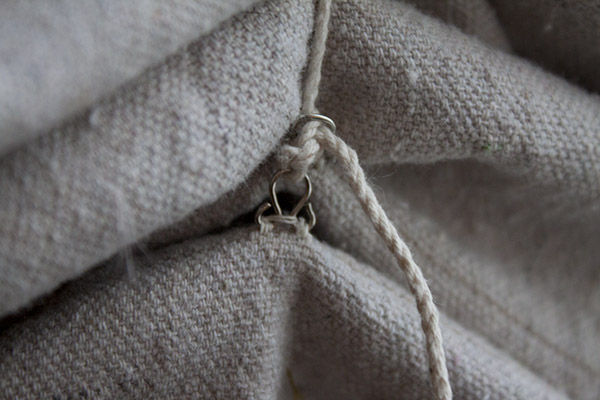
I tried one final new idea on this shade: I sewed on eyes (from hook and eye sets) instead of rings for the shade strings.

I have a huge lot of vintage hooks and eyes that came from an estate sale. I thought I would try using them in place of rings to guide the ropes that raise and lower the roman shade. They were easier to sew on, but I don’t recommend them for shades that you’ll raise and lower a lot. the sharp eyes will cut the ropes eventually.

After all of that, I finally have a finished shade that I really like. Challenges will always arise when you’re designing a new project. The more you exercise your creativity to overcome the obstacles, the easier it gets. And in the long run, those creative solutions will become your best work!

–Loryn

Christmas Ornament Countdown: Wire Wrapped Joy

Christmas Ornament Countdown
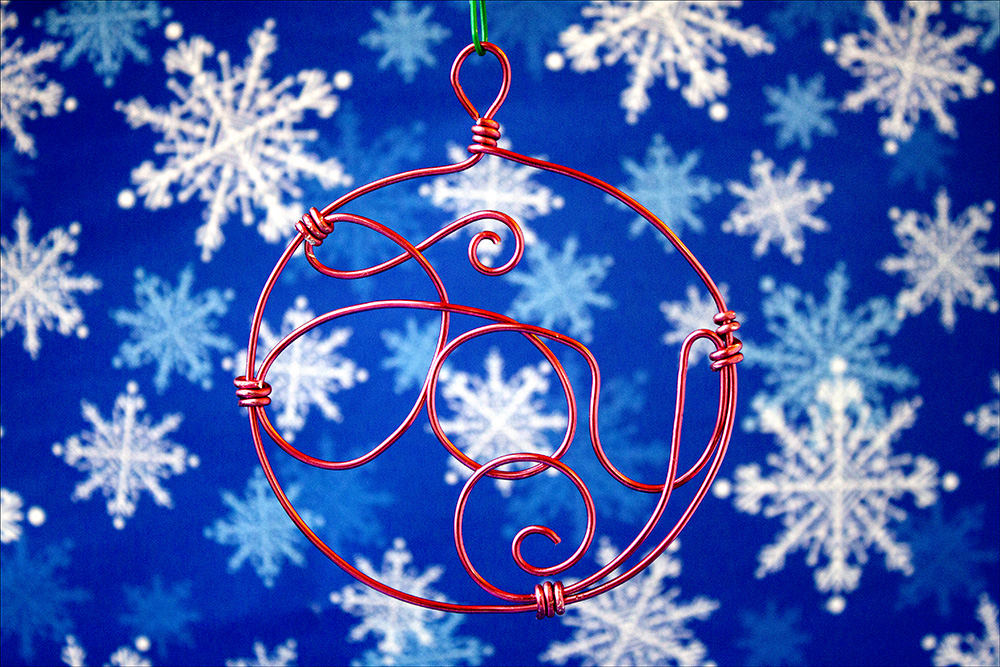
Wire "Joy" Christmas tree ornament.

Cheri: While my sis and I were shopping at Hobby Lobby the other day, we were checking out the wire in the jewelry section. Back many years ago when I first started working with wire, I was using baling wire. This is the wire that holds bales of hay together. It was a good thing I was young and my hands were in good shape.

Since then wire comes in all shapes and sizes and colors. The wire I picked up for this ornament was really soft, and my hands really appreciated it. I was able to form the letters very smoothly and if I made an adjustment to the wire, it was easy to get the kinks out.

This ornament is really quite simple. I shaped the word “Joy” and then I made a big circle with a hanger at the top and placed the word in it. I then took small pieces of wire and held the word in place by wrapping it at various points. I think it turned out very nice and should really add a lot to the ornament tree that we are all working on.

Merry Christmas from Crafty Sister Cheri.

Christmas Ornament Countdown: Wire-wrapped Ice Fairy

I love Cheri’s Chinese Fortune ornament. It will just glitter and shine next to the lights on the Christmas tree.

For an ornament last week, I did an homage to my stepfather’s sequin and pin ornament and for today I am doing one for my sister. Loryn has this ornament that she received from our grandmother (Memom – the other two sisters’ that make up The Crafty Sisters, mom) in 1981. As we were growing up Memom would give us each a Hallmark ornament for Christmas. One of the joys of decorating our tree was being able to hang the ornaments that were yours. This one in particular was a lovely Ice Fairy holding a snow flake.
Hallmark ornament from 1981 of an Ice Fairy holding a snowflake.
This is the original ornament. Unfortunately not ours, as this one still has her wings and snowflake.

I have many memories of this ornament and I know that my sister has even more. Unfortunately, time has not really been kind to the poor fairy. She has lost her wings and snowflake, but she is still a lovely ornament so she is hung on the tree every year. Here is my version of the ornament:

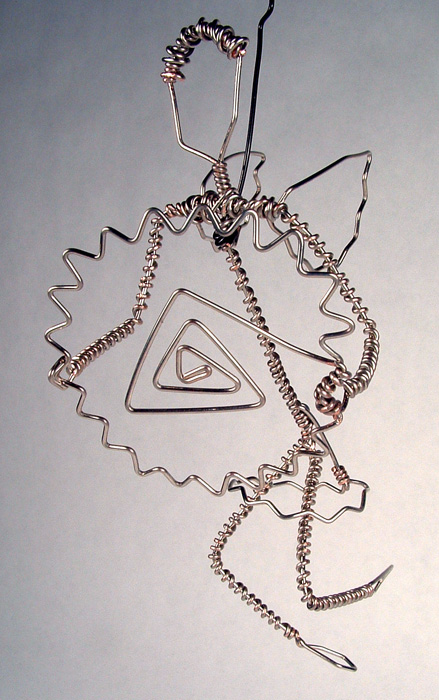
Wire version of the ice fairy.

I made her with silver wire. I started with the arms, wired on the neck and head and then continued with the rest of the body. Then I made the snowflake and wired it onto one of the hands and adjusted the other hand to hold it. The wings were made next and each is wired separately to her shoulders. I added her hair last.

Wire version of the ice fairy.

Happy Holidays from Kristin!

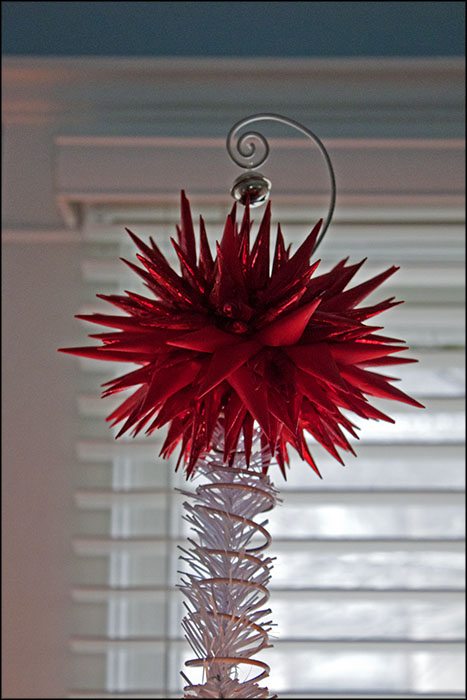
Paper Star Christmas Tree Topper

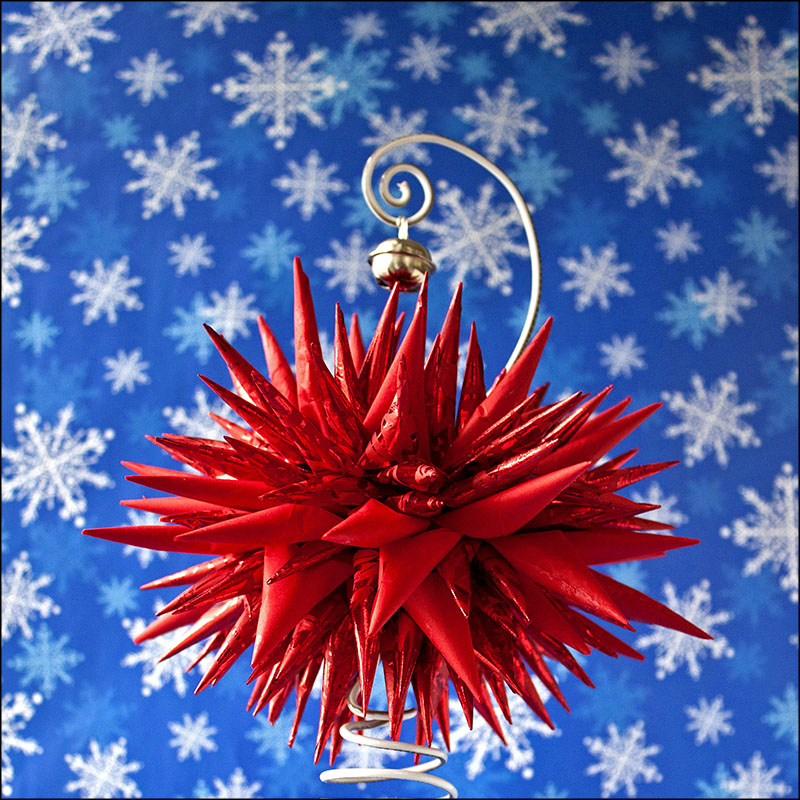
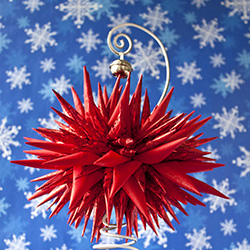
Paper Star Tree Topper
Paper Star Christmas Tree Topper

Lynne: We crafty sisters have been making ornaments all month, but we are not the only ones. Last week, I went to the Pear Tree Gallery to attend Teri Partridge‘s class on making a tissue paper star.

The ornament is not difficult to make, but it is repetitive and good company with good conversation speeds the whole process. Of course that meant Teri had to talk a little louder while giving instructions, but she is a retired middle-school teacher and up to any task.

Materials you will need:

tissue paper

white glue

white colored pencil

scissors

CD for a circle template (or something similar in size)

binder clips

12 to 20 inches of 18 or 20 gauge wire

pliers

buttons or bells

wet cloth or sponge

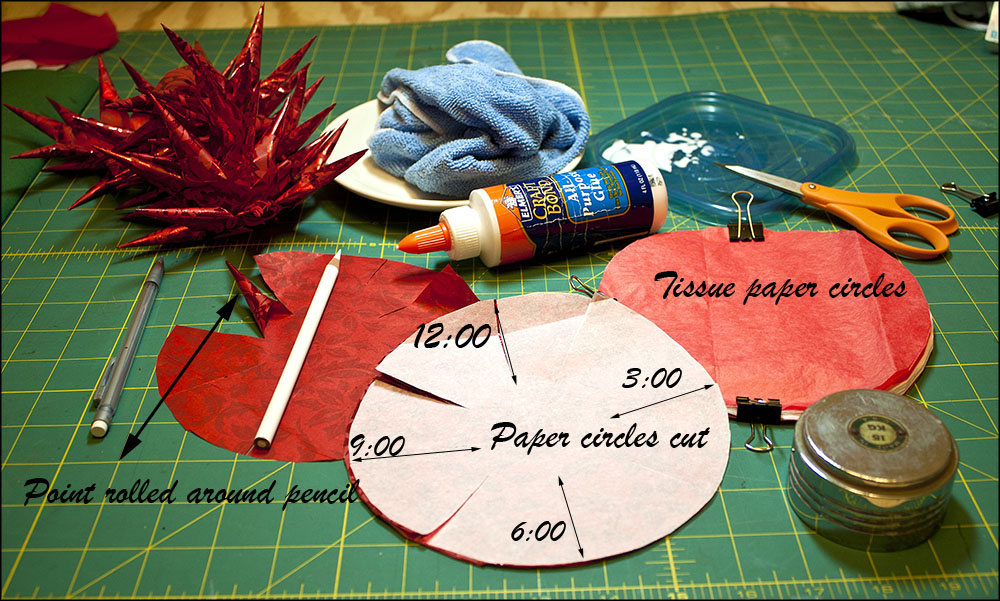
You need about 14 circles of cut tissue paper for the completed star. Stack your tissue paper so that you can cut all of the circles at once. We used an old CD to draw around as a template for the circles. Hold the cut-out circles together with small binder clips to keep from having to constantly adjust them. Cut into the circles at the 12, 6, 3 and 9 positions of the clock and then cut halfway between each of those quarters. Make sure the cut does not go all the way to the middle. You need the center section to hold the paper on the wire. The photo below should help with my directions.

Paper Ornament Tree Topper

Have a little glue poured out on a throwaway lid, a dampened sponge or cloth to wipe your fingers free of glue, a white colored pencil (a darker color could mark the paper and show through the point), and the cut circles and you are ready to begin.

Position your pencil with the tip in the middle of each cut and roll the tissue paper around it to make a point. Slide the pencil out and put a little glue on the edge to keep the point from unrolling. Use the 3rd or 4th finger of your hand for the glue and you will not have to keep wiping the glue off the index finger you are using to roll the paper.

When you have all fourteen of the circles finished, you are ready to put the ornament together. Cut your wire anywhere from 12 to 20 inches long depending on how many spirals you want to make and how long a hanger you want. Make a loop in the wire to hold the circles in place. The loop should be several inches from one end of the wire depending on how long you want the hanger to be. You can also use a button or a bell to make a stronger stop to keep the paper from sliding upwards when you tighten the star.

Make a hole with a needle or ice pick in the middle of the circles. String the first 7 circles onto the non-looped end of the wire with their points down and string the other 7 circles with the points up. You want the star to have the top points pointing down and the bottom points pointing up to give the ornament its circular shape. Use a bell or a button pushed up tight to the bottom circle and make another loop to hold the bell on. Arrange the circles so the points show to best advantage and make sure the circles are bunched tightly together to make it pouf out properly. Secure the bottom bell and cut the wire or make some spirals or twists if you like. Bend the wire on the top to form a hanger and you have your star ornament.

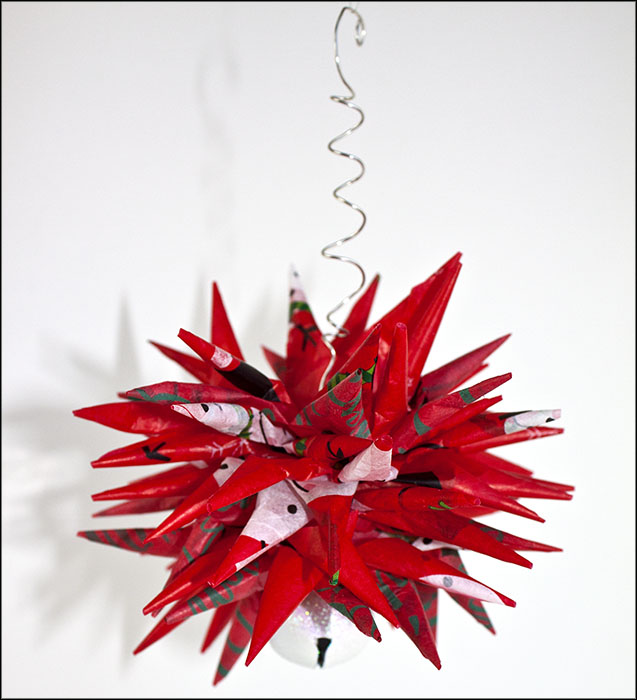
Paper Star Ornament
The ornament that I made in class with Teri Partridge.

When I got home, I liked the star so much I wanted to make a larger one as a topper for my tree. I made the circles slightly larger by using a 7″ plate as a template for the circles. Don’t go too big or the circles get too floppy and do not pouf right.

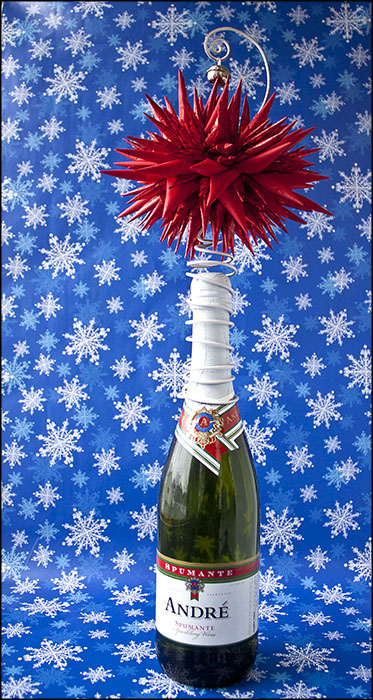
I needed heavier wire to make the ornament stand on its own at the top of the tree. I found some 12 gauge white electrical wire at the hardware store and took it to Cheri to have her bend the wire into the right shape. She used the neck of a champagne bottle to bend the wire into a coil to fit on the top of the tree.

Paper Star Ornament
Wire coiled around the neck of the champagne bottle.

The 12 gauge wire was harder to bend close enough to the paper circles, so we used pieces of cork above the stop loops in the wire to help hold them close together.

Paper Star Tree Topper
The cork holds the tissue paper circles tightly together.
Paper Star Tree Topper
The champagne bottle we used to coil the wire made a great stand for our photo.

The star looks great on the top of our tree and if you like the topper on the champagne bottle, it would make a great centerpiece for your holiday table.

Have yourself a merry holiday!

Paper Ornament Tree Topper
Our new paper star tree topper.
Paper Star Tree Topper

Christmas Ornament Countdown: Scrapbook Paper Origami Stars

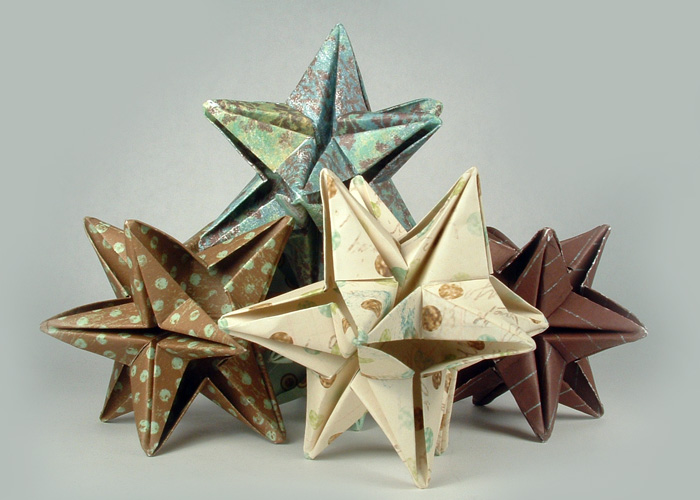
At the beginning of this countdown I wrote up a list of 8 different media that I wanted to use to make ornaments. I have now arrived at paper. I found this wonderful video tutorial for how to make 12-point origami stars and made with some pretty scrapbook these are perfect for holiday ornaments and decorations.

Origami 12 point stars made from scrapbook paper.

I have found after making them that I have a few suggestions. I originally thought to make these with Christmas wrap, but found that the wrapping paper is just too thin and prone to tearing to be practical. I did have some really pretty scrapbook paper in some excellent colors that was a heavier weight. Don’t use cardstock as it will not fold easily once you get to several layers of paper. Anything in between wrap and cardstock would work very well. I also recommend using something to press the creases down such as a bone folder.

Origami 12 point star made from scrapbook paper.

To hang these as ornaments from my tree, I am going to pull a thread through the star with a doll needle (a really long needle) and attach a hook to the thread. Voila! a wonderful ornament form the tree or just beautiful to set on a table as decoration.

Origami 12 point paper star.

Happy Holidays from Kristin!

Origami 12 point star made from scrapbook paper.


This post was edited to fix the link to the tutorial. The old link had disappeared and I was able to find a new tutorial on YouTube.

Happy Crafting,

Kristin

Upcycled Felted Wool Sweater Christmas Stockings

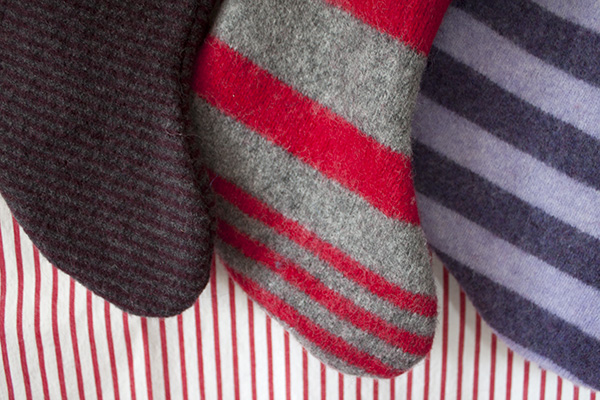
Christmas stockings made from felted sweaters

Loryn: Old wool sweaters from the thrift store make a great source for inexpensive wool felt. Just run the sweaters in your washing machine on the hottest cycle, and you’re ready to start sewing!

I made a basic stocking template that makes a 16″ stocking. You can download the PDF here. To print it on an 8 1/2 by 11″ printer, choose the tile option and tape the pieces together.

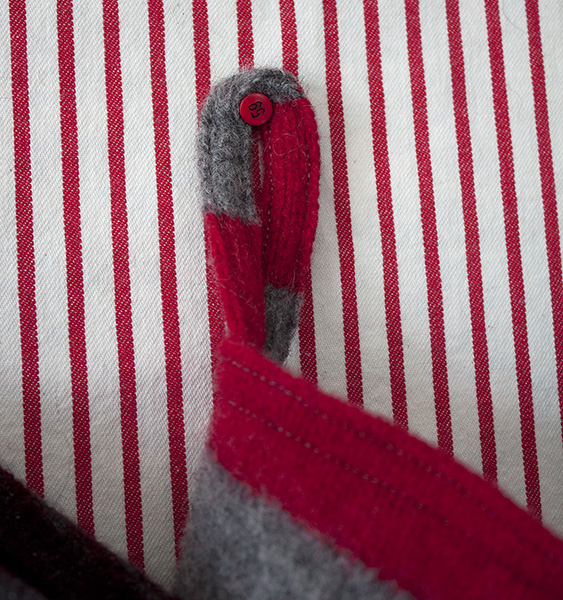
These were assembled with a 1/2″ seam and a simple turned hem at the top (it won’t ravel, so I just turned it once). Sew a simple hanger from a 1″ piece, folded in half and top stitched.

Earrings on Parade

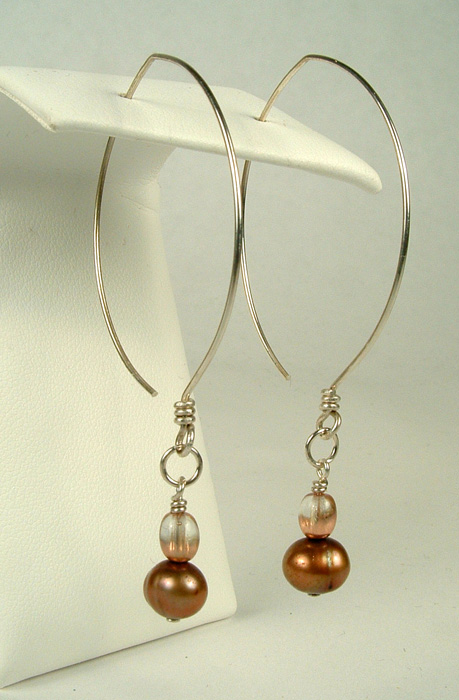
I realized that I haven’t posted any of my jewelry lately and decided that I would show some earrings  I have made as presents for Christmas this year. They are all made with pearls and sterling silver. I made the earwires as well.

Brown pearl dangles on almond shape earwires.

Maroon pearl dangles on french style earwires.

White pearl dangles on drape style earwires.

I just love the almond shape for earwires. I have made several pairs of these for myself and they always look so beautiful. I think I will have to make a pair of the white pearl earrings for myself too. These would look good with just about anything!