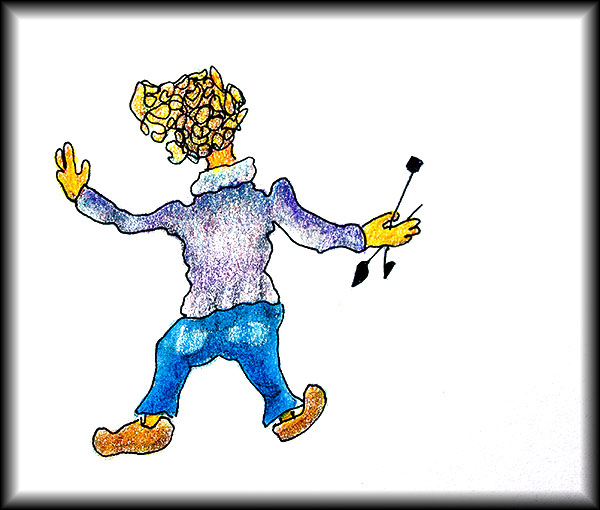
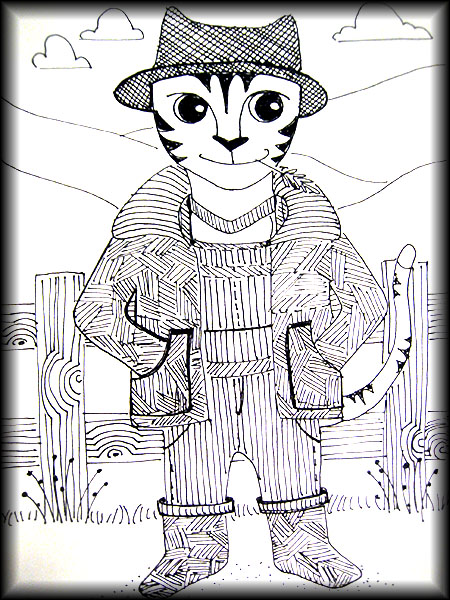
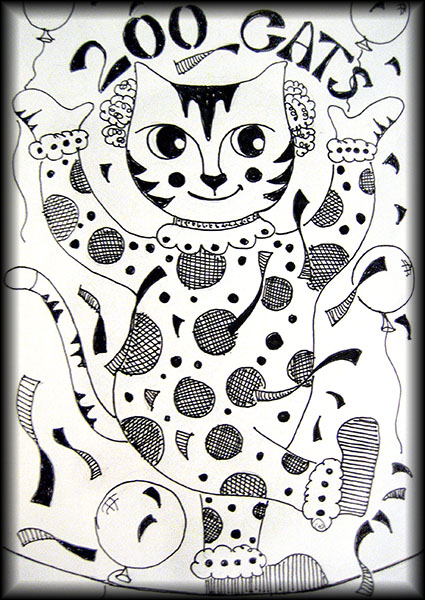
I did this as my avatar for Facebook. The size isn’t quite right and I will have to do another one to keep my head and feet from being clipped. In the meantime, this one will do and I caught just enough likeness.
This squiggle is just color pencils without much blending. The texture is really accented.
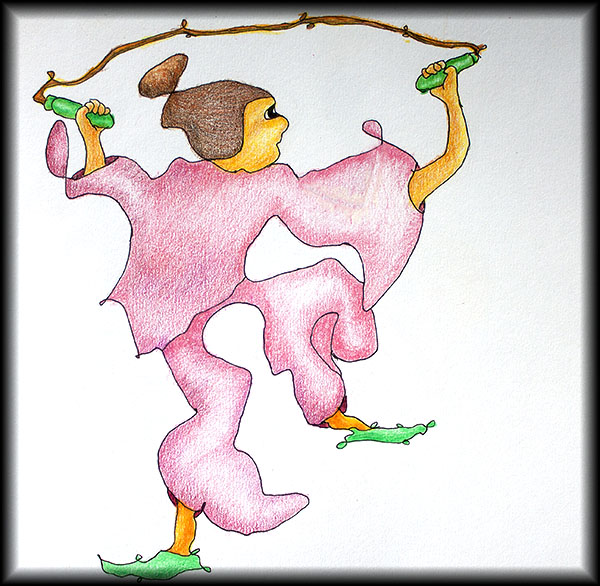
I used a complementary color scheme of red and green. I used the lighter tones of pink and light green and it makes for a nice contrast. The drawing uses only color pencils, not markers this time.
This little girl squiggle has so much energy and her clothes flap in the breeze of her twirling rope.
This elephant is not afraid of mice and loves butterflies.
I did this squiggle of the elephant using only red, blue and yellow color pencils. This was before I used black to bring out some depth and I can see how that would help. I do like the way though that not all of the color is blended. This does add some depth and lots of texture.
The mouse and the butterfly are a combination of marker and pencil. They are there because the elephant was lonely.
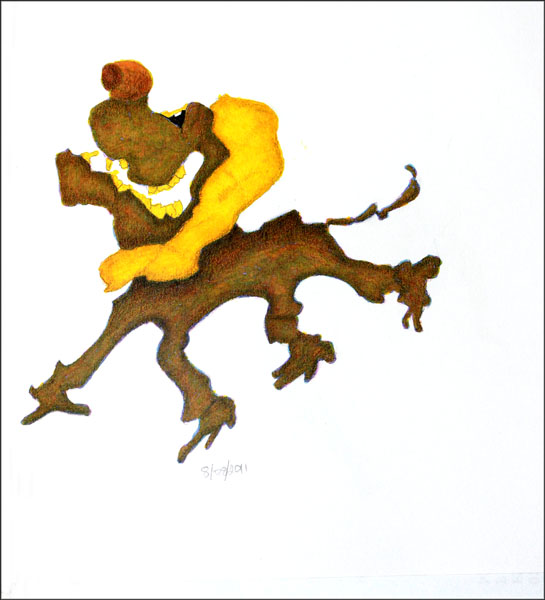
This is an experiment in the uses of blue and yellow to make green. I used yellow as the first layer as I have found that yellow under another color shows more than yellow over a color. I then used a light blue to make the lightest green. I used a dark green and a dark blue for the shadows and then added some black in the darkest places. I added the red tongue as a complement accent to the green.
This dog squiggle surprised me. All of the other squiggles were really small and this just kept getting bigger and bigger. With my drawings larger, I had to begin to learn about markers and what their strokes looked like. Filling in large spaces was especially hard, as I was always so impatient when I colored in coloring books. Now I have to tell myself to slow down because it’s very important how something is initially colored. Then you can go back in and add shading with color pencils.
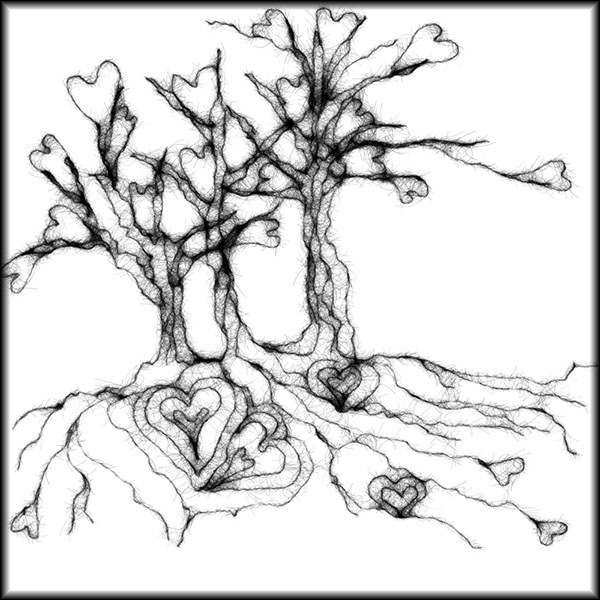
I love it when I am surfing the web and I come across a program that is almost too cool for words. A few days ago I came across a program that is called Scribbler Too. It is a drawing tool on the computer. I have used a few of these before because they offer a really exciting view into the possibilities of computer drawing. This one has become one of my favorites. It is easy to find and you need next to no instruction about it. You just start drawing. The program makes you feel like an outstanding artist and if you don’t like your drawing you can just clear it. I do have to admit that drawing with a mouse does take some getting used to but, the effort is really worth it because you end up with what I feel are some really incredible works of art. The drawing I am posting is called “Growing Love”, and I have done several renditions of it. I love to look at trees and I do really enjoy drawing them. This program is fabulous for that and I am able to get little bit of satisfying creativity off my chest. Try it, I can guarantee you will really love it.
A squiggle that has been built up with markers and then shaded with color pencils.
I have always wanted to be able to draw, but a very early life experience with a football coach posing as an art teacher had me convinced that I was no artist. (In my early years I went to a school that had all the grades together. The rough chastising that must have worked with teenage boys did not have the same effect on a first-grade girl-child.)
In the last several years in an effort to shake the coach’s gloomy prognostications, I have taken drawing lessons. I found the Pear Tree Gallery and Teri Partridge, an artist and teacher, who is bound and determined to make everyone an artist. (Ask anyone who has passed through Columbia Middle School and they will tell you the same. This is not to imply that I am young enough to have had her as a teacher when I was a student there.)
One of her oft repeated lessons (the one on drawing shapes has to be most repeated) is the importance of shading and shadow. What I came to realize after Teri had patiently repeated it over and over was that where I had thought my drawings were simply terrible, in reality they were simply not finished. I came to realize that there is a world of difference between the first set of marks you put on the paper (shapes, always remember) and the last set of marks you put on the paper (shading and shadow.)
Now, after several years, I can say that I am competent with pencil and paper. My black and white drawings look enough like the real thing to make me think some of Teri’s lessons have sunk in. However, I wanted color and unfortunately it did not want anything to do with me. I simply did not know what colors to use. My watercolors did not mix well, I did not like acrylics and oils did not look simple enough..
Finally, after wandering with much self pity among those many did nots, I came across this quote by Johannes Itten, a teacher of the Bauhaus style of art in the 1920’s;
If you unknowing, are able to create masterpieces in color, then unknowledge is your way. But if you are unable to create masterpieces in color out of your unknowledge then you ought to look for knowledge.
With that unsubtle nudge, I decided to seriously look at how color works. Some people know immediately what the primary colors are and their relationship to secondary and tertiary colors, but I have to plod my way through color theory and keep a color wheel beside me. (The Color Chart blog is packed with information about color schemes and theory.)
I was snooping through Cheri’s shelves one day and found a book called Drawing Lab For Mixed Media Artists by Carla Sonheim. There were 52 exercises to make drawing fun, but the one that really caught my eye was scribble drawings. The exercise consisted of making a scribble, just a random mark on the page and then looking at it every which way until something popped out. An arm, a leg or even an eye would peek at me just like the face and vase optical illusion that tricks you into seeing one and then the other. The best thing was that these were the types of doodles I did as a child (frowned upon by a certain football coach) and I had been seeing things in scribbles for years.
What I did not know was that scribble drawings were my eureka moment to color. They only needed a simple color scheme and with the color wheel I could pick the scheme I wanted before I put a marker to paper. As long as I stayed with the predetermined choices, I could play without the fear of a terrible muck up.
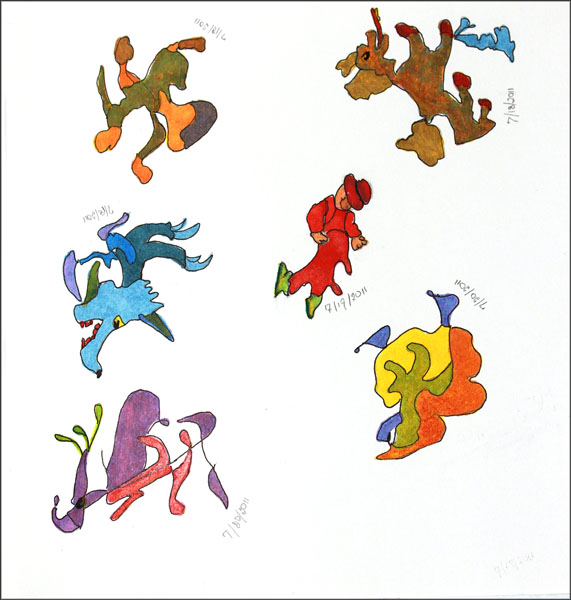
I have named these scribble drawings squiggles because squiggle is an artistic term for the short curves and twists that I end up with when I scribble. The sketchbook pages posted below are the first squiggles I did and I have included three photos of the progression of a scribble to a squiggle. The drawing at the top of the post is what my squiggles are starting to look like now. I add lines and take away lines and use a combination of markers and color pencils to create the shading and shadows. Squiggles are my eccentric way into the world of color and imagination. And who knows? Someday, I may pick up a brush and not muddy the watercolors.
-Lynne
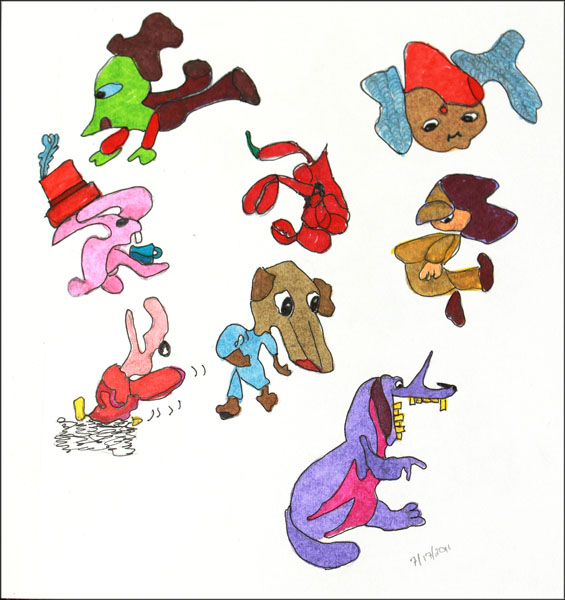
These are all done with markers.Separating one squiggle into two allowed me to think about erasing lines.I have started to turn the sketch book in all different directions.The result of a random scribble.The random scribble turned into a figure.The finished drawing. I used color pencils and marker in a primary blend of red, blue and yellow.