I had some trouble finishing the drawing of this squiggle. I wanted to show that she was yelling enthusiastically and needed some darkness in the interior of her mouth to show it was open. I was even given a lesson by Teri Partridge in how to draw the structure of the back of the throat, but that seemed to be too much detail for the drawing. I finally decided that I would fill her mouth with words. She is saying: “Hi! How are you doing? It’s good to see you.” I drew this when I was waiting to pick Loryn up at the airport so the wording seemed appropriate.
I used colored pencils and markers for this drawing in a complimentary sort of way.
Lynne: In our last challenge for wooden spools I spent most of the two weeks trying to make a colored pencil stand that would:
1. hold my pencils where I could easily reach them
2. let me see the color quickly
3. keep the pencils from rolling to the floor and breaking
4. keep the point sharp
5. look cool doing all of the above.
Eventually, I came to the conclusion that wooden spools were not the answer to the colored pencil problem and instead I made the embroidery floss project box.
During the big reveal of our wooden spool projects, I began to elaborate on my search for a pencil holder when Loryn brought up the website Apartment Therapy and showed me this plastic grass countertop drying rack. She thought that the drying rack could be something similar to what I had in mind. She was right, but I had no plastic grass and was unlikely to find any cheap enough anytime soon. I kept thinking of things that were thin, straight and pointed and came up with bamboo skewers. Loryn had a website for that idea also and showed me this bamboo skewer knife holder.
Bamboo skewers work because their points allow just enough room for the pencil point to slide in between each skewer even though the skewers are packed tightly at their base. The pencils do not have to be guided into a specific slot which can be aggravating; enough so, that you end up impatiently laying the pencils down where they roll to the floor breaking the lovely point you just so carefully shaped. Best of all, those lovely points are not marred when you push the pencils in among the skewers.
Excited about finally getting my dream pencil holder, I set about finding the container I needed to keep the skewers upright and packed tightly. I didn’t want something too small because there would not be enough room for the pencils and I did not want something too large because there is a limit to the number of bamboo skewers you want hanging around.
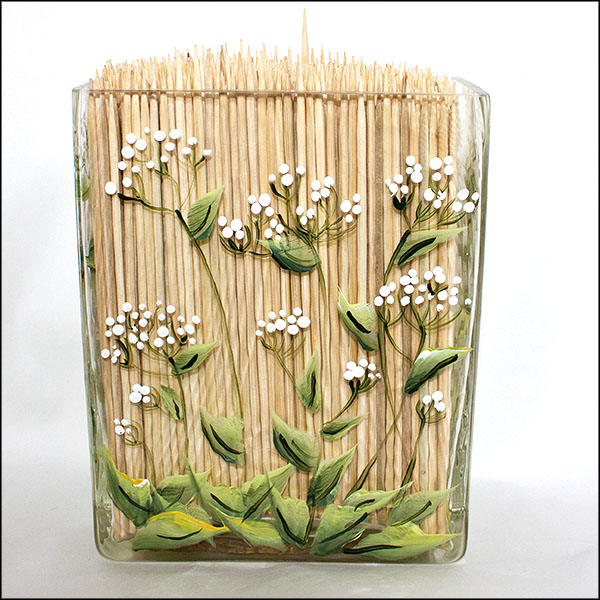
Cheri has a talent for arranging flowers and as a gift for my birthday, she had given me a bouquet in a rectangular glass vase. As a bonus, she painted a delicate tracery of lilies of the valley around the outside of the vase. I have used the vase again for other flower arrangements but at the moment it was standing empty in my cupboard. It looked to be the right size and I liked that it was not round because that meant no pencil would be in the middle surrounded by other pencils and out of my easy reach. The vase is shown in the photo below. I love the delicate flowers.
The empty flower vase that Cheri painted for me.
I found the bamboo skewers I wanted at the local farm store and bought 7 packages of 195 skewers each which turned out to be just enough. Sometimes, things just work out right for no good reason at all. The skewers were longer than the vase and I had to find some way to cut them all to the same length. I tried a miter box and handsaw but I could not keep the skewers bundled together enough to cut them without splintering the ends. I finally just grabbed my wire cutters and taking about 10 at a time I turned them point-side down in the vase and cut them even with the top of the vase. This allowed me to measure and cut at the same time.
There is one thing about using the wire cutters that I should mention. When you cut the pieces go flying everywhere. You end up pulling them out of your hair, picking them up off the floor and even out of the chandelier. It didn’t take as long as I thought it would, but I need to sit down and think of a better way to cut bamboo skewers if I ever do this again.
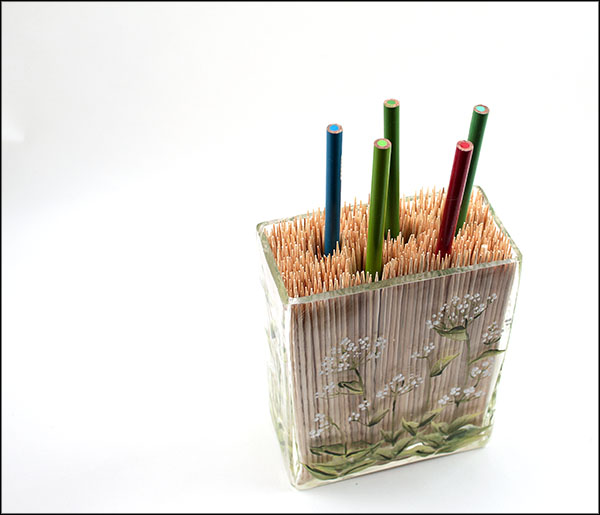
While cutting I did have the foresight to place all the skewers with their points in the same direction in a box. I did not want to spend more time sorting through pointed sticks than I had to. When I was done I stacked the skewers into the vase as shown in the photo below.
Most of the points of my skewers are just a little above the rim of the vase. It has something to do with the curve on the inside of the bottom of the vase. I should go through and cut them all so they are just below the lip of the vase, but I have had my fill of flying bamboo.
This holds about 10 pencils and does all of the things I wanted it to do. I cannot call the project a cheap trick since the skewers were about $14.00 for all of them, but it is a good organizer and I am glad to have the pencil problem solved for now.
The vase filled with bamboo skewers.Top view of the vase.
This view shows the dimensions of the vase from the top.
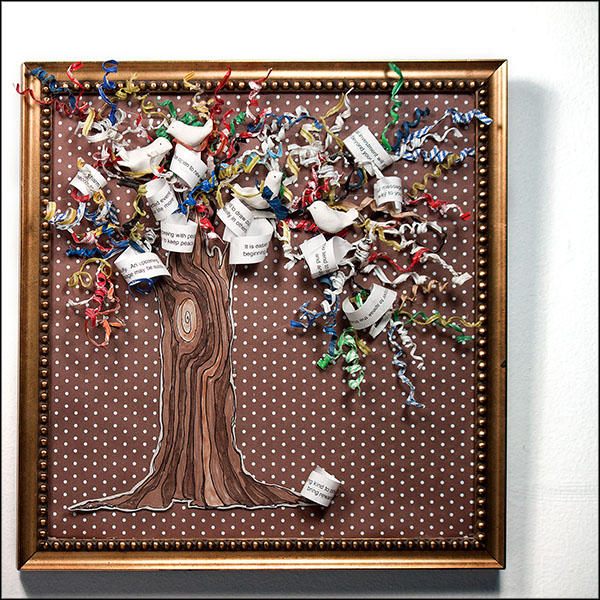
My tree with the fortune cookie leaves and bread twist-tie branches.
Cheri: At garage sales I am usually on the lookout for items that I can use in a collage. I have mentioned before that I like to purchase multiples of small items. My reasoning is; if you have a lot of one item you get the luxury of messing it up and having more to fill in if you really want to try it again. So, I have multiples of various items.
That being said, when you are at a garage sale, do not overlook the free box. This is a great place for multiples. Often, people will collect silly things, like, bread closures, bottle caps, nuts, old nails and the like. I really do not know what makes someone decide to keep these items, but I am always very glad they have.
It was one of those happy instances, when I looked in a free box and there in a bag was about 200 bread wires. They were crinkled up and they looked like a bunch of branches. I had been working on a tree design that I liked and I thought the wires would look great as the branches.
This is how I put together this tree collage. After I placed the branches, I decided the branches needed leaves. I remembered the fortunes that I had been saving from our weekly trips to China Lane (a local Chinese food restaurant). They were perfect for the leaves after I gave them a little curl. The birds were made from Fimo clay and were left over from another project I had been working on. All of the pieces came together and it worked. I really like that when that happens.
Close-up of the Fimo clay birds and Chinese fortunes.
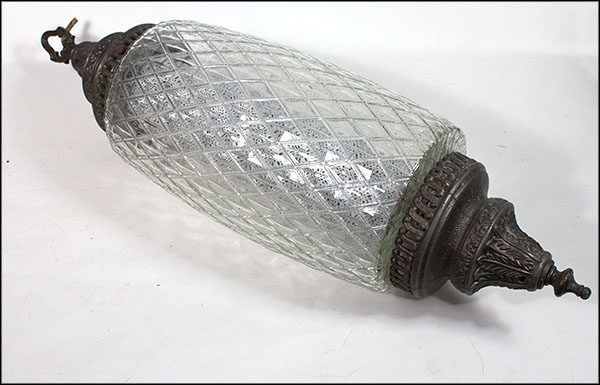
Loryn: These electric hanging lights were everywhere in the 1960s and 70s. I have had this one in storage for a while. I like the look of it, but I hate the 15′ of cord trailing to an outlet that comes with it. It was poised to go to Goodwill until I realized that a battery-operated candle would be perfect for it.
Disassembly
Here I’ve started disassembling the fixture. I cut off the (unplugged!) cord and removed the top metal portion. The bottom metal portion also comes off by twisting off the finial at the bottom. I’ll save the perforated metal diffuser for another project.
The original socket and the replacement stem
I also wanted to remove the socket and replace it with a shorter stem (needed to hold the hanging loop on). I happened to have a shorter piece of lamp pipe to replace it with. You could cut the existing piece off with a hacksaw instead.
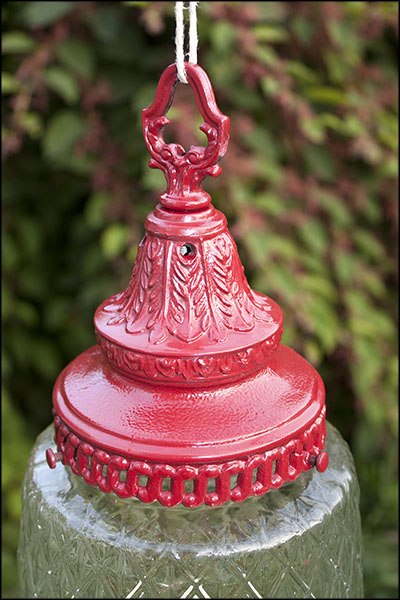
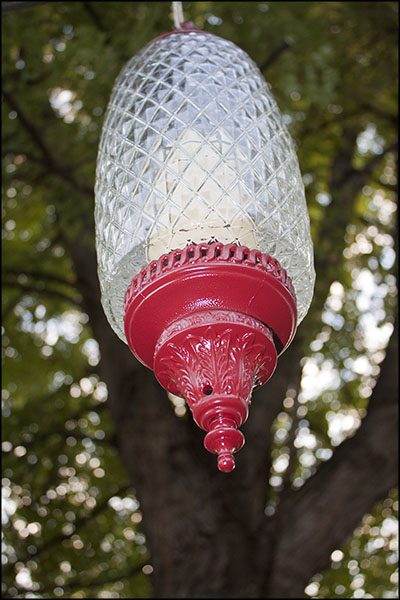
The next step was to thoroughly wash the metal parts so I could spray paint them. I used Krylon’s Colonial Red, which is a gorgeous deep red. Then it was simply a matter of reassembling the lantern.
And here is the finished lantern! The battery operated candle is great because you can put it in places that don’t get much air. I thought a remote control for a candle was silly until I came up with this use for it. The lantern will hang close to the ceiling, and the remote makes it really easy to turn on.
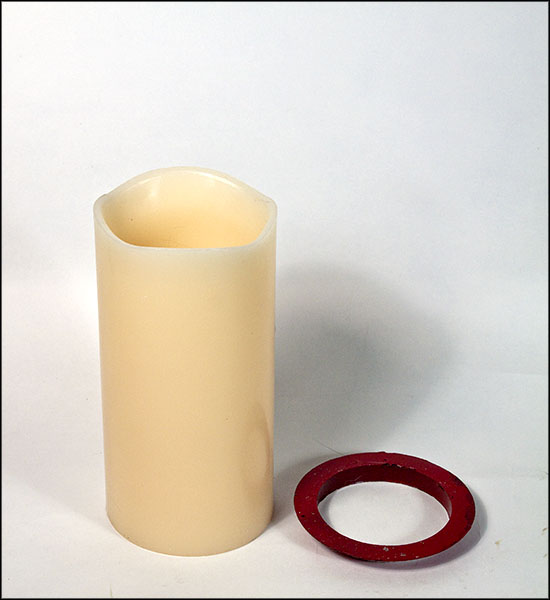
One last thing: The lantern had a washer at the bottom of the glass shade, so the candle couldn’t sit flat. I found a large rubber flange in the plumbing department of my local hardware store and spray painted it to match. Now the candle will sit flat, and it isn’t very noticeable.
Painted flange to sit the candle on.
The finished lantern will go in the hallway outside my guest room, to make a night light for guests. I’ll show it when I get the artwork up in the finished hallway!
With our first official Crafty Challenge completed (incredibly successfully too!), our eyes – and itchy crafting fingers – are looking forward to our second challenge. This one is a bit more focused in an odd sort of way. Instead of a specific material to work with, our limits are money and where that money can be spent.
The rules:
There is a $5 limit.
The money must be spent in a hardware store (a home improvement store counts).
You can only use materials that you purchased with the $5 from the hardware store.
Projects must be presented on October 23rd.
All of the Crafty sisters are hardware/home improvement store junkies. In fact, Loryn and I can spend hours just wandering around Home Depot, not really spend any money, completely solving a specific repair, craft or decor difficulty and both feel that we had a great and productive day. We are all also incredibly thrifty and bargain savvy (I think I have unofficially declared Cheri Queen of the Bargain), hence all the garage saleing, so this particular challenge is right up our alley.
So, wish us luck and tune in on Sunday, October 23rd when we will post our projects. I can’t wait to get started! I promise I won’t procrastinate this time.
All of my embroidery floss for my Lake Michigan bracelet.
Lynne: This project told me something about myself that I did not realize before. The objects I create come from a need for something rather than from the parts themselves. I had to think of a need and then decide if the spools could fit that need.
I spent most of the two weeks drawing spools in my notebook. I find that drawing my ideas first helps me find problems that could occur before I put any permanent glue in place. After pages and pages of spools in all different configurations, I found that the container I wanted for my colored pencils could not be made with the spools I had. I had to find another need.
Since Kristin and I have been back from our Indiana Dunes trip, I had been wanting to make a bracelet that reflected the colors of Lake Michigan. Friendship bracelets have been the rage all summer and I thought a woven chevron would give me the effect I wanted. However when I went to get the lengths of embroidery floss I wanted, the bobbins kept falling to the floor always ending in the dustiest corner of the room. I decided I needed a covered box with a bobbin that would roll and there I realized was the use for my spools.
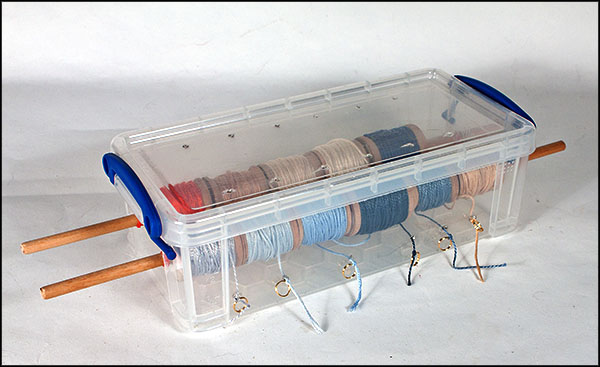
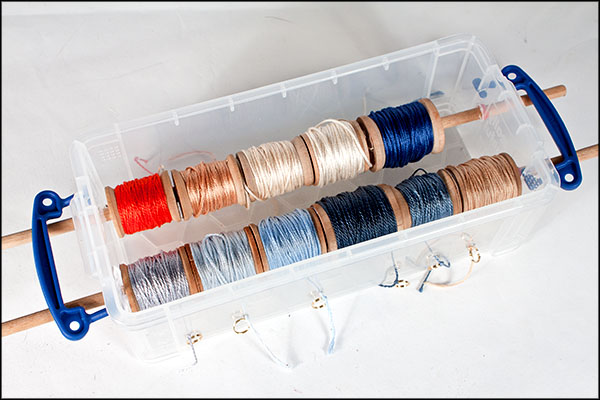
I wound the floss I needed for the bracelet project onto some of the wooden spools. I threaded the spools onto two 12 inch dowel rods and put the rods into four holes that I had put in the plastic box. I used a heated awl to start the holes and then a craft knife to make them just a little larger than the dowels.
I originally poked holes in the lid for the floss to come out of the box, but the threads tangled every time I removed the lid. I put new holes near the bottom of the box which worked great. I tied jump rings to the thread ends so they would stay in place. I cut off the jump rings when I need floss and retie them when I have the length I want.
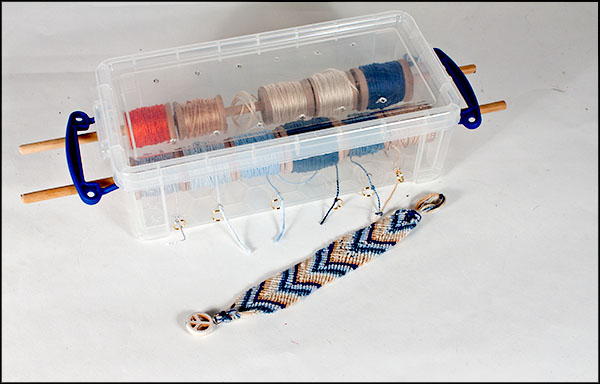
The spools can be changed depending on the colors needed for a project and the floss stays clean and neatly wound. The bottom photo shows the completed bracelet.
We were not allowed to see or talk about anyone else’s project before the time limit was up. It was a lot of fun to get together and see what we had all come up with. The projects reflected each of us perfectly. We had a lot of fun with this and are already planning more.
The box opens so I can change spools and colors.The ends of the thread are tied to jump rings.The finished bracelet with the project box.
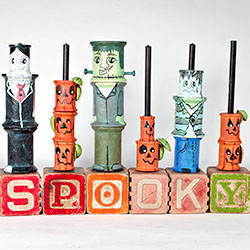
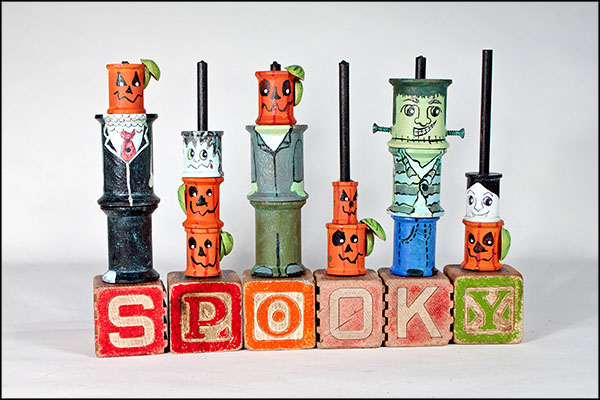
Cheri: This spool challenge was a lot of fun to do. I think all of us had a really good time and our projects were all so different. For my spool project I decided that I wanted to do a Halloween project. That being decided, I realized that I wanted to paint some monsters on the spools and then I thought it would be so cool to be able to change the parts of the monsters around. I spent a few hours painting the spools and then I had to decide what I wanted to display them on. I had picked up some old alphabet blocks maybe a year ago and they just had the right feel to them. I started working with the letters to decide what I wanted to spell and finally felt that “SPOOKY” was a very appropriate word. I drilled a small hole in the top of the blocks and then I cut 5 pieces of dowel. I then hot glued the dowel into the blocks. My son suggested that I paint the dowels black so they didn’t stand out so much, and voila!!! My project was completed. I think we all did an awesome job and I can’t wait to get started on our next project.
Halloween spools.Count Dracula and his pumpkins.Frankenstein with screws in his neck.A zombie for a neighbor.It's even spookier when they exchange body parts.
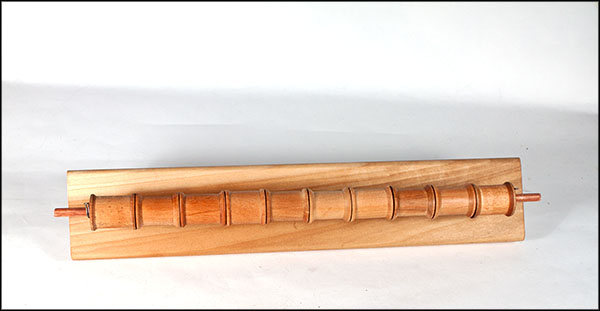
Loryn: One of my first ideas for the spools was a towel holder that would take advantage of the spinning spools to make getting towels on and off easier.
Spool challenge towel holder
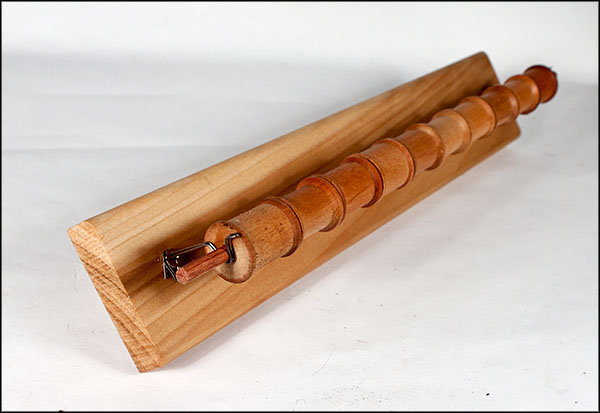
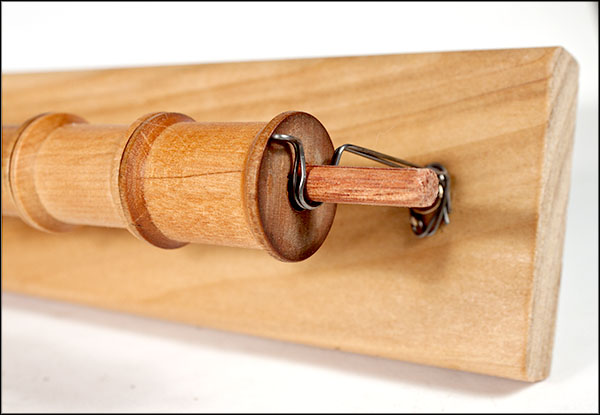
I used a piece of scrap wood left over from the new wood trim I put in my laundry room. My first thought was to use some wire from the garage to hold the spools, but it sagged too much, so I bought a 1/4″ dowel. I had also planned to use two more pieces of scrap wood to hold the wire at each end, but it just looked too big and clunky. I didn’t have any hooks or strapping that would work, and I didn’t want to make another run to the hardware store.
Closeup of the wire hook.
The wire was still sitting on my work table, so I tried bending it into a hook. Doubled, it’s strong enough to hold the dowel full of spools. The same screw that mounts the towel holder to the wall also holds the wire hook on. Simple and efficient! I can see a lot of uses for hooks like that, so expect to see more down the road!
The trim wood I used is poplar, which would normally be painted. I wiped everything down with a little boiled linseed oil to make it look a little more finished. I really like the look of linseed oil, but make sure that you spread your rags out flat to dry in the sun before throwing them away. Linseed oil can spontaneously combust if you wad up soaked rags and toss them in the trash.
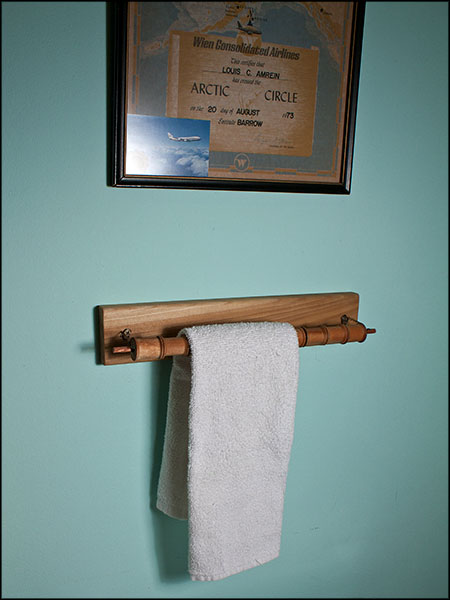
The finished towel holder in place.
And here it is in my bathroom! I hung it next to the sink to hold hand towels. The wire isn’t heavy enough to hold wet bath towels, but it’s perfect for this use.
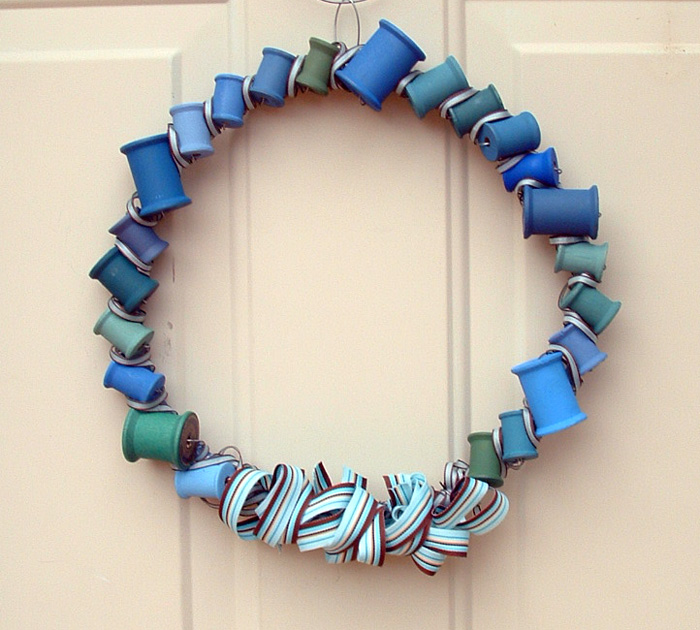
So, we posted two weeks ago about our latest activity, the Crafty Challenge. This challenge was to use old thread spools in a craft; any sort or craft. There were no limits and you had two weeks to complete the project. Today we unveiled our projects and here is mine!
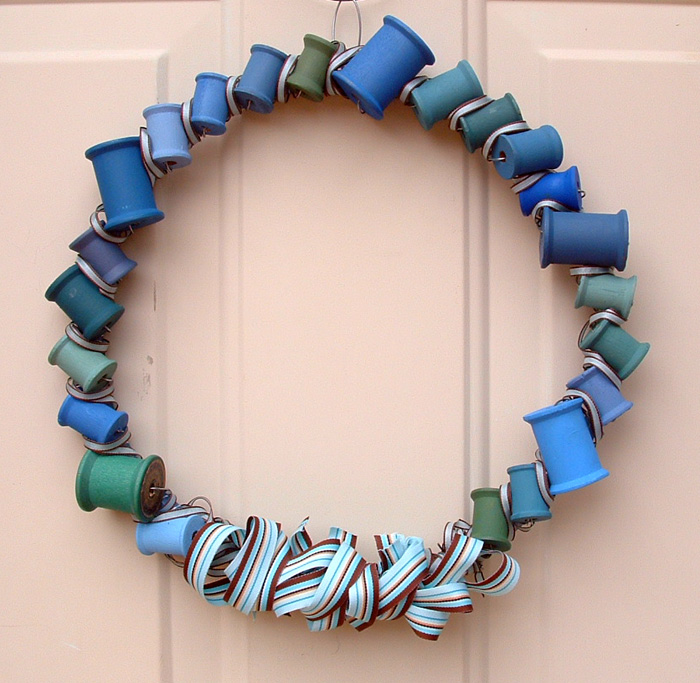
I think it is easy to tell that my favorite color is teal.
I decided to make a wreath. This is usually Cheri’s forte, but I thought I could do something that was good, clearly not up to her standards (I will have to get some pics of the wreaths she has made for me posted sometime), but pretty.
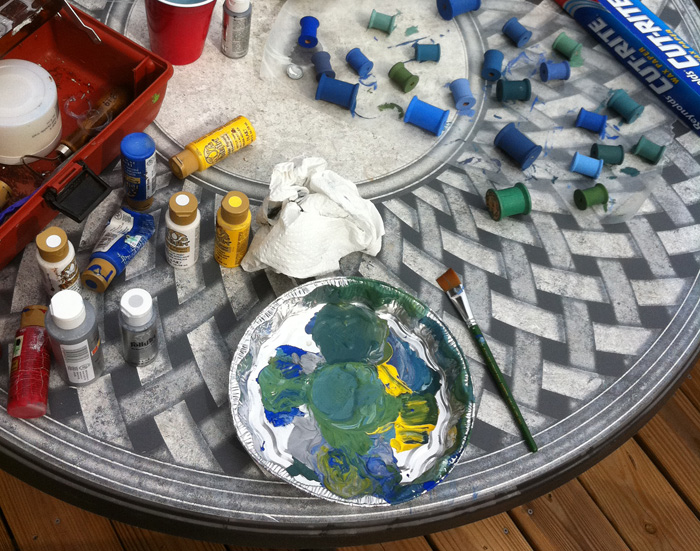
I have to admit that I procrastinated the whole two weeks away and actually made this in about 2 1/2 hours this afternoon. First, I had to paint the spools. I used some acrylic paint I had leftover from an art class. None of the colors are repeated and in fact one of the spools is not painted at all, it is a lovely green color. You can see it below with the labels still in view.
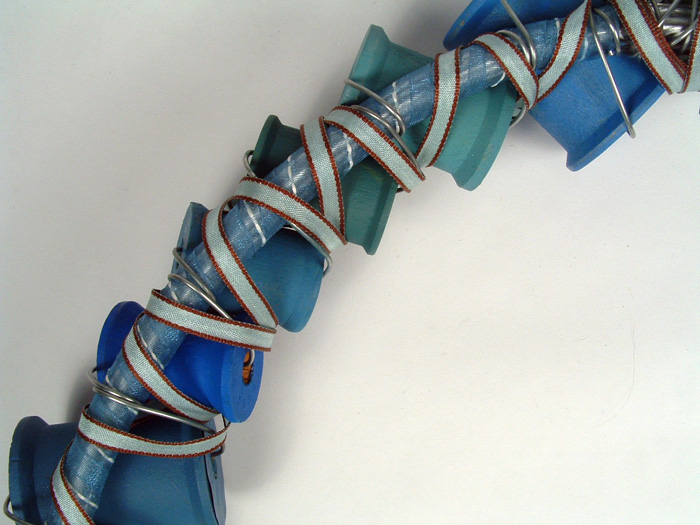
I used some heavy gauge wire and some plastic tubing to make the wreath base. I pulled the wire through the tubing and then wired the ends together. I then made the loop hanger. I covered the tubing with some pretty blue ribbon to hide the base and blend it into the background a little.
Then, I wired the spools to the base. We actually only received 22 spools for this challenge and I did not have enough to go around the entire base, so I designed a large bow-type decoration at the bottom of the wreath to hide this fact.
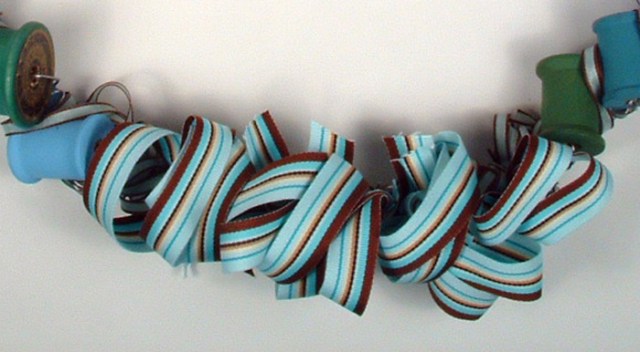
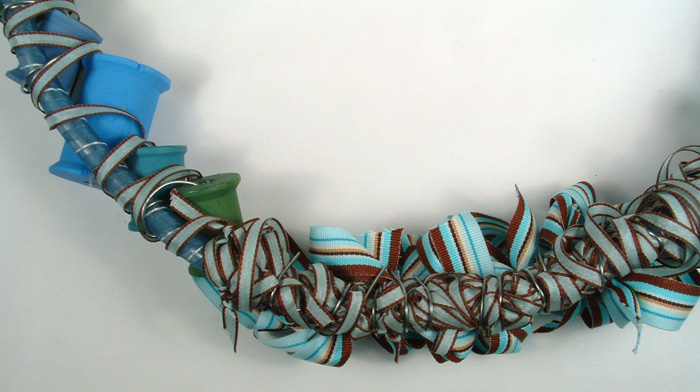
I wrapped the thin teal and brown ribbon all around the spools and then layered it very heavily in the bottom space to give some fullness to the striped bow.
The striped ribbon is cut into several pieces and each curled and then wrapped around the wreath base with some more wire. This gave me a long bow instead of a really large bow.
I am really happy with how the whole project turned out. I was so surprised by the variety of each of our finished crafts, so keep on reading! I can’t wait for the next Crafty Challenge (to be announced tomorrow)!
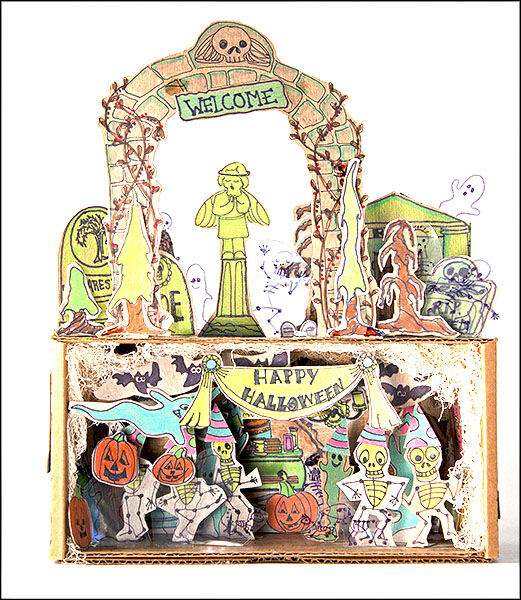
It looks peaceful but a party is getting ready to erupt!Halloween Party!
Cheri: There is something about hidden picture games. I just have a great time trying to find hidden objects in pictures. I think that is probably why I am so drawn to making dioramas.
When I decide to make a diorama, I go through this process of thinking about what I would like to relate to someone. The piece must be relatively calm on the surface and a shocking surprise below. It must use very basic materials, like a box and cardboard, crayons, markers and glue.
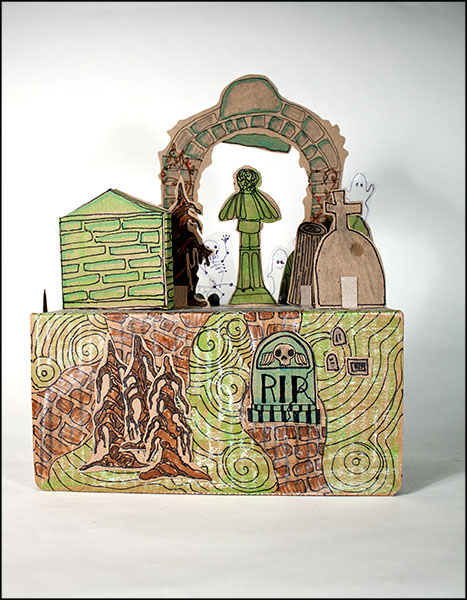
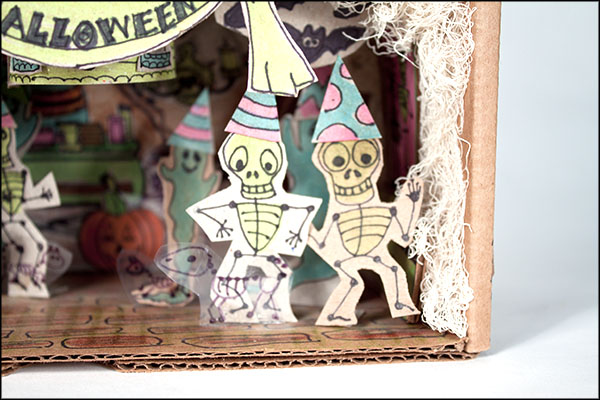
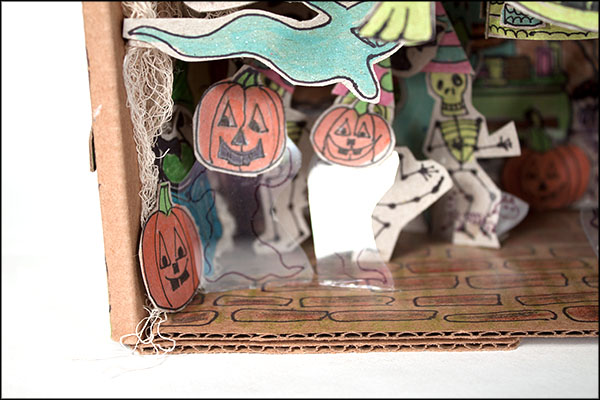
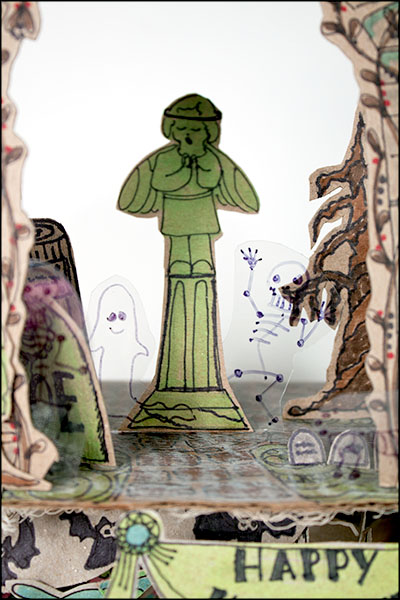
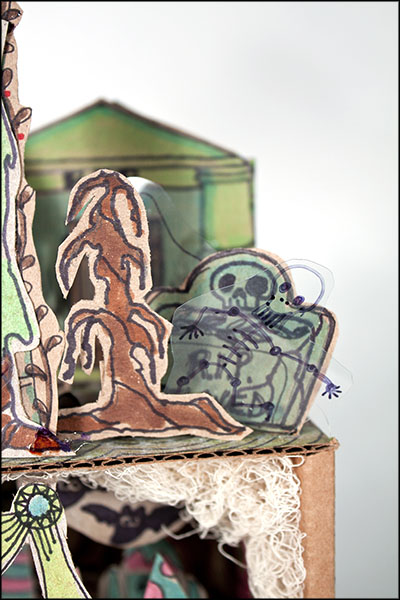
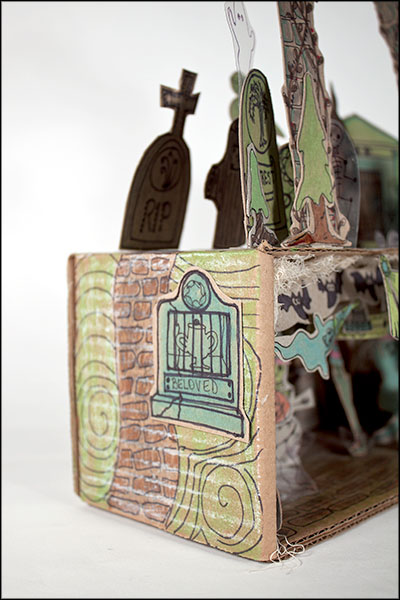
When I decided to make the Halloween diorama, I knew that I wanted the surface to be a grave yard and what in my “wildest dream”, could possibly be going on under that surface. I spent quite a bit of time dreaming and thinking about what I wanted the lower level to look like, I also wanted some fun surprises, like the coffin in the back acting as a buffet table, or the ghosts that are transparent and seem to float.
When I make a diorama, I am able to connect with the child-like imagination I used to experience when I was a kid. That makes all the painstaking detail worth it.
The back of the diorama. Rest in Peace.The skeletons are happiest when shaking their bones.The ghosts choose pumpkin-head masks for their costumes.The ghosts are transparent so they can play above the ground without being seen. Unless they want to scare you.Trees with ghosts and spiderweb decorations.Side view of cutouts and how they are placed.The other side view.
Lynne: I just wanted to add that this diorama is all Cheri’s doing. She draws and colors the pieces, cuts them out and glues them in. We’ve tried to do a lot of photos to show the amazing detail, but they are so much more in person. There is something new every time you look.
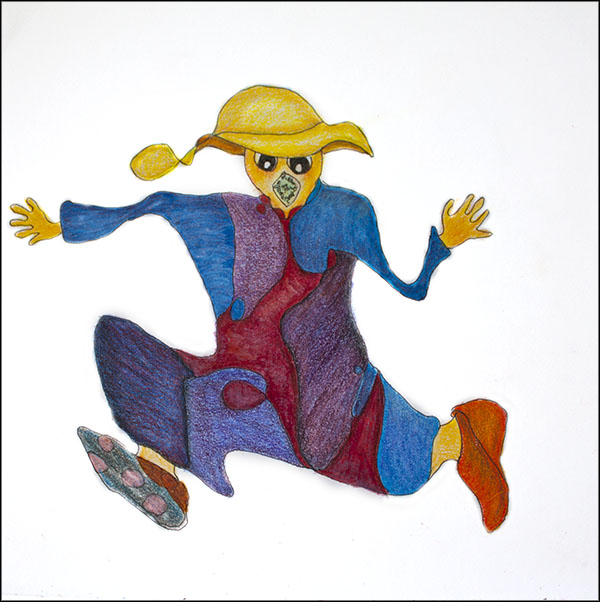 The squiggle greeter.










 the crafty sisters