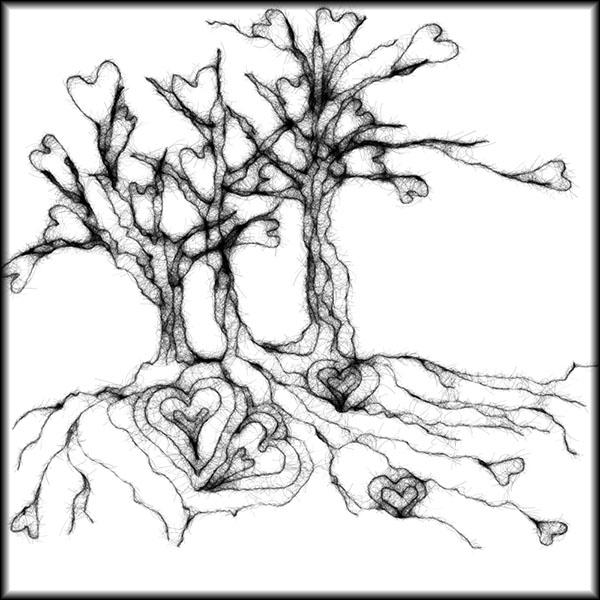
I love it when I am surfing the web and I come across a program that is almost too cool for words. A few days ago I came across a program that is called Scribbler Too. It is a drawing tool on the computer. I have used a few of these before because they offer a really exciting view into the possibilities of computer drawing. This one has become one of my favorites. It is easy to find and you need next to no instruction about it. You just start drawing. The program makes you feel like an outstanding artist and if you don’t like your drawing you can just clear it. I do have to admit that drawing with a mouse does take some getting used to but, the effort is really worth it because you end up with what I feel are some really incredible works of art. The drawing I am posting is called “Growing Love”, and I have done several renditions of it. I love to look at trees and I do really enjoy drawing them. This program is fabulous for that and I am able to get little bit of satisfying creativity off my chest. Try it, I can guarantee you will really love it.
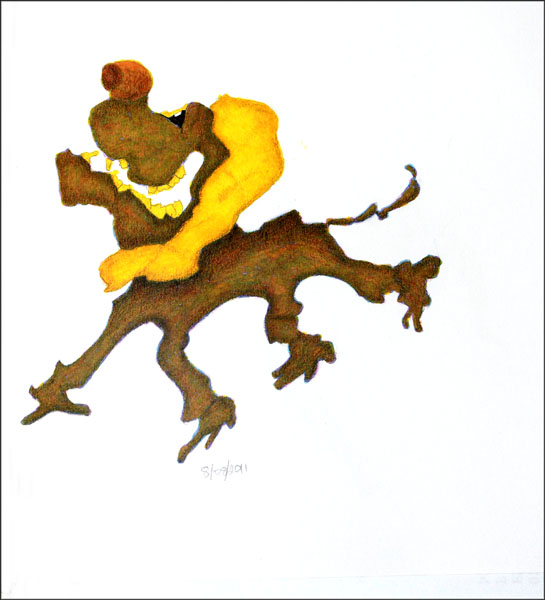
A squiggle that has been built up with markers and then shaded with color pencils.
I have always wanted to be able to draw, but a very early life experience with a football coach posing as an art teacher had me convinced that I was no artist. (In my early years I went to a school that had all the grades together. The rough chastising that must have worked with teenage boys did not have the same effect on a first-grade girl-child.)
In the last several years in an effort to shake the coach’s gloomy prognostications, I have taken drawing lessons. I found the Pear Tree Gallery and Teri Partridge, an artist and teacher, who is bound and determined to make everyone an artist. (Ask anyone who has passed through Columbia Middle School and they will tell you the same. This is not to imply that I am young enough to have had her as a teacher when I was a student there.)
One of her oft repeated lessons (the one on drawing shapes has to be most repeated) is the importance of shading and shadow. What I came to realize after Teri had patiently repeated it over and over was that where I had thought my drawings were simply terrible, in reality they were simply not finished. I came to realize that there is a world of difference between the first set of marks you put on the paper (shapes, always remember) and the last set of marks you put on the paper (shading and shadow.)
Now, after several years, I can say that I am competent with pencil and paper. My black and white drawings look enough like the real thing to make me think some of Teri’s lessons have sunk in. However, I wanted color and unfortunately it did not want anything to do with me. I simply did not know what colors to use. My watercolors did not mix well, I did not like acrylics and oils did not look simple enough..
Finally, after wandering with much self pity among those many did nots, I came across this quote by Johannes Itten, a teacher of the Bauhaus style of art in the 1920’s;
If you unknowing, are able to create masterpieces in color, then unknowledge is your way. But if you are unable to create masterpieces in color out of your unknowledge then you ought to look for knowledge.
With that unsubtle nudge, I decided to seriously look at how color works. Some people know immediately what the primary colors are and their relationship to secondary and tertiary colors, but I have to plod my way through color theory and keep a color wheel beside me. (The Color Chart blog is packed with information about color schemes and theory.)
I was snooping through Cheri’s shelves one day and found a book called Drawing Lab For Mixed Media Artists by Carla Sonheim. There were 52 exercises to make drawing fun, but the one that really caught my eye was scribble drawings. The exercise consisted of making a scribble, just a random mark on the page and then looking at it every which way until something popped out. An arm, a leg or even an eye would peek at me just like the face and vase optical illusion that tricks you into seeing one and then the other. The best thing was that these were the types of doodles I did as a child (frowned upon by a certain football coach) and I had been seeing things in scribbles for years.
What I did not know was that scribble drawings were my eureka moment to color. They only needed a simple color scheme and with the color wheel I could pick the scheme I wanted before I put a marker to paper. As long as I stayed with the predetermined choices, I could play without the fear of a terrible muck up.
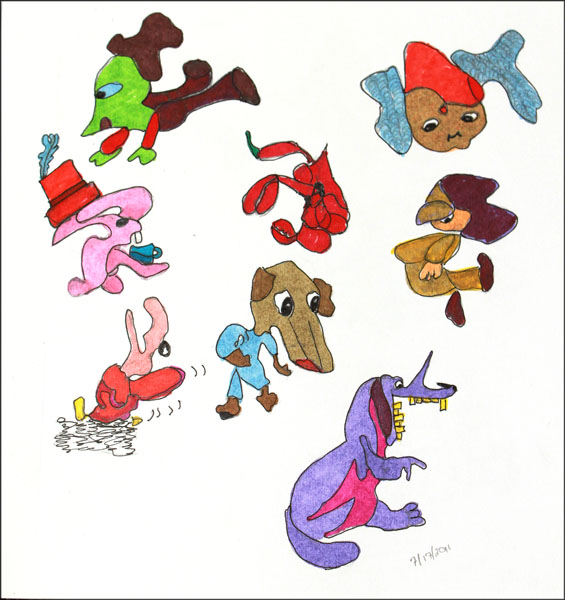
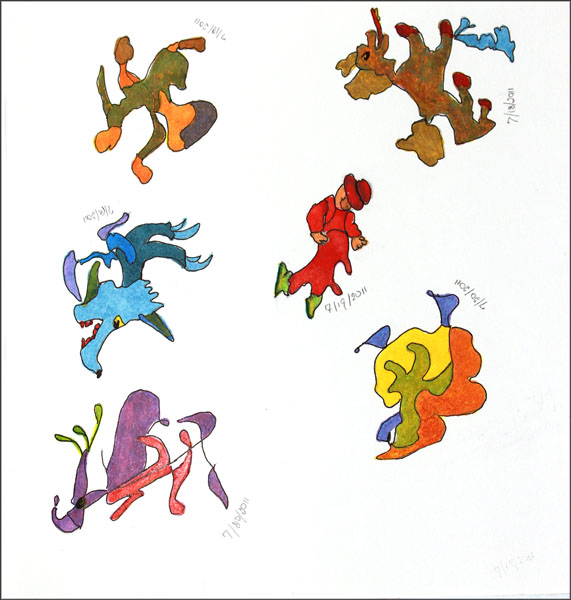
I have named these scribble drawings squiggles because squiggle is an artistic term for the short curves and twists that I end up with when I scribble. The sketchbook pages posted below are the first squiggles I did and I have included three photos of the progression of a scribble to a squiggle. The drawing at the top of the post is what my squiggles are starting to look like now. I add lines and take away lines and use a combination of markers and color pencils to create the shading and shadows. Squiggles are my eccentric way into the world of color and imagination. And who knows? Someday, I may pick up a brush and not muddy the watercolors.
-Lynne
These are all done with markers.Separating one squiggle into two allowed me to think about erasing lines.I have started to turn the sketch book in all different directions.The result of a random scribble.The random scribble turned into a figure.The finished drawing. I used color pencils and marker in a primary blend of red, blue and yellow.
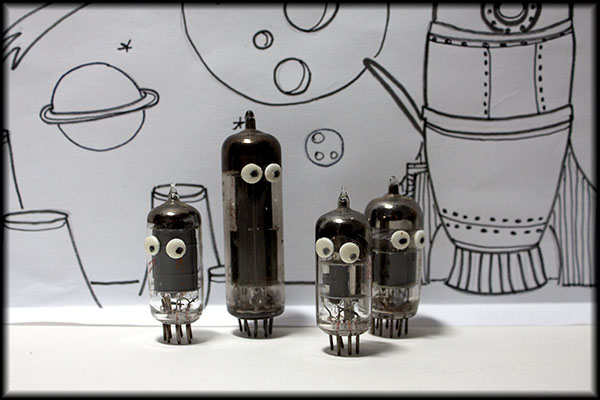
The space invaders ready for a war of the worlds. Or maybe just a close encounter.
Space Invaders
The space invaders ready for a war of the worlds. Or maybe just a close encounter.
I pick up lots of small items at sales, and I have always had a pretty vivid imagination. I like to create creatures out of objects. The TV tubes are the perfect example. At one point you have just TV tubes, (which are really pretty amazing works of art by themselves), but if you put eyes on them, you give them a personality. And if you give the creatures a landscape, you have a whole story. It’s true, one picture is worth a thousand words.
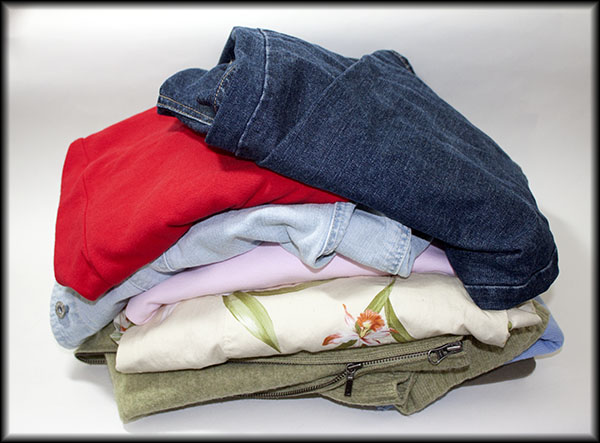
We had very nice weather for Garage Sales this weekend, and it was what I like to call a “clothes” day . Occasionally, we are able to go to Garage Sales and buy clothes that we might like. Clothes sales are really great if the items don’t go over one dollar. Twenty five cents is pretty great, that way if they don’t fit or you decide you don’t like them we don’t feel so bad putting them in the Goodwill bag.
Some of the clothes we found this past weekend.
So our first few sales this week were clothes sales. We eventually got down to the nitty gritty though. Estate sales (true estate sales) have got to be the very best sales ever. There is usually a bunch of junk mixed in with the nice items and truthfully, I love the junk. I really like it when someone pulls out a junk drawer and you get to go through it. It is always best to be cautious though. You never know what may be lurking in the drawer, ie, razor blades, nails, tacks. Anyway, I have certain items I like to pick up.
Lately, I have been drawn to old TV tubes, (they really do look neat, almost like little vintage robots). Dresser hardware or cabinet hardware is another item I try to pick up, but it does need to be vintage and have a cool patina. Keys, I pick up most keys that I find. I also like to pick up little pieces of old toys. If the item you find is really greasy or dirty you can put it in a mesh bag or a dishwasher basket and run it through the dishwasher and if it gets destroyed you just throw out the pieces.
Now, if I ever figure out what I am going to do with the things I pick up and collect, I will pass that on, but for now, they just sit in jars and I look at them and dream.
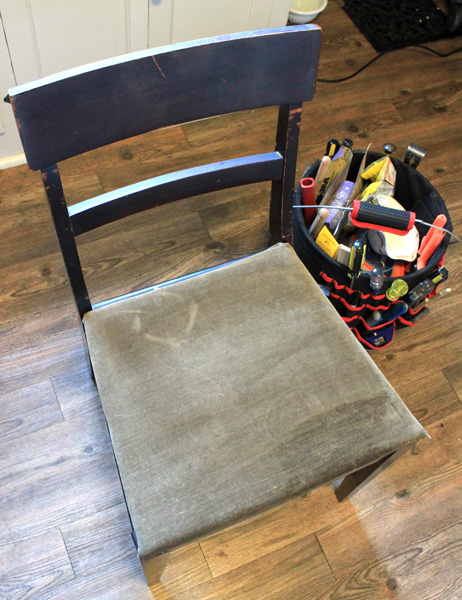
I wanted a chair to put next to the back door in my mud room/laundry room/entry way if I needed to set something down or take off my shoes. This chair was my great-grandmother’s, a vanity chair that is part of a bedroom set. It has been up in the guest bedroom doing duty as a bedside table, and it’s just the chair I’ve been wanting for the mud room.
I put that brown upholstery fabric on five or six years ago, and it’s worn and too drab. I just wanted to do a quick and dirty upholstery job.
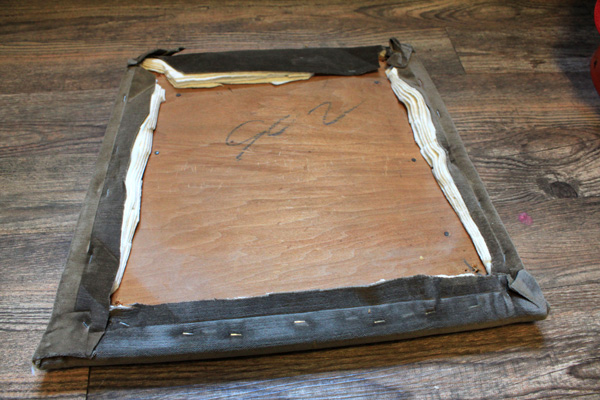
Chair seat removed
First things first, I removed the screws to take the chair seat off. This chair seat is a good example of why perfectionism isn’t always necessary. My previous upholstery job wasn’t that great. Two of the four screws holding the seat on were missing, and many of the staples holding the fabric on had loosened. It still looked fine and held together. Imperfection works!
Normally, you would use poly batting for upholstery, but when I did the first job I just used what I had around, which was Warm and Natural quilt batting. I put a layer of muslin over it to protect the batting, and it made this job really easy.
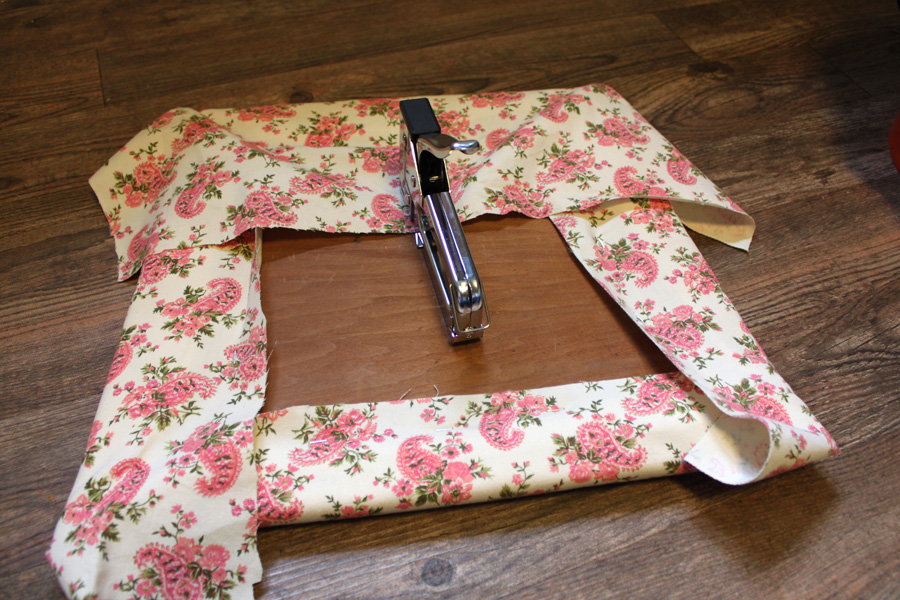
Stapling the finished fabric
Here you can see most of the stapling of the new fabric. The print is random, so I lined the grain of the canvas up with the front edge of the seat. The fabric is a vintage paisley canvas from an auction years ago.
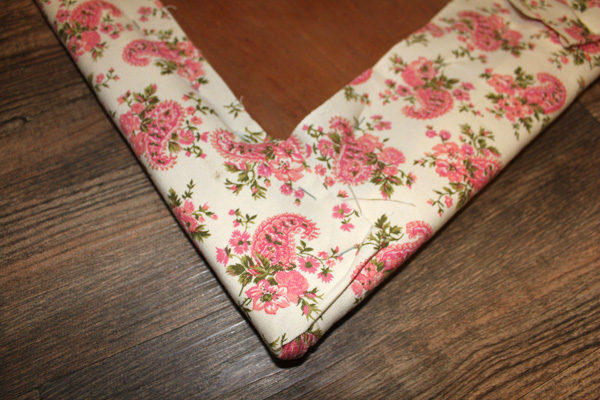
The corners are the hardest part
Turning the corner properly is the hardest part, but it doesn’t have to be perfect. Cut away any excess to make it easier to fold.
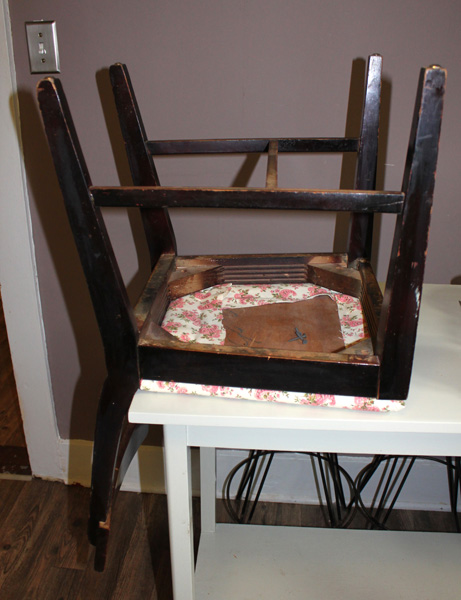
Reattaching the seat
To make reattaching the seat easier, put the chair upside down on a table.
Chair with the Finished Fabric
Here’s the finished product!
Finished chair in the mud room
And here is the chair in the room. I still have a few things to do, including finishing the baseboards, so watch for upcoming posts on this room.
For a really detailed explanation of chair seat upholstery, see this excellent guide from one of my favorite blogs, Design Sponge. The tool list given may seem a bit intimidating, but don’t let that stop you. I only needed a flat and a phillips screwdriver, staple gun, scissors, and water bottle (to keep a cat off my project!).





 the crafty sisters