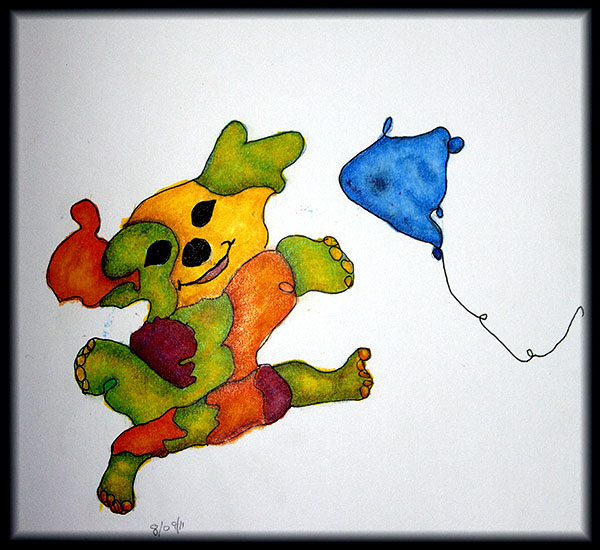
This teddy bear’s ears were the first things to pop out of the scribble for me. I added feet so he looked like he was skipping and the kite appeared from an extra mark on the paper.
I wanted to use a double split complementary color scheme as I had never tried one before. The double split consists of two pairs of complements, one apart on the color wheel. I’ve used a yellow-green and red-violet complement pair combined with a yellow-orange and blue-violet complement pair in this drawing. (I don’t see any blue-violet in the drawing. I must have substituted red-orange. I have begun to write the colors in pencil on my sketch. It helps me keep track of what colors I am actually supposed to be doing.)
Since the yellow of my markers does not show very well on top of other colors, I started with a yellow layer on all but the red-violet color. (Yellow under red-violet would give me a brownish color.) With yellow as the prominent color, I used its complement, blue, for the kite.
I wasn’t totally pleased with this teddy bear, but he seems to be happy enough.
Loryn: If you’ve been wanting to improve your sewing skills, this article kicks off a series of articles on how to make simple home dec projects really shine. Most home decor projects, like curtains, pillows, and bedskirts, are just simple rectangles, so it’s the details that make them special. These simple curtains look good because of three basics:
Pressing
Lining
Edgestitching
I started sewing when I was about five years old. I made project after project after project, drafting my own patterns and getting wildly creative. The one thing that I didn’t have any patience for was the finishing details. My work was sloppily finished until I saw the projects a friend of mine produced. She wasn’t an experienced sewer, but her simple projects were so beautifully finished that they looked great! It finally sank in that all the creativity in the world didn’t pay off if I didn’t pay attention to the details. If you haven’t been quite happy with the results of your sewing, read on for tips you can apply to any project.
If you only apply one tip to your sewing, it should be pressing. Pressing every seam open may seem like a lot of fuss, but the results are worth it. I set up one end of my work table as an ironing board so I don’t have any excuse to skip it. Because I’m cheap, I just throw a folded towel down and iron on it, as it gives me a lot more surface area than an ironing board.
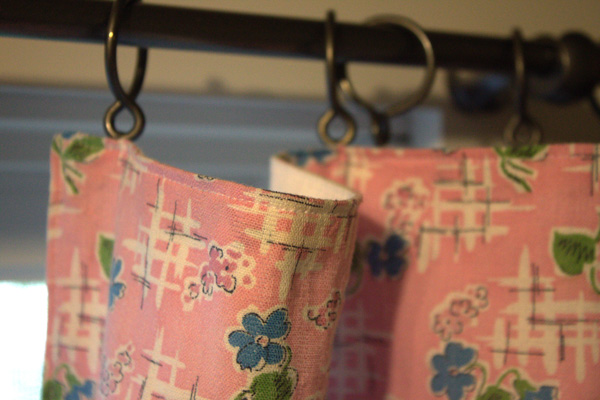
These curtains are lined, as unlined feedsacks are thin and don’t give a lot of privacy. The lining also helps the curtains keep those nice folds at the top. My favorite source for linings are old sheets. This lining is made from new in package vintage fitted sheets that were too small for thick modern mattresses. If you see at garage sales, be sure to pick them up! Here you can see the difference the lining makes:
To make the lining, I sew the lining and and the main fabric (right sides together) around three sides like a pillowcase. Press the stitched seam, then turn the curtain right side out. Use a pin to get your corners pointy, then press the edges again in preparation for edgestitching.
The edgestitching makes precise edges that look great. I use the 1/8″ mark on my machine’s throat plate to keep the stitching line precise. If your edgestitching is not as straight as you’d like, keep your attention on the 1/8″ mark and keep practicing! Edgestitching around the three seams, and then you’re ready for the hem.
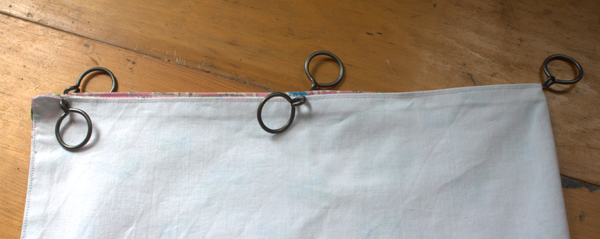
To get the best results, hang your curtains on the rings, and then fold a standard hem. I sewed two lines of stitching. This makes a firm hem that makes a flippy curve along the bottom.
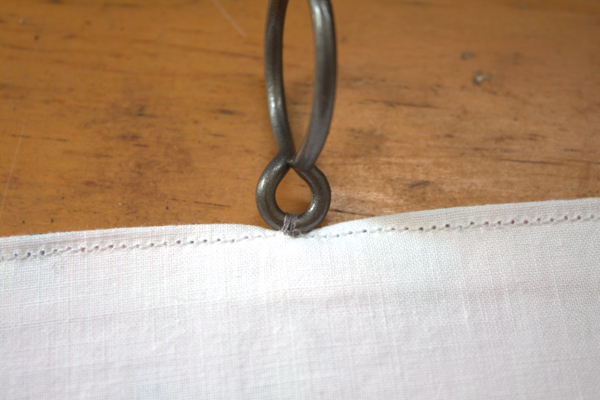
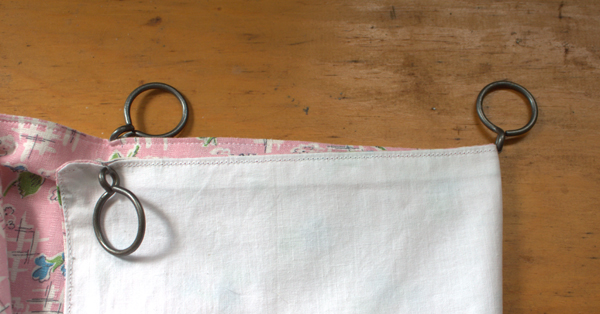
Here you can see how I’ve tacked the rings to the curtain. Clips would also look nice, but I have a large supply of vintage cafe rings.
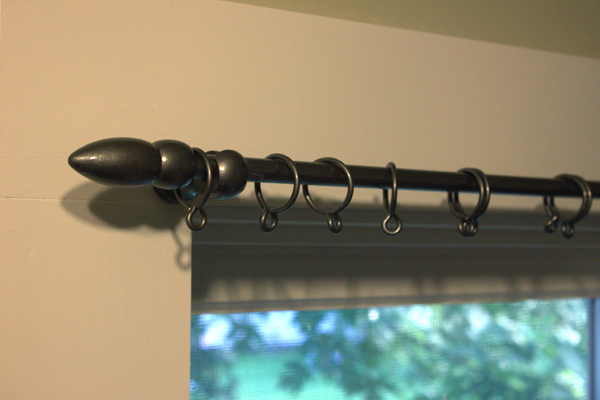
The rings are brass, which doesn’t go with my kitchen/laundry room, so I spray painted both the rings and the rod:
Here’s a simple way to get your rings or clips evenly spaced. First, always use an odd number of rings. Sew or place the rings at the ends, then fold the curtain in half, lining up the rings you just placed. Place the middle ring at the fold mark.
Then quarter the curtain by lining up the end ring with the middle ring. The fold is the spot for your next rings. Do that on each side. For small curtains, I use five rings for each panel.
After one final pressing, the curtains are ready to hang.
I hope you’ve found a few tips that will be helpful. Check back soon for another post on how to upgrade your sewing!
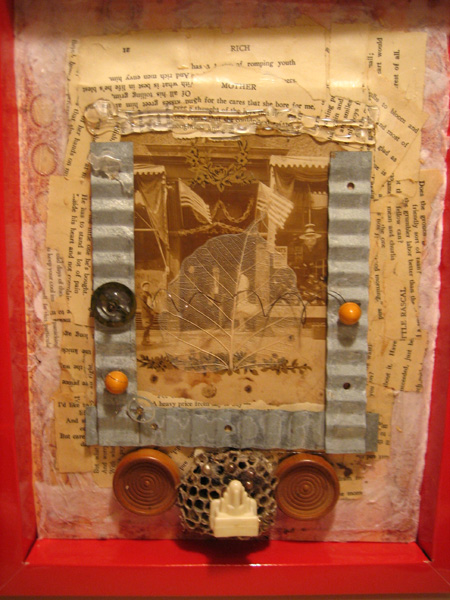
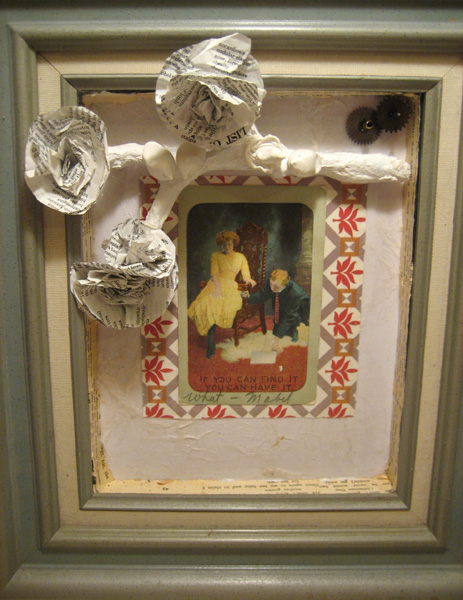
Cheri: A few years ago, I decided that I wanted to change the direction of my creative endeavors. I had read a few books about assemblage and decided that this was the art form for me. The definition of assemblage is: a) sculptural technique of organizing or composing into a unified whole a group of unrelated and often fragmentary or discarded objects. b) a work of art produced by this technique. Kind of like collage.
I love assemblage, or at least I love the idea of assemblage. I have a lot of interesting pieces of junk I have been collecting for a long time and I really was looking for a technique to pull some of these items together. After a few failed attempts at what I thought would be a no brainer for me, I learned that it was not nearly as easy as I thought it should be. My unrequited love of assemblage has resulted in several unfinished projects, some cussing and in the end some truly satisfying pieces. Actually, assemblage is basically a metaphor for life. How fitting.
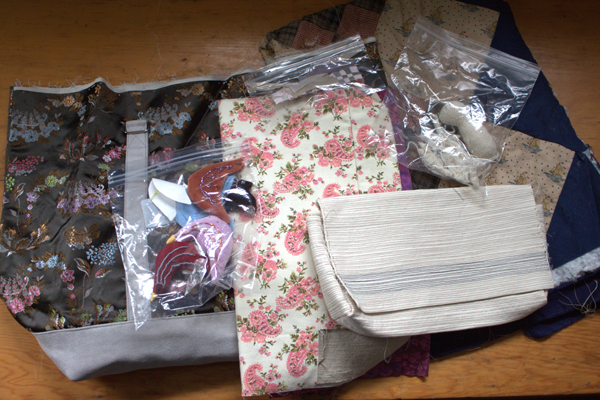
Loryn: Unfinished projects are the bane of every crafter, and I have more than my share of them. The ones above are just my sewing projects. I’m not even going to bring up home improvement projects or beading!
It was really helpful to pull all of the projects out and evaluate them. Many are quite good and deserve to be finished. Others are a good technique that I should revisit. If you haven’t looked over your unfinished stuff recently, try it out. You might be surprised how inspiring it can be!
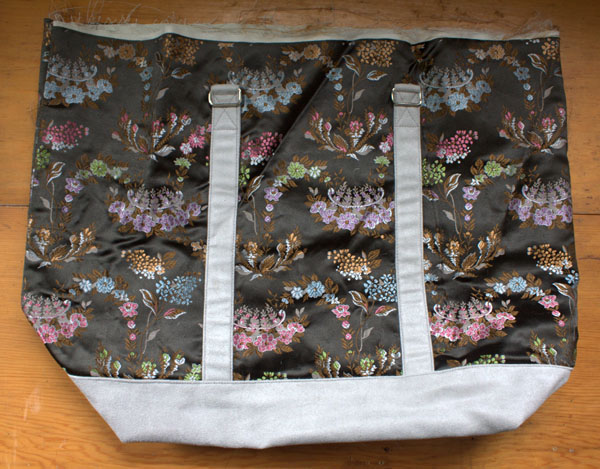
This one is a puzzler. Why on earth didn’t I finished this large tote bag? The body is a poly/silk brocade, and the base and straps are ultrasuede. The lining is cut and inside the bag, and the zipper is there, too. I think I’ll finish this one soon. I like sturdy bags that can stand on their own, so I think I’ll add another layer of canvas for structure.
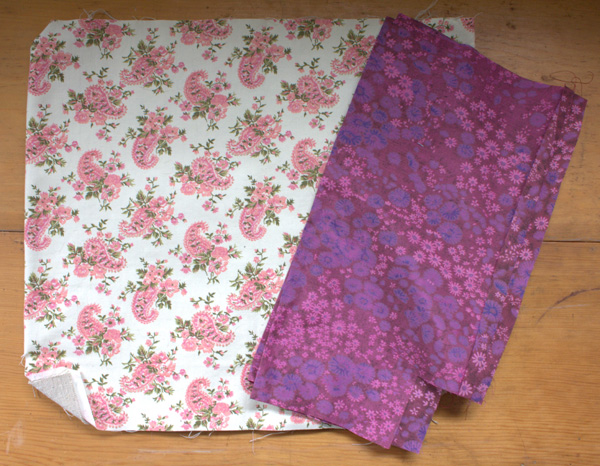
You might recognize this canvas from the chair in my laundry room/entry way. This is a mid-size bag, about half the size of the one above. I absolutely love the bright lining fabric with the paisley canvas. I sewed the side seams of the body and lining before getting distracted. This one has a very heavy canvas interlining, which gives the bag great structure. I think I’ll finish this one right away, so I can use it before summer is over!
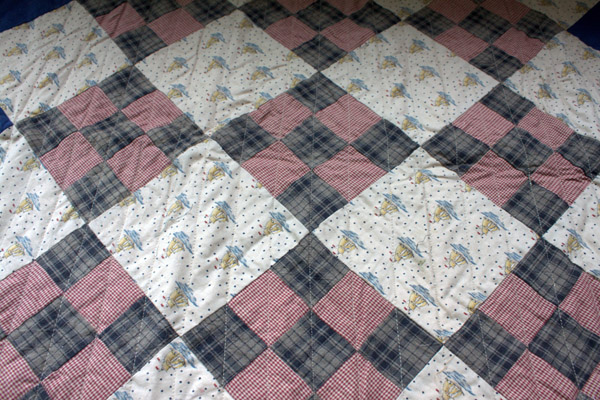
This is the oldest project in my unfinished project pile. I started this for my friend Melissa’s son. He just turned 16! All it needs is quilting perpendicular to the current quilting and binding, and it’s not even very big. She has a second son who is now 15 months old, so I need to get this done before he grows up! This will be the second project to finish up.
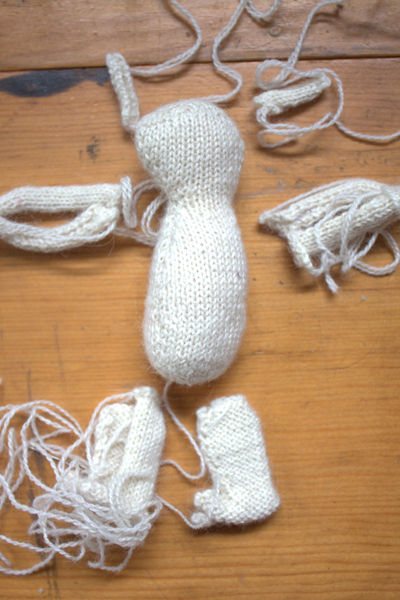
This is really a knitting project, but since all it needs is sewn together, I’ll lump it in with this group. This is a knitted stuffed cat that I started as a Christmas gift for someone several years ago. It’s hard to tell scale in a photo, but the body is just under 3″ tall. I knit it in lace weight alpaca at 12 stitches per inch. This one definitely needs to be finished. I did so much knitting on tiny needles that I really messed up my hands. All that effort shouldn’t go to waste! The pattern is from The Knitted Teddy Bear by Sandra Polley. It’s one of my favorite knitting books.
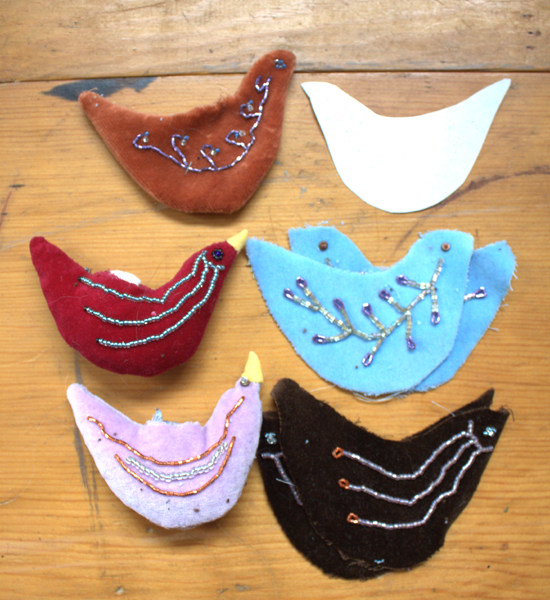
Aren’t these adorable? I started these more than ten years ago, and I think I set them aside because I wasn’t quite sure what I would do with them. At the time, I was doing a lot of hand beading. I’ve been wanting a hand sewing project (they’re hand beaded and hand sewn), so I think I’ll work on them in the near future and use them as Christmas ornaments, or maybe put them on a wreath.
This is a long, narrow bag with a free-hand quilted texture. I didn’t finish it because I didn’t plan the construction well enough. I should have finished the flap edges before I quilted it, and I didn’t think of that until too late. Bulky hems or binding at the flap edges would ruin the look. Still, I really like this technique, and need to try it on a different bag, or maybe a pillow. The fabric is muslin, sandwiched around flannel. The closely spaced stitching is time consuming to complete, but it gives an inexpensive cloth like muslin a rich look and great body.
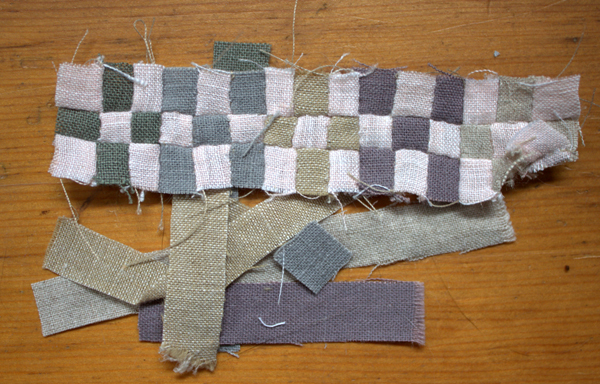
Here’s another miniature. The finished patchwork squares are 1/4″. I love the beautiful colors of the linen, but this one was too fiddly, even for me. I had visions of tiny, hand-quilted miniatures, but I will never get beyond this point. I don’t have the heart to get rid of it, and it doesn’t take up much space!
Those are my current unfinished projects. Of course, this doesn’t include the hundreds I’ve gotten rid of over a lifetime of crafting, just the best of recent years. I’m going to get started finishing these, and you’ll see them in the blog soon!
Loryn: Feedsacks, floursacks, just about anything that came in a sack (including flour, beans, chicken feed, and rice) was sold in bright printed fabric during the depression era. Feedsacks have to be the best marketing ploy for crafters that has ever come along! In the 1920s, manufacturers realized that lots of housewives used the sack fabric, and they would buy even more if it was a pretty print. Here in the middle of Indiana, with all of our farms, we have lots of feedsacks around even today.
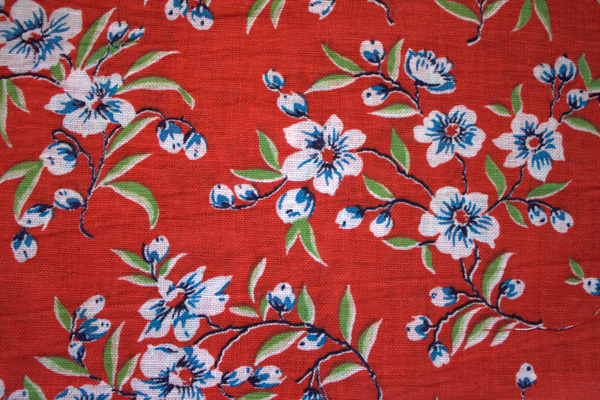
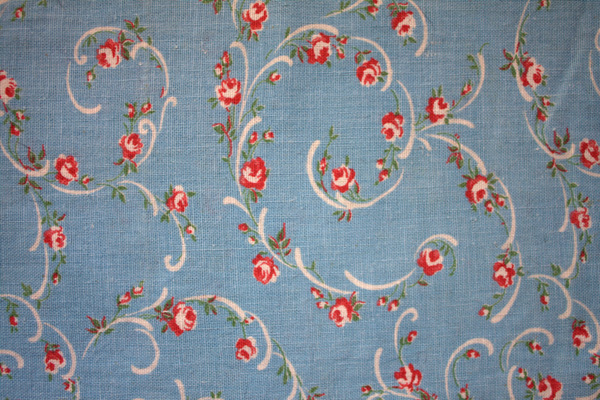
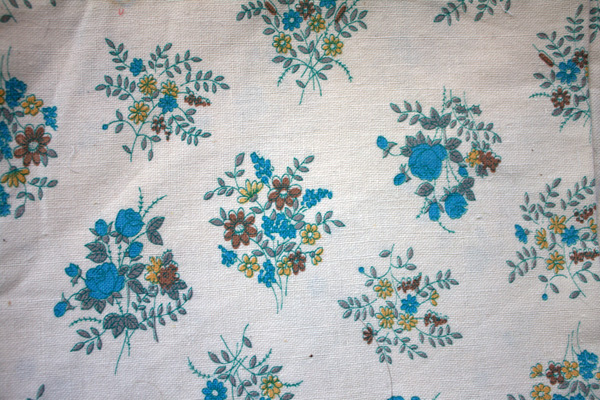
So, how do you know if you have a feedsack? The first clue is a cotton fabric with a tell-tale loose weave, that looks something like this:
Most feedsacks are very loosely woven
Not all fabric with that weave was actually a feedsack, though, as you could buy the same fabric in yardage. The sacks were usually between 36-39″ wide and 43-46″ long. If you have the entire sack, you should be able to see the stitching holes along two sides, like this:
If the sack has been taken apart, you can still see the stitching holes
Sometimes you’ll find a sack still stitched together. The seam was sewn with a chain stitch, so it pulled out easily. I’ve come across one with the label still intact, too. If you fabric doesn’t show the stitching holes, it may have been yardage. From a crafting viewpoint, though, the prints are just as nice!
I really enjoy sewing with feedsacks, as the prints are great and the cotton fabric is very easy to handle. I often line feedsack items because of the loose weave, to give it a little more body.
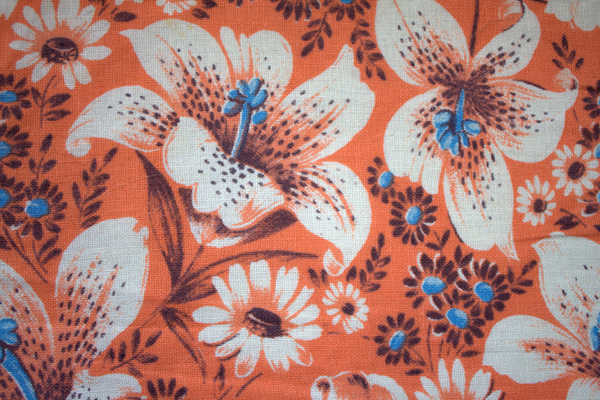
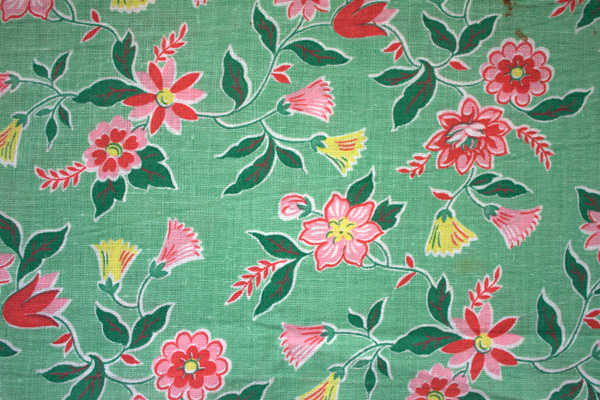
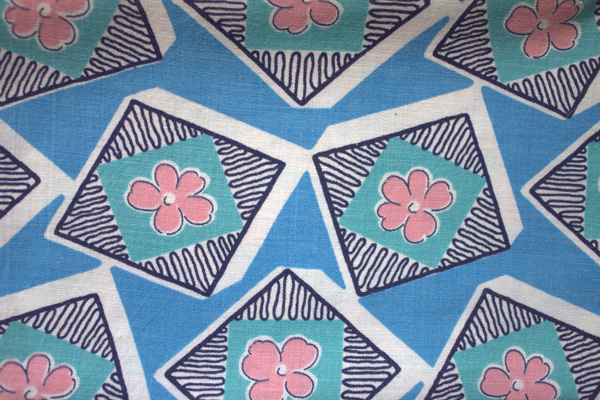
Now on to a gallery of prints!
Gorgeous red print, one of my mom’s (Lynne’s) favorites! This one is even more loosely woven than most.
Red stripe. Stripes can be challenging, because the stripe is not always on the grain of the fabric.
One of my favorite prints!
I have several sacks in this print, and you’ll see them in use soon!
I only have a few scraps of this print, which is too bad.
Yellow is one of Cheri’s favorite colors, so I’ve used this fabric in projects for her.
I love this bright gingham, but the print is slightly off register.
Beautiful!
A fun print.
One of my favorites.
This is one of the first feedsacks I ever purchased, while antiquing in college.
Feedsacks were made into the 60s (though in more limited quantity), and I suspect this is a late print.
This is a change from the bright prints that I usually prefer.
This one has a few stains. The oxy boiling method will get rid of all of them!
Like the bright pink one above, this has a woven stripe.
I hope you’ve enjoyed seeing part of my collection! For a fun read on feedsacks (including a woman who left the part of the label that said “self rising” on her husband’s drawers!), head to womenfolk.com. For a site that is full of information, head to quiltersmuse.com.
As a beader and jeweler hobbyist, there is nothing better than more materials. More beads, wire, findings, centerpieces, doesn’t matter. Yesterday, I made a trip up to Whiteland to Beads Unlimited which is a wonderful store. Their website is still under construction, so you can’t really see just exactly how wonderful, but believe me it is well worth a trip. Their selection of seedbeads, silver, glass, natural stones and metal beads is the best I have found in Indiana so far. There are other bead stores that have more of a particular type of bead or material, but for all around purchases, don’t miss Beads Unlimited.
My favorite items to pick up from Beads Unlimited are jasper and agate drilled stones to use as pendants.
10 drilled stones I purchased Saturday
The color and striation variations that come from agate and jasper seem to be endless and now that they have started successfully dying the agate, it has broadened the uses even further (the turquoise stone above is dyed agate, isn’t it pretty?). I seem to have gone for a more Asian feel with the stones I picked up yesterday, and they are mostly of neutral shades. Some of them are drilled straight through and others have more interesting (and what may have been faulty) drill-holes.
While Loryn was here last weekend, I was showing her my stash and was talking about a pink quartz triangle donut in my collection that has two drill-holes which, as it is a transparent stone, makes it look rather odd. Loryn, the excellent visualist she is, immediately showed me how to use it in a unique fashion. Since then, I have been actively looking for stones with odd holes and found a few this trip. It is wonderful to be able to take this flaw and really make it something unique and gorgeous.
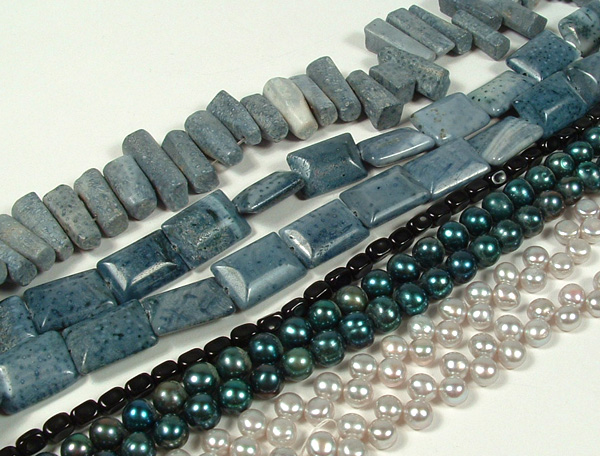
I have also had this small obsession with coral and imagine my joy when I found some blue coral. I have a ton of red coral (in so many shapes and sizes), so the blue was an excellent find.
I have yet to cut them off their strands
Blue coral is a light denim color with darker blue specks and whorls. I bought it in two shapes and cannot wait to use them. Also pictured are a strand of black glass rectangles with dimples on all the sides and two pearl strands. The blue/teal pearls are halfway between potato and spherical (I’m sure this shape actually has a name, although I don’t know it) and are absolutely beautiful. The natural, off-white pearls are dots. They are flat on one side and have a hole drilled towards the top to make them drop beads of a sort, supercute.
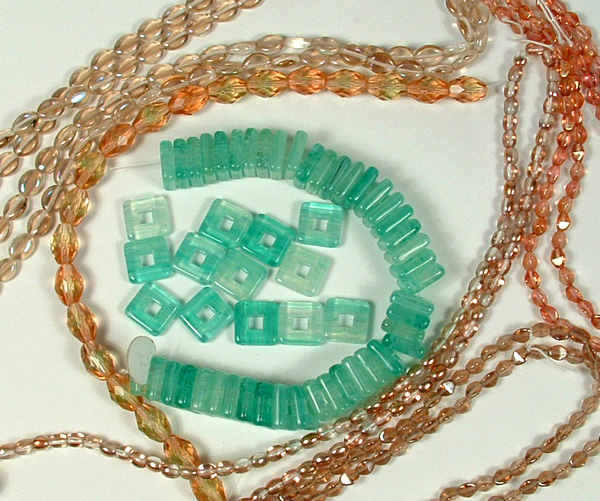
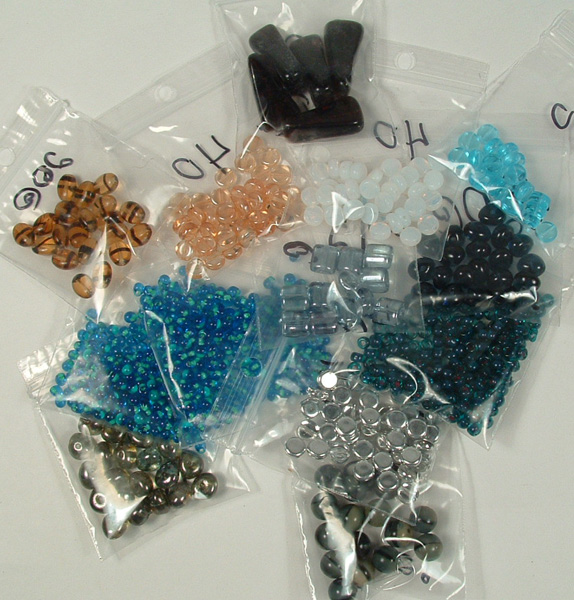
I also bought a bunch of glass, both strung and not in varying colors and shapes.
I picked up quite a few neutral to brown glass strands to go along with the pendant stones I purchased. The square green glass beads in the center of the first photo were just too cool and cute to pass up. Haven’t figured out what or how I will use them, but nothing in my stash is ever wasted.
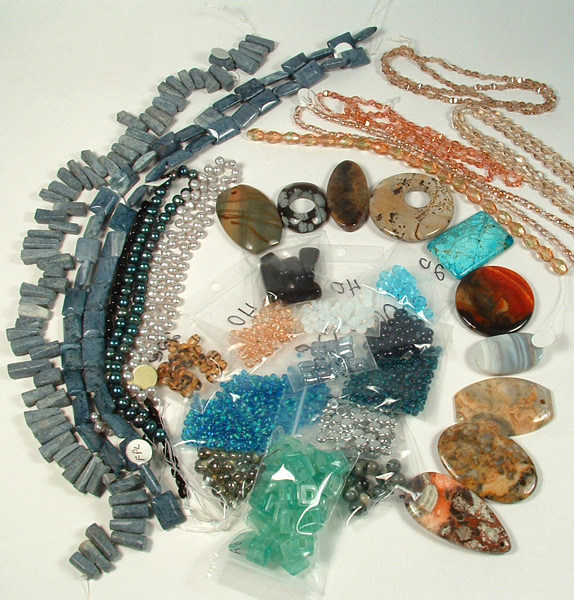
Here is a photo of the entire haul:
I did stay within my budget, only just, but until I actually sell a piece, I am trying to restrict myself, although it may not look it. I cannot wait to create some new pieces from this bead run. Hey, what am I waiting for? Talk to you later!
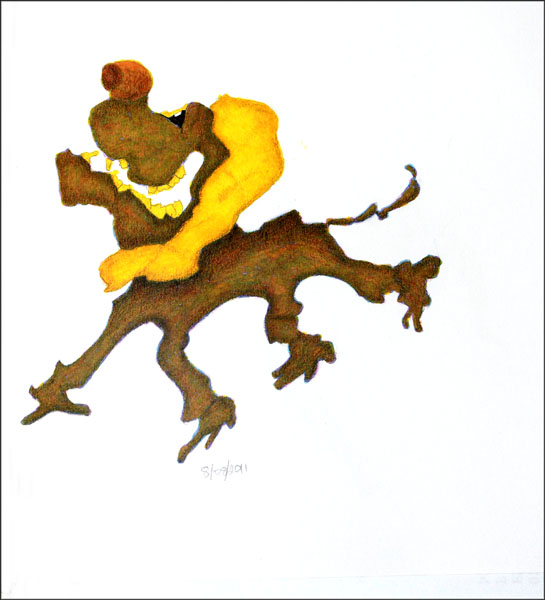
A squiggle that has been built up with markers and then shaded with color pencils.
I have always wanted to be able to draw, but a very early life experience with a football coach posing as an art teacher had me convinced that I was no artist. (In my early years I went to a school that had all the grades together. The rough chastising that must have worked with teenage boys did not have the same effect on a first-grade girl-child.)
In the last several years in an effort to shake the coach’s gloomy prognostications, I have taken drawing lessons. I found the Pear Tree Gallery and Teri Partridge, an artist and teacher, who is bound and determined to make everyone an artist. (Ask anyone who has passed through Columbia Middle School and they will tell you the same. This is not to imply that I am young enough to have had her as a teacher when I was a student there.)
One of her oft repeated lessons (the one on drawing shapes has to be most repeated) is the importance of shading and shadow. What I came to realize after Teri had patiently repeated it over and over was that where I had thought my drawings were simply terrible, in reality they were simply not finished. I came to realize that there is a world of difference between the first set of marks you put on the paper (shapes, always remember) and the last set of marks you put on the paper (shading and shadow.)
Now, after several years, I can say that I am competent with pencil and paper. My black and white drawings look enough like the real thing to make me think some of Teri’s lessons have sunk in. However, I wanted color and unfortunately it did not want anything to do with me. I simply did not know what colors to use. My watercolors did not mix well, I did not like acrylics and oils did not look simple enough..
Finally, after wandering with much self pity among those many did nots, I came across this quote by Johannes Itten, a teacher of the Bauhaus style of art in the 1920’s;
If you unknowing, are able to create masterpieces in color, then unknowledge is your way. But if you are unable to create masterpieces in color out of your unknowledge then you ought to look for knowledge.
With that unsubtle nudge, I decided to seriously look at how color works. Some people know immediately what the primary colors are and their relationship to secondary and tertiary colors, but I have to plod my way through color theory and keep a color wheel beside me. (The Color Chart blog is packed with information about color schemes and theory.)
I was snooping through Cheri’s shelves one day and found a book called Drawing Lab For Mixed Media Artists by Carla Sonheim. There were 52 exercises to make drawing fun, but the one that really caught my eye was scribble drawings. The exercise consisted of making a scribble, just a random mark on the page and then looking at it every which way until something popped out. An arm, a leg or even an eye would peek at me just like the face and vase optical illusion that tricks you into seeing one and then the other. The best thing was that these were the types of doodles I did as a child (frowned upon by a certain football coach) and I had been seeing things in scribbles for years.
What I did not know was that scribble drawings were my eureka moment to color. They only needed a simple color scheme and with the color wheel I could pick the scheme I wanted before I put a marker to paper. As long as I stayed with the predetermined choices, I could play without the fear of a terrible muck up.
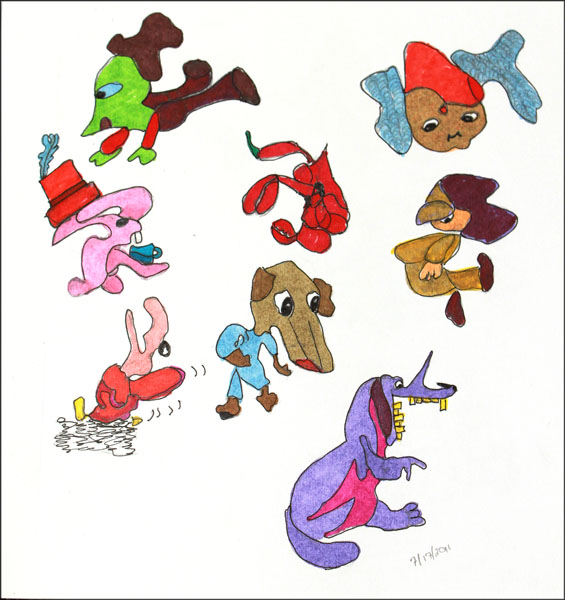
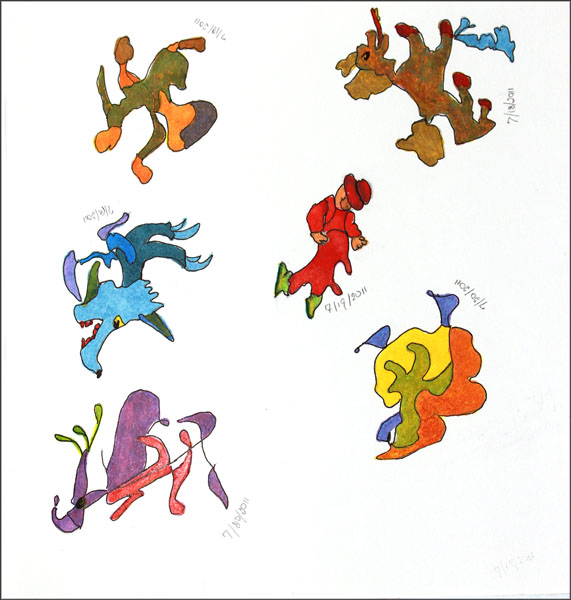
I have named these scribble drawings squiggles because squiggle is an artistic term for the short curves and twists that I end up with when I scribble. The sketchbook pages posted below are the first squiggles I did and I have included three photos of the progression of a scribble to a squiggle. The drawing at the top of the post is what my squiggles are starting to look like now. I add lines and take away lines and use a combination of markers and color pencils to create the shading and shadows. Squiggles are my eccentric way into the world of color and imagination. And who knows? Someday, I may pick up a brush and not muddy the watercolors.
-Lynne
These are all done with markers.Separating one squiggle into two allowed me to think about erasing lines.I have started to turn the sketch book in all different directions.The result of a random scribble.The random scribble turned into a figure.The finished drawing. I used color pencils and marker in a primary blend of red, blue and yellow.



















 the crafty sisters